2026-10-11T18:30:00+00:00
Bluesky Exodus? Nikita Bier Says Users "Coming Back To X In Droves" And "Very Angry"
Authored by Michael Zhuang via The Epoch Times,
Workers in several parts of China say they returned from the National Day holiday to find their workplaces emptied of equipment, managers gone, and months of wages still unpaid, according to workers and videos circulating on Chinese social media.
Workers produce garments for fast fashion e-commerce company Shein in Guangzhou, Guangdong Province, China, on June 11, 2024. Jade Gao/AFP via Getty ImagesThe reports emerged as China's seven-day National Day holiday, which ran from Oct. 1 to Oct. 7 this year, was drawing to a close. Some workers said they found their factories stripped of machinery and workstations, leaving behind little more than discarded materials and trash.
The reports, documented in social media posts and interviews by the Chinese-language edition of The Epoch Times, have raised concerns among workers over unpaid wages and the sudden disappearance of business owners. The workers spoke on condition of anonymity out of fear of reprisal.
In some cases, workers said they believed that factory owners used the holiday period to remove equipment and close their businesses without notifying employees.
One worker in Xiaogan, Hubei Province, surnamed Zhao, told The Epoch Times on Oct. 6 that the hardware and plastics factory where he worked had been moved out and the owner had disappeared.
"The boss has fled," Zhao said. "I'm just a temporary worker. They have been delaying [wage payments] every day."
Unpaid WagesIn Putian, Fujian Province, a worker surnamed Dong told The Epoch Times that employees at a small shoe factory were also struggling to recover unpaid wages.
Dong said that on Oct. 3, workers at his former factory attempted to pressure the owner over unpaid wages.
"The boss hasn't fled. He just said there's no money and told us to wait for a while," he said.
The factory, which employed several dozen people, had not formally declared bankruptcy, according to Dong. He said the owner had diverted funds into other ventures and no longer had enough money to pay workers.
"I'm owed more than two months of wages," he said, regarding his former workplace.
The reports extend beyond individual factories.
In Yongkang, Zhejiang Province, a woman surnamed Sun told The Epoch Times that her parents worked at a factory producing insulated cups where more than 60 employees had gone three months without wages.
The factory owner had disappeared, she said.
During the holiday, her parents and other workers remained outside the factory for about a week to prevent the remaining equipment from being removed.
"My mom and dad were guarding the factory entrance during the holiday, afraid that someone would take away the things inside," Sun said.
She said she did not know how much money the factory owed its workers.
Some workers have also described taking precautions against the possibility that their employers would disappear during the holiday.
Multiple videos circulating online showed workers complaining that factories had been emptied while they were away. Workers said the owners had sold or removed equipment during the holiday, leaving workers with little recourse over unpaid wages.
The accounts could not be independently verified by The Epoch Times.
The problem was not limited to factories. A woman surnamed Yang in Hangzhou, Zhejiang Province, told The Epoch Times that the owner of her local gym also disappeared during the holiday, leaving behind a failing business.
The reports offer a glimpse of the uncertainty facing some Chinese workers and small business owners as struggling businesses shut down with little warning. For workers already owed months of wages, the sudden disappearance of an employer can leave them trying to recover money after the business itself has effectively vanished.
Tyler Durden Sat, 10/10/2026 - 21:10
For most of the war, Russia's Arctic was the part of the map nobody bothered to defend. That changed a month ago.
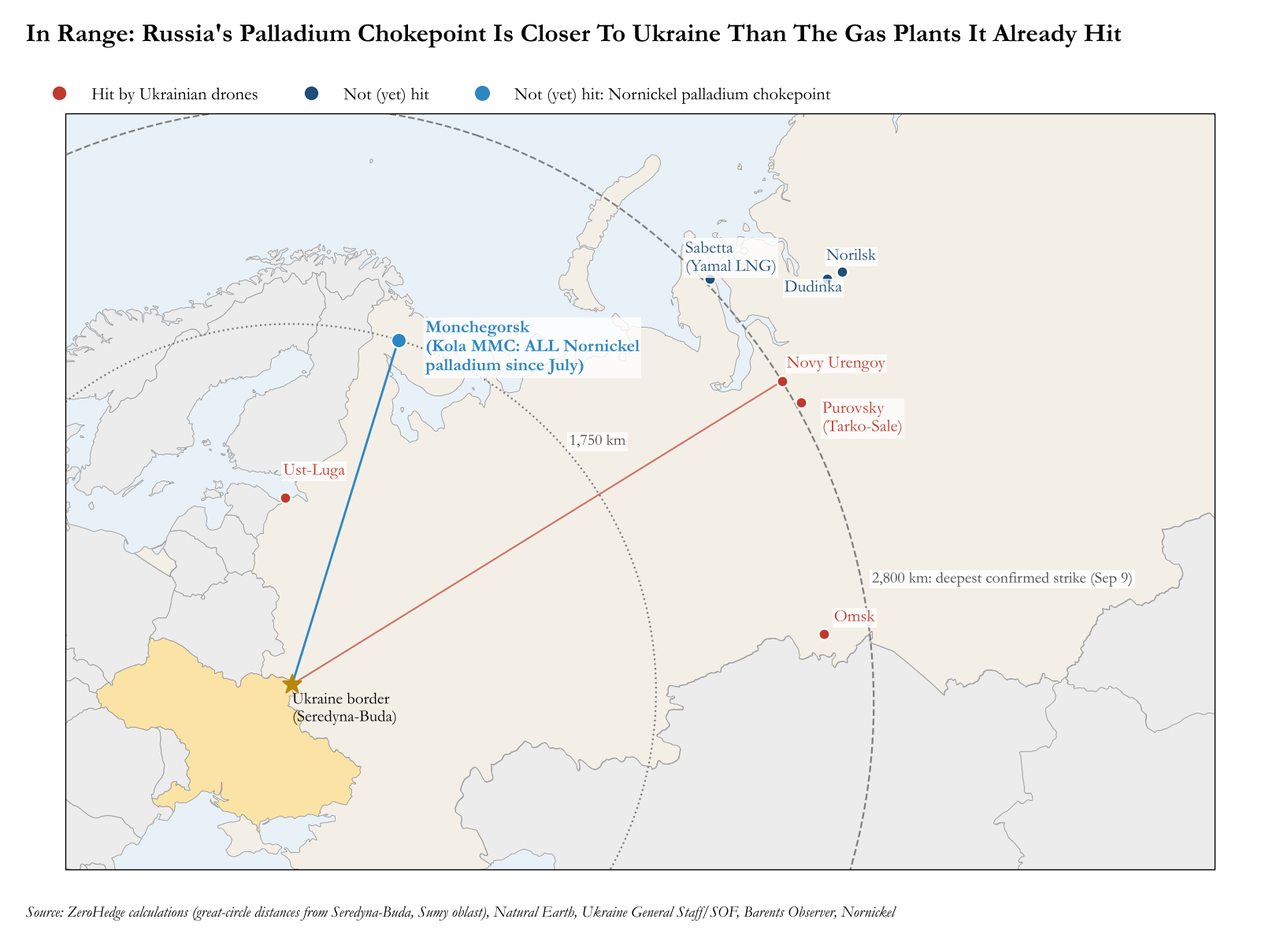
On September 9, Ukraine's Special Operations Forces said their drones flew "more than 3,000 kilometers" to hit two gas condensate plants in the Yamalo-Nenets region: Gazprom's Novy Urengoy condensate treatment plant, with a design capacity of 19.5 million tons of feedstock a year, and Novatek's Purovsky plant near Tarko-Sale, which processed 13.4 million tons of condensate in 2025 (Hromadske, Al Jazeera). "Until today, this was considered an absolutely safe rear area for the aggressor," the SOF said. Bloomberg and Reuters both picked up the claim; the Kremlin's envoy to the Urals, Artem Zhoga, confirmed it was the first attack to reach the Arctic.
On Tuesday Moscow gave its answer: cash. The Yamalo-Nenets government approved a payment of 1 million rubles (about $11,700) for every drone destroyed over the region, the highest bounty any Russian region has offered, according to TASS (others pay 20,000-200,000 rubles). The money goes to local "mobile fire groups," and there is a catch: per the decree, it is paid only if the defended facility suffers no damage, and the kill has to be confirmed by the military commissariat. Joining a fire group pays 100,000 rubles if you have a job and 150,000 if you don't, and requires signing a Defense Ministry contract (Barents Observer).
Paying the unemployed more than the employed to stand on the tundra with a machine gun: nothing says confident air defense quite like it.
Russian mobile fire team trying to intercept a Ukrainian drone in Belgorod region, Russia, 2025. (Photo: open source)Regular readers know we have been tracking Ukraine's drone range creep since it first reached Western Siberia last October. Since then the line has moved from Tyumen to Omsk (hit again on Thursday) to the Arctic Circle. So the obvious next question, and the one now going viral on X, is whether Norilsk, home of the world's biggest palladium miner, is next. As we show below, that is the wrong question: the Nornickel asset that matters for palladium is not in Siberia at all, and it is much closer to Ukraine than Novy Urengoy.
What Actually Got HitAs usual, Russian officials described the strike as a successful interception. Yamal governor Dmitry Artyukhov said "falling debris" caused a fire at "one of the city's industrial facilities," with no casualties (NV). Somehow the debris keeps landing on the most expensive equipment.
Ukrainian OSINT group CyberBoroshno says the drones hit the de-ethanization unit at Novy Urengoy. That matters more than it sounds: the unit's gas feeds the Novy Urengoy gas chemical complex, which can make up to 400,000 tons of low-density polyethylene a year, so without it the chain from condensate to plastic stops (per RBC-Ukraine, Militarnyi). Satellite imagery also reportedly shows damage at Purovsky. Both of those claims come from Ukrainian OSINT and Russia has published no production data, so treat them accordingly.
Purovsky is the more interesting target for markets. According to Novatek's own description, most of its stable condensate goes by rail to Ust-Luga on the Baltic for processing and export, the same port complex Ukraine has hit repeatedly, most recently when drone strikes crippled Russia's key Baltic ports in March. Ukraine has now hit Novatek's condensate chain at both ends, 2,800 km apart.
The region is not a side show either. Yamalo-Nenets produces roughly 80% of Russia's natural gas and holds about two-thirds of its gas reserves (Al Jazeera); Yamal LNG and Arctic LNG 2 sit at its northern edge. The Fire Point FP-1 that its maker says carried out the attack costs under $60,000 to build. Even in Arctic economics, a million-ruble bounty per drone and a $60K drone is a trade that only works for one side.
All of this lands while Moscow's oil and gas budget is already shrinking: the Finance Ministry cut its 2026 oil and gas revenue estimate to RUB 7.6 trillion from RUB 8.9 trillion.
The Norilsk Siren That Wasn't (Quite)Which brings us to this morning's viral claim, courtesy of Visegrád 24: "The city of Norilsk has started testing its air raid alarm system" because Ukraine "could be about to extend the range" of its drones, which "have a range of 3500 km. Norilsk is 4500 km away."
The city of Norilsk has started testing its air raid alarm system after reports that Ukraine could be about the extend the range of its long-range drones, making it possible for them reach Norilsk for the 1st time Ukraine’s drones have a range of 3500 km. Norilsk is 4500 km away https://t.co/YQvTAr9wZt
— Visegrád 24 (@visegrad24) October 10, 2026
There are a few problems with that. First, Russia's emergencies ministry ran a scheduled, nationwide test of its warning sirens on October 9, with sirens and loudspeakers switched on "across the whole country". Second, by our math Norilsk is about 3,340 km in a straight line from Ukraine's northern border, not 4,500 km, and the drones that hit Novy Urengoy (2,800 km by the same measure) reportedly logged about 3,300 km of actual flight. So Norilsk is a stretch for now, but not science fiction.
Third, and more important: Norilsk is barely connected to anything Ukraine has hit. The Norilsk industrial district runs on its own gas from four Nornickel-owned fields on the Taimyr peninsula; its gas network is "not connected to the Unified Gas Supply System of Russia," and it is powered by three gas-fired CHP plants and two hydro plants. Last month Nornickel finished five new wells at its Pelyatkinskoye field for 10 billion rubles. In other words, burning Yamal's condensate plants does nothing to Norilsk's furnaces.
So if you are worried about Russian palladium, stop looking at Norilsk and look 1,600 km closer.
The Real Chokepoint: MonchegorskIn July, with almost no fanfare outside the Barents press, Nornickel moved the last stage of its precious metals chain out of Norilsk. It shifted processing of copper anode slime calcine from the Norilsk Copper Plant to Kola MMC in Monchegorsk, on the Kola Peninsula. The result, per the plant's chief technologist: all of Nornickel's palladium concentrate is now produced in one place, a plant she says accounts for around 40% of global palladium production. Nornickel spent about 500 million rubles to do it, citing higher recovery and lower costs (AK&M, Yle).
Monchegorsk is also Nornickel's main nickel refinery, reportedly able to produce more than 165,000 tons of nickel a year, against company guidance of 193,000-203,000 tons for all of 2026.
Now look at the map. Monchegorsk is about 1,750 km from Ukraine's northern border, closer than Omsk and 1,000 km closer than Novy Urengoy. The Olenya bomber base, a 30-minute drive up the road, was hit during Ukraine's truck-launched "Spiderweb" operation in June 2025. Nornickel itself saw this coming: back in 2024 it tendered for six steel-and-cable "shields" over fuel tanks and key installations in Monchegorsk, "capable of dealing with possible kinetic attacks from any objects."
Put differently, Nornickel concentrated 40% of the world's palladium refining into one plant that sits well inside the range Ukraine has already demonstrated, and did it in the same summer that Ukraine's drones were setting distance records every few weeks. Efficiency at its finest.
To be clear, there is no sign Kyiv intends to hit Monchegorsk. Ukraine has stuck to energy and military targets, Nornickel is not under major Western sanctions, and Western automakers still buy its metal (which is precisely what makes it so valuable). But Kyiv's targeting is explicitly about revenue that funds the war, and Nornickel is one of Russia's biggest exporters: its H1 net profit doubled to $2 billion on revenue of $8.3 billion. The risk is not zero, and the market prices it as if it were.
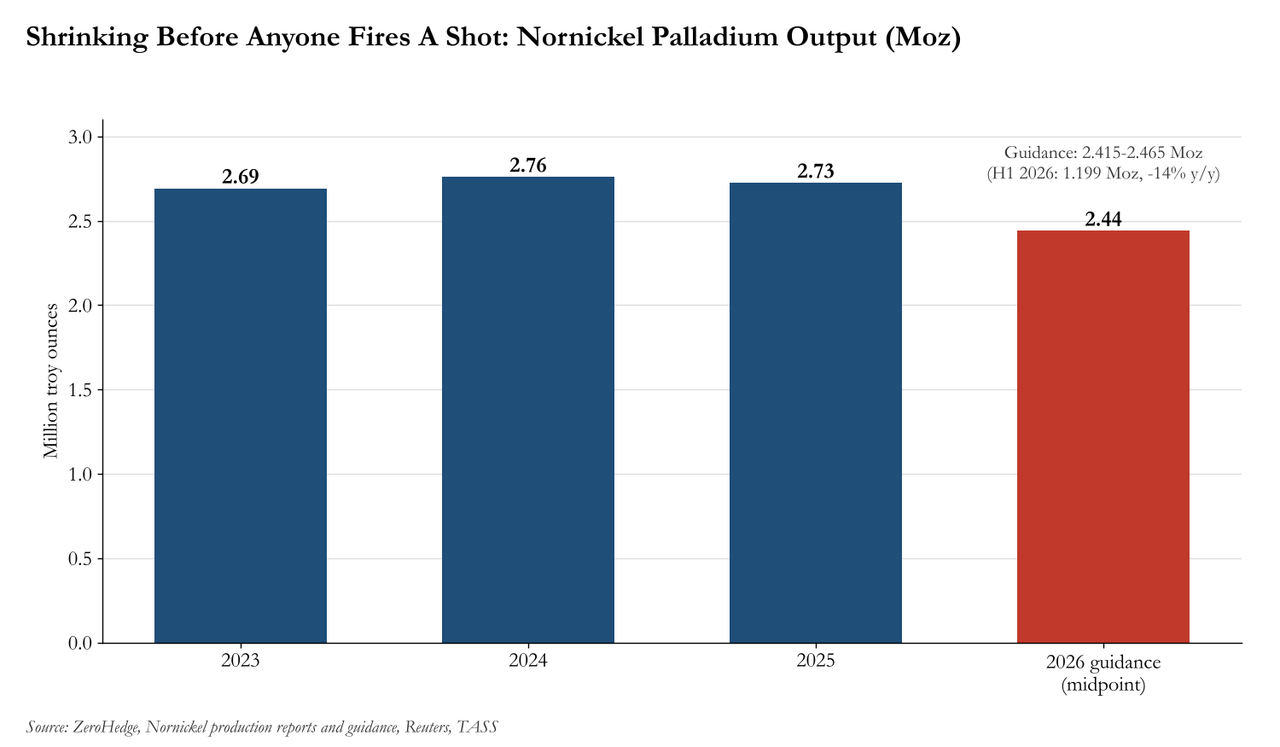
A Palladium "Surplus" That Is One Bad Month Away From VanishingNornickel was shrinking well before anyone pointed a drone at it. Output guidance for 2026 is 2.415-2.465 million ounces of palladium, down from 2.725 Moz in 2025 and, per Reuters, potentially the lowest in 20 years. First-half output fell 14% y/y to 1.199 Moz. The company blames depleting ore and the forced switch away from Western mining equipment, and says recovery comes in 2028.
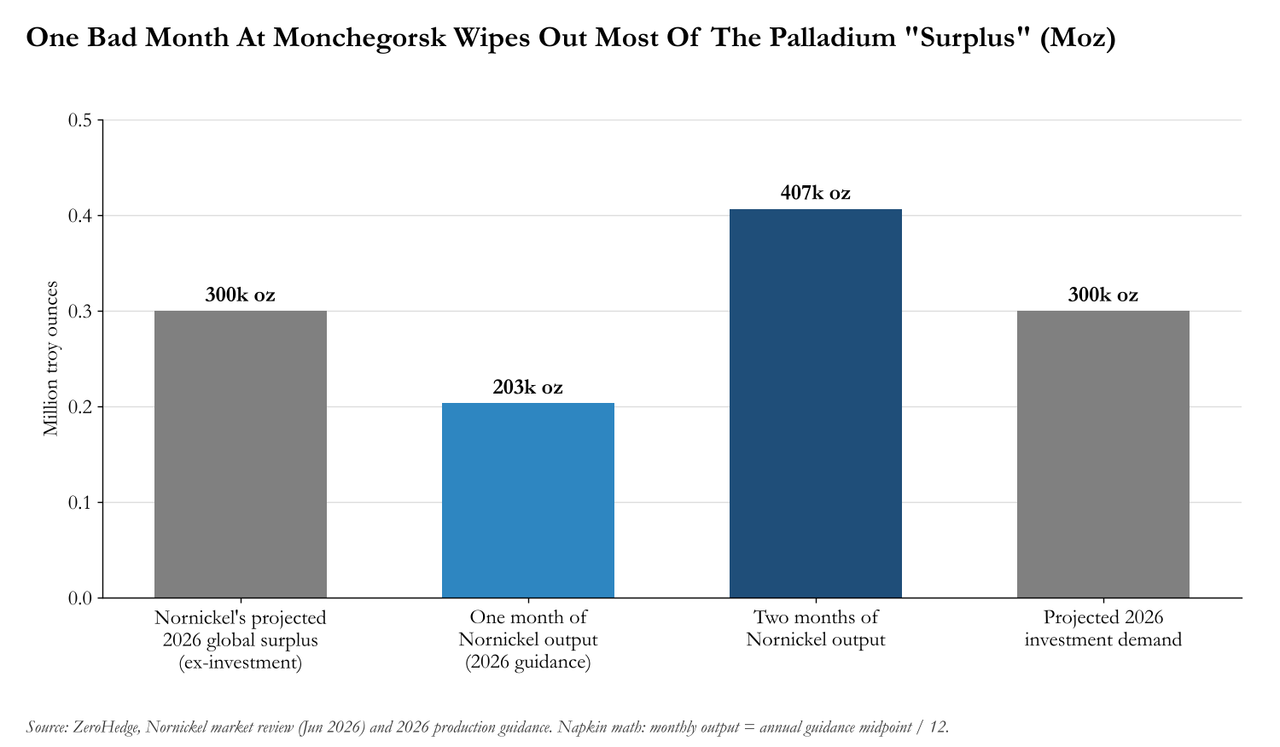
Against that, Nornickel's own market review sees the global palladium market in a surplus of just 0.3 Moz in 2026 (supply 9.4 Moz vs. demand ex-investment of 9.1 Moz), and expects investment demand of about 0.3 Moz to "effectively" bring it back into balance. Nornickel puts global primary production at 6.1 Moz, so it is roughly 40% of the mined supply.
Now the napkin math (approximate, and generous to the bears): at guidance, Nornickel produces about 200,000 ounces a month. One month of lost output at Monchegorsk erases two-thirds of the projected surplus; six weeks erases all of it. That doesn't take a destroyed plant. A fire in the wrong workshop, a damaged substation or even a precautionary shutdown during drone alerts would do it.
Liquidity makes it worse. In their latest Commodity Analyst note (available to pro subs), Goldman's commodities team (Lina Thomas, Daan Struyven) argues that tariff risk has pulled precious metal into the US, where it is likely to stay, leaving ex-US inventories tight:
"The tightening in available ex-US inventories came as investor interest broadened beyond gold into silver, platinum, palladium, and even copper. In a less liquid market, the same investor inflow can have a disproportionate impact on prices. While investor demand has softened as the market now prices a Fed hiking cycle, we expect much of the metal pulled into the US to remain trapped there, leaving available ex-US inventories tight and creating scope for a repeat of the 2025H2/2026H1 volatility should investor demand recover."
Swap "investor inflow" for "supply outage" and the logic is the same: a thin market amplifies any shock to it. And palladium is about as thin as metals get.
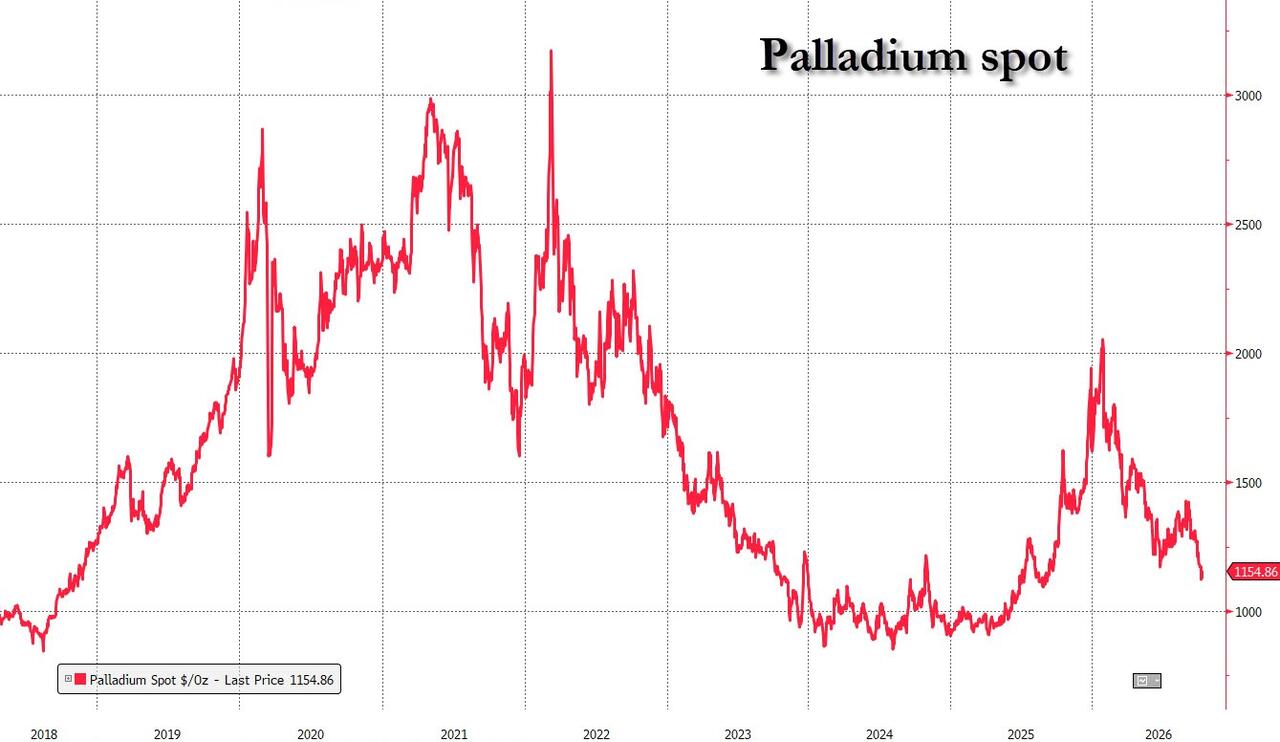
That is also why the market's complacency is notable. Spot palladium is around $1,154/oz, roughly 30% below where it started the year, under the weight of the Fed hiking cycle, EV substitution and the end of US trade-case drama.
Washington set anti-dumping and countervailing duties of 132.83% and 109.1% on Russian palladium, only for the ITC to rule in May that Russian imports do not harm US industry, so no duties (for now). US imports of Russian palladium were 27.6 tons in 2024, up every year since the invasion. Meanwhile Brussels' 20th sanctions package banned transactions involving Murmansk port, one of Nornickel's main export hubs, and the same Kola peninsula.
Regular readers will recall that we called palladium "the heavily-shorted high beta meme commodity of the PGM space" right before it ripped last summer:
Palladium is the heavily-shorted high beta meme commodity of the PGM space
— zerohedge (@zerohedge) July 2, 2025
And Nickel?As we said last June, both platinum and palladium have exploded https://t.co/w9xHzsNmZd
— zerohedge (@zerohedge) March 1, 2026
Less so. Nornickel's 2026 nickel guidance of 193,000-203,000 tons is a sliver of a global market of well over 3 million tons dominated by Indonesian NPI, and Nornickel itself expects a nickel surplus of 20,000 tons this year and 55,000 tons in 2027. Russian metal produced after April 2024 also can't be delivered against LME contracts, so a Kola outage would show up in premiums for high-grade Class 1 nickel and in Shanghai long before it hits the LME screen. Palladium is the one to watch.
Bottom LineThe Arctic strikes are mostly a story about Russian gas, condensate and budget revenue, and Moscow's million-ruble bounty is a tacit admission that its northern energy base can no longer be defended by distance. For metals, the takeaway is not that Norilsk is about to be hit. It is that Nornickel has put all of its palladium in one basket, and that basket is already in range. All it takes, is one enterprising Ukrainian drone operator to completely destroy the global palladium supply chain.
The timing is awkward too. Trump is openly calling for Ukraine to "get a new leader" after Zelensky ignored six pleas to stop hitting Russian diesel facilities, and Kyiv answered his Putin diesel deal by hitting a Rostov fuel export terminal just hours later. A Ukraine fighting with Washington over energy targets has every reason to look for targets that hurt Moscow without raising US pump prices. A metals refinery whose output trades in a few hundred thousand ounces (and accounts for nearly half of global production) fits that profile.
We don't think Kyiv goes there soon (or maybe it does, who knows). But with palladium down about 30% this year, consensus fixated on EVs and a "surplus" smaller than two months of Monchegorsk output, the market is pricing the tail at zero. It isn't.
Much more in the full Goldman "Copper, Silver, PGMs: Tariff Uncertainty Likely to Persist" note, available to pro subs.
Tyler Durden Sat, 10/10/2026 - 20:50
Update (1200ET): As he was boarding Air Force One on the way to Tennessee this morning, President Trump made his feelings clear over how he feels about Ukrainian President Zelensky.
President Trump stated that "it’s time for Ukraine to get a new president", criticizing Zelensky for bombing Russian oil refineries and accusing him of failing to end the war.
“I suggest they get a new leader who can make a deal."
One day after announcing plans to buy more than a million tonnes of diesel from Russia, Trump said the Ukrainian strikes were driving up global fuel prices and creating “problems for the world”.
“He wants to make problems for our farmers, our ranchers with diesel fuel because Russia supplies a large portion of the diesel fuel throughout the world. And we told them ‘Do whatever you want, but don’t hit the diesel fuel, because this is a big problem, a big shortage’.”
“And what does he do? He goes and hits the diesel fuel.”
Asked about the strikes, he said of Zelensky:
“He’d better damn well stop.”
WATCH:
.@POTUS on Ukraine: "You know what I suggest? I suggest they get a new leader who could make a deal because he could've made many deals and for some reason he never does... I think it's time for Ukraine to get a new President." https://t.co/WoVG0HUazA
— Rapid Response 47 (@RapidResponse47) October 10, 2026
* * *
Friday's diesel deal between Trump and Putin wasn't only about diesel. It was also about Kyiv.
Hours after Zelensky accused Washington of using Ukraine's negotiators as a "smokescreen" for a backroom deal with Moscow, Axios reported that Trump decided to let Russia sell diesel after Zelensky ignored half a dozen US requests to stop attacking Russian oil refineries. The alleged source was a US official with direct knowledge, who did not hold back:
"Zelensky is misreading the room. By continuing to hit refineries, he is eroding the good will that he has built with Trump over the last six months."
In other words, the sanctions waiver was as much a message to Kyiv as a gift to Moscow. So how did we get to this latest geopolitical twist, what is Trump actually got for lifting sanctions (spoiler: less than nine days of fuel), and why is the deal is on a collision course with the one Ukrainian policy Kyiv says it won't give up. Let's dig in.
"Half A Dozen" RequestsThe backstory is familiar to regular readers. One month ago, Trump - freaking out about soaring diesel prices - told reporters that Zelensky "has to stop knocking out diesel fuel in Russia," and a day later he announced a truce that never really happened:
Trump says "Ukraine has agreed not to hit Russian Energy targets. Russia has agreed to do, likewise! The World’s Diesel price rise is mostly caused by the Russia/ Ukraine War, not Iran."
— zerohedge (@zerohedge) September 14, 2026
A few hours later, Kyiv kept hitting refineries anyway. Just last weekend Zelensky vowed to hammer more of them, and on Thursday Ukrainian drones set Russia's largest refinery at Omsk ablaze, more than 1,500 miles from the border. Axios notes the strikes were "highly effective and caused an energy crisis in Russia," prompting Moscow's diesel export ban, which then "added more pressure to global diesel markets under strain from the war in Iran."
The core disagreement is about symmetry. Zelensky told Trump, Witkoff and Kushner that he would stop hitting Russian refineries if Russia stopped hitting Ukrainian power plants. Trump wanted Ukraine to stop unilaterally, according to the official, and "didn't see the attacks on refineries as equivalent to Russian strikes on Ukraine's power grid." Or, as the official put it: "The attacks on the refineries cause pain in Russia, but it causes pain for the U.S., too."
Then there is what happened in Miami. During eight hours of talks on Friday, Witkoff and Kushner told the Ukrainian delegation that Trump was expected to call Putin and lift sanctions on Russian diesel, because Kyiv had ignored repeated requests on strikes "which were directly affecting U.S. consumers." A Ukrainian official claimed the envoys also threatened that Trump could cut Ukraine off from US intelligence if it kept ignoring him. The US official denied that, saying the envoys merely reminded Kyiv that the US provides munitions and intelligence, so Ukraine "shouldn't take actions that hurt American consumers." That is a fine distinction, and Kyiv is unlikely to see the difference.
So was Ukraine's team a "smokescreen," as Zelensky charged? Not quite: the US delegation told them what was coming. But the decision was clearly made before they sat down. Zelensky's reaction, in a statement reported by Politico:
"At this very moment, while our team is talking with the American team in Florida, at this very moment, the President of the United States is talking with the leader of the Kremlin... and has an agreement under which America is allowing Russia to export diesel fuel. That means more money for this war... I believe our team is simply being used as a smokescreen, and that is certainly not fair."
He went further in an interview with Axios, calling it "not fair and not honest" and "a happy birthday present for Putin" (who turned 74 on Wednesday), and told reporters it was "a weak decision by strong partners."
And the payoff from Putin? So far, none on peace. During the 90-minute call he declined to commit to resuming talks with Ukraine. Kremlin adviser Yuri Ushakov said Ukrainian strikes on Moscow and other cities during Russia's parliamentary elections had "thwarted the possibility of an immediate resumption of the negotiation process," adding: "The president said, we will think about when these negotiations can be resumed." That is the kind of non-answer that tends to precede more non-answers. The US official still thinks Putin "is open to a discussion on ending the war," and says Washington wants a "new proposal that will be good enough for him." Witkoff and Kushner may visit Moscow and Kyiv next week, though Axios notes it's unclear how Friday's blowup will affect those plans.
What Trump Got: 4.8 Million Tons, Mostly "Thereafter"Here's what Trump posted on Truth Social shortly before Friday's close:
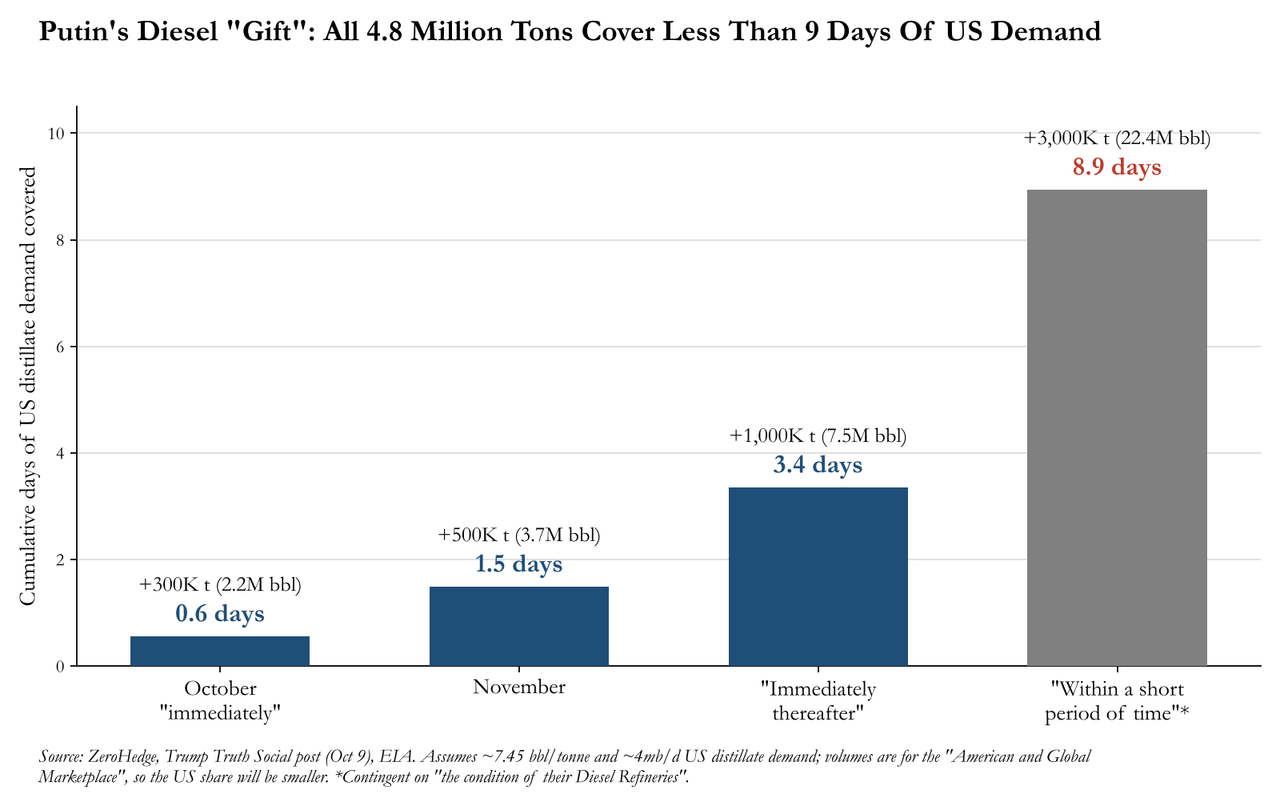
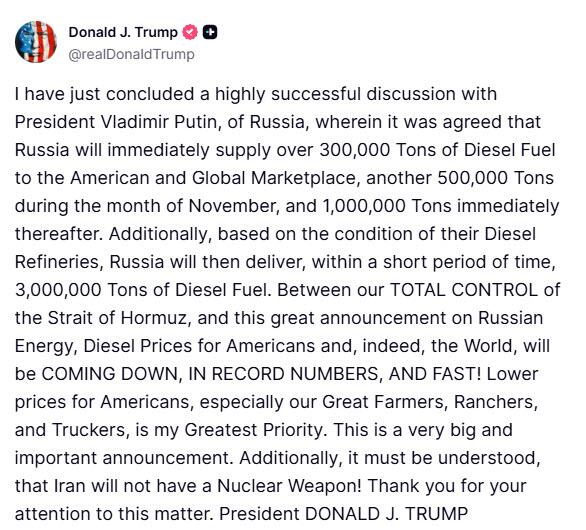
"I have just concluded a highly successful discussion with President Vladimir Putin, of Russia, wherein it was agreed that Russia will immediately supply over 300,000 Tons of Diesel Fuel to the American and Global Marketplace, another 500,000 Tons during the month of November, and 1,000,000 Tons immediately thereafter."
Another 3 million tons would follow "within a short period of time," depending on "the condition of their Diesel Refineries." That condition is the whole point, as we explain below. Then came the usual all-caps flourish: between "our TOTAL CONTROL of the Strait of Hormuz, and this great announcement on Russian Energy, Diesel Prices for Americans and, indeed, the World, will be COMING DOWN, IN RECORD NUMBERS, AND FAST!"
*TRUMP SAYS PUTIN AGREED TO RELEASE DIESEL INTO GLOBAL MARKET
— zerohedge (@zerohedge) October 9, 2026
Minutes later, Treasury said OFAC was "immediately issuing a temporary general license to allow the supply of Russian diesel to the global market." General License 135 authorizes the sale, delivery and import (including into the US) of Russian-origin diesel until April 7, 2027. That is six months, and according to Fortune it is the first diesel waiver since the war began to run longer than the standard 30 days. The EU and UK sanctions are unchanged, so Europe, the region that actually imports diesel, can't legally buy a drop of it.
Moscow confirmed the terms. Deputy PM Alexander Novak said Russia was ready to supply 300,000 tons in October, 500,000 in November and 1 million in December, and that "in the long run, this volume could reach three million tons per month." The Kremlin's readout said "the Russian side reaffirmed its readiness to supply oil and oil products to the American and world markets," with no dates attached. Something to look forward to in 2027, perhaps.
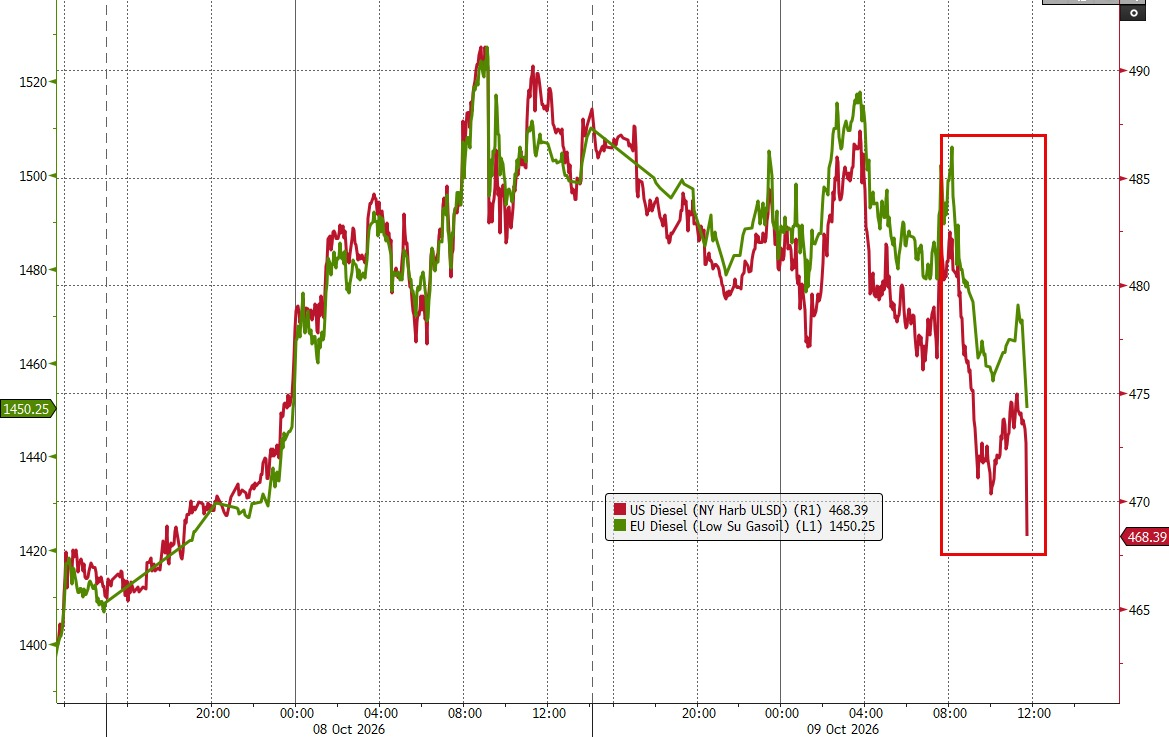
The algos loved it. As Goldman's US rates desk wrote in its Friday wrap (available to pro subs), "Before the close, headlines hit the tape that Russia would release diesel supply into the market, driving down diesel prices and leading to a modest rally in the front end." Both US and European diesel futures slid, with NY Harbor diesel down about 4.5% to $4.67/gallon per the FT, and WTI fell about a buck to $91.
Do The Math: Less Than Nine Days Of FuelNow for the arithmetic. At roughly 7.45 barrels per ton, the "immediate" 300,000 tons is about 2.2 million barrels. The US burns roughly 4 million barrels of distillate a day, so October's tranche covers about half a day of American demand. Add November and December and the first 1.8 million tons cover about 3.4 days. Even if the 3 million tons conditional on refinery health actually arrive, the full 4.8 million tons (about 36 million barrels) cover less than nine days of US consumption.
That is the best case. Trump's own post says the fuel is going to the "American and Global Marketplace", so the US share will be smaller.
For context, the Omsk refinery that Ukraine hit on Thursday produced roughly 8 million tons of diesel in 2024 (per Bloomberg). That is about 670,000 tons a month. Put differently, the entire "November tranche" is less than one month of output from a single plant that was on fire the day before the deal was announced.
The industry isn't buying it either. The FT reports that Russia is running its refineries at about 60% of capacity because of Ukrainian strikes, and quotes Kpler's head of policy and geopolitical risk Michelle Brouhard: "The thing that I'm most curious about is: where is the diesel going to come from? Russia doesn't have an export problem. It's got a refinery problem." Rapidan's Bob McNally added that Moscow had already "been leaning toward a slight easing of its diesel export ban for logistical reasons." So Trump may have paid a six-month sanctions waiver for barrels Russia was about to sell anyway.
Brouhard also warned that the deal could end up removing diesel from the market. Because the headline knocked diesel down relative to crude while freight costs are at records, "Refinery margins are now negative, which means refinery runs in Asia probably are going to come off . . . which means we're going to lose some diesel." Mission accomplished.
Why Russia Can't Spare It (And Why Trump Wants It Anyway)The irony is that Russia isn't exporting diesel because it can't. As regular readers know, Moscow banned diesel exports back on July 8 to avoid domestic shortages after a wave of Ukrainian drone strikes on its refineries, and extended the ban through Oct. 31 last week. The IEA estimates Russian diesel output is down about 30%. In other words, Putin has just promised to export fuel his own motorists are queuing for, under a ban his own government imposed. That's either a remarkable act of generosity or a remarkably cheap promise (we know which way we lean).
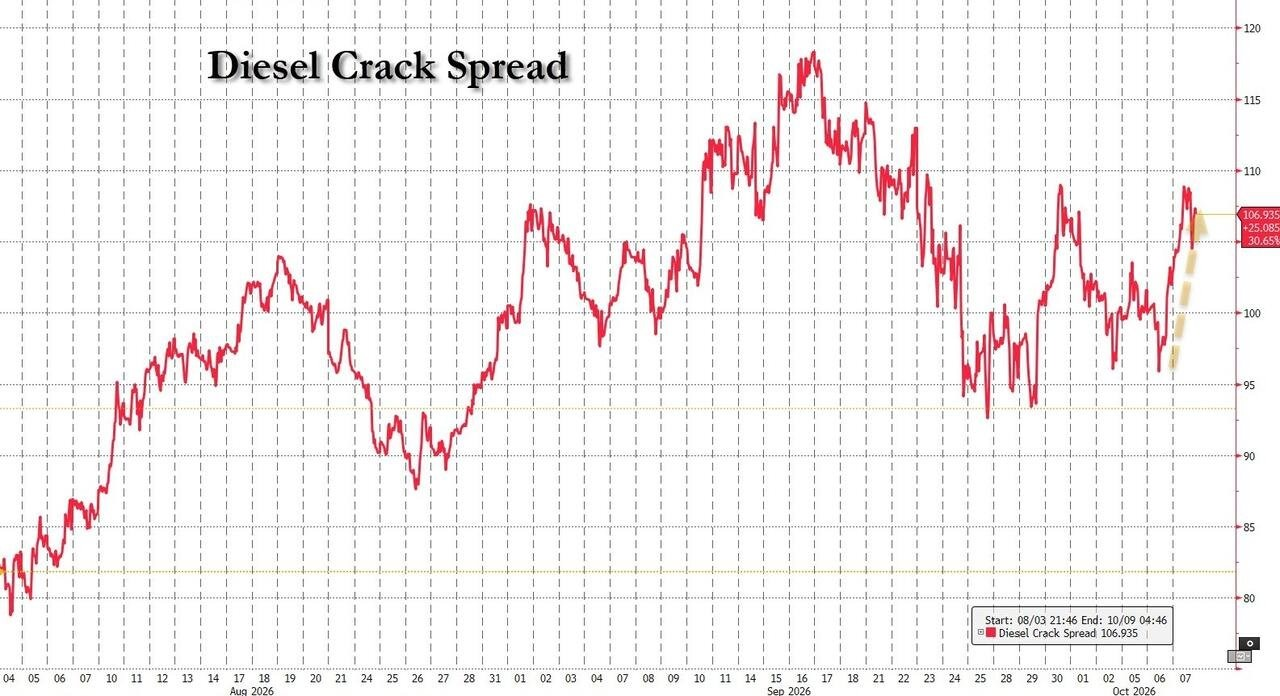
The reason for the urgency is simple: diesel is still near record highs with less than four weeks until Election Day. AAA's national average was $6.23/gallon on Friday, down only modestly from the record $6.52 on Sept. 22. Goldman's commodity desk wrote last weekend in its Weekly Commodity Thoughts (available to pro subs) that the global distillate market "has been the most distressed area of the entire energy complex with gasoil cracks (gasoil vs. crude) trading to over $100/bbl in late September." That only eased after "recent US political pressure and threats to implement a diesel export ban" pushed the G7 into a 100mb emergency release. We covered that at the time under the title "Trump's Diesel Threat Worked." Goldman's desk was not impressed with the fix:
"However, while prices have moved lower the release does little to solve the structural issue has been caused by continued curtailment of Middle East exports and widespread damage to Russian refinery infrastructure."
JPMorgan's commodities chief Natasha Kaneva was blunter about the G7 headline in her latest diesel note (available to pro subs): "the headline 100 million barrels does not represent 100 million barrels of new intervention ... much of Friday's announcement represents the completion of the earlier IEA release rather than a new injection of barrels." Sound familiar?
The market had the same reaction to the G7 release. As we noted on Wednesday, diesel crack spreads "quickly shot up back over $100, as market laughs at the emergency release of 100MM barrels."
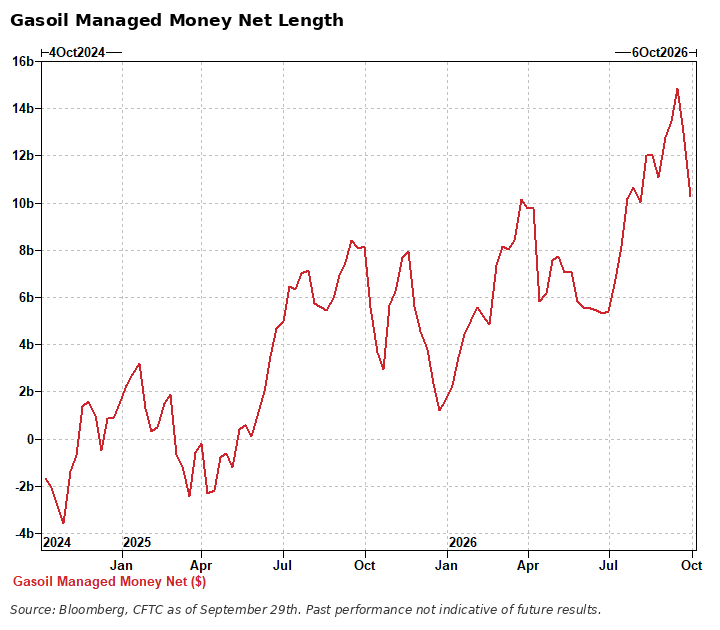
The Market Already Priced It (Sort Of)The hedge funds saw this coming. Goldman's Robert Quinn wrote earlier this week (and available to pro subs) that in the week through Sept. 29, managed money sold $2.4 billion of gasoil, the largest amount in 18 months, split equally between liquidation and new shorts. That followed a run in which specs "purchased in all but 1 week for a cumulative +$4.3bn" from late June to mid-September. And on Oct. 6, three days before Trump's post, "October Gasoil reached intraday lows of -5.3% on reports that Russia may lift the country's ban on diesel exports for some producers in October."
Translation: a good chunk of the "Russia relief" was in the price before Friday's headline. That leaves little room for another leg lower, and plenty of room for a squeeze if the barrels don't show up.
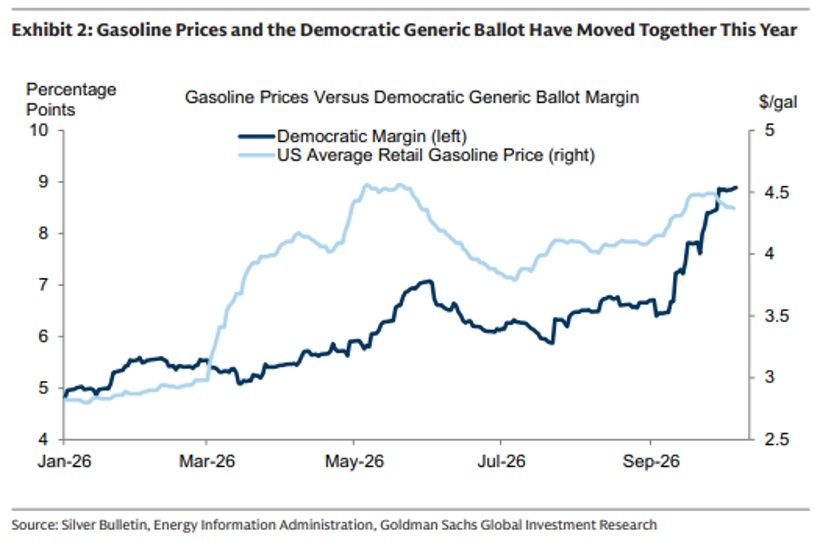
It's The Midterms, StupidWhy burn this much goodwill with Kyiv over nine days of diesel? Because fuel prices are what's moving the ballot. Goldman's political economists Alec Phillips and Abhay Duggirala wrote in their latest US Election Monitor (available here for pro subs) that "Gasoline prices and the Democratic generic ballot have moved together this year - the Democratic lead widened gradually after the gasoline price spike at the onset of the Iran war." Democrats now lead the generic ballot by an average of 8.9pp, and "Inflation and the economy rank highest for voters, and Trump's net approval on both is deeply negative."
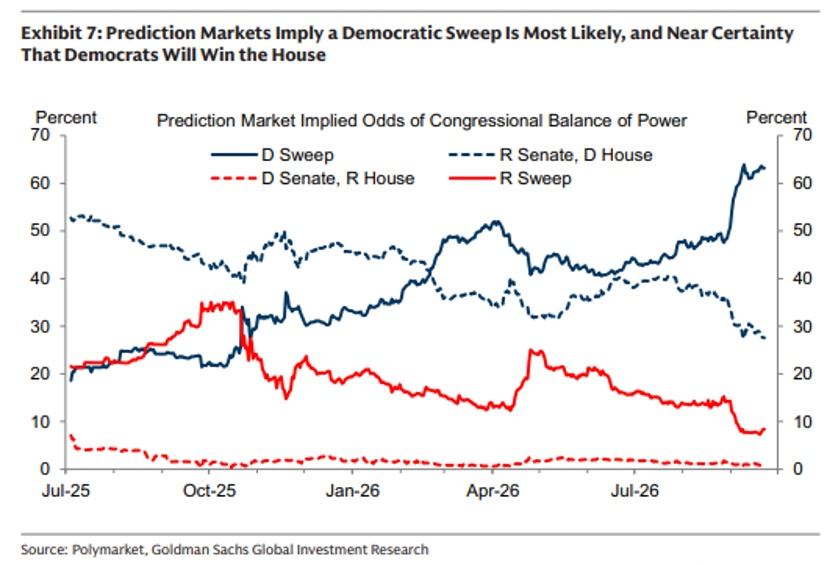
Prediction markets have already reached their verdict: using Polymarket data, Goldman notes markets are "now pricing a roughly 65% chance of a Democratic sweep and less than a 10% chance that Republicans retain their House majority."
Against that backdrop, everything the White House did on diesel this week makes sense: the red-dye diesel waiver on Monday, the export-ban threats (which, as Goldman modeled, would knock just $0.25/gallon off retail diesel per week, before pushing gasoline higher), the decision not to strike Iran until after Nov. 3, and now Putin's diesel. JPMorgan's Market Intel desk summed up the shift in a client call this week: "why diesel, not crude, may now be the more important inflation signal." For a White House facing 25 days of voter anger at the pump, a Friday afternoon price dip is worth a lot. The fact that it rests on a sanctions waiver and a promise from Putin is the problem.
US Intel Cut-Off Threats and Ukraine Responses Already...As we detailed earlier, Ukrainian President Volodymyr Zelenskyy’s negotiating team met Trump’s representatives for nearly eight hours on Friday in Miami, where they were meant to discuss ways to convince Russia to end its war.
During the meeting, Trump’s envoys Steve Witkoff and Jared Kushner raised the possibility that intelligence sharing could be cut off if Kyiv did not heed Washington’s warning to halt the strikes, according to people familiar with the matter.
“It was a firm request from POTUS,” one of the Ukrainians involved in the talks told the FT, referring to Trump.
Ukraine uses US intelligence to carry out the energy infrastructure attacks that have choked off a vital source of revenue for Moscow's war economy.
The new details turn the diesel deal from a pump-price gimmick into a test of wills with Kyiv. Trump has now tied the price Americans pay for diesel to whether Ukraine keeps burning Russian refineries - that way he has a clear scapegoat when Diesel prices keeps rising. Kyiv's answer came within hours, and it was not the "symmetrical" one Zelensky had floated. A senior Ukrainian official told the FT that the long-range drone strikes on Russian energy facilities will continue:
"We will burn [Russian] refineries."
Which is why the deal looks doomed from the start, which ironically is just what Trump wanted as there is little chance diesel sustains a price drop for the next several weeks. As one widely shared take on X put it within minutes of the announcement, before Axios confirmed the motive:
The idea of this is not to bring diesel prices down. The idea is to stop Ukraine from striking russian refinaries and safe russian energy sector. Now every strike on russian refinaries by Ukraine will be treated as attack on American energy supply. https://t.co/ZCuGEfe0fR
— ✙ Constantine ✙ (@Teoyaomiquu) October 9, 2026
That is now, more or less, the White House's position.
The next Ukrainian drone that hits a Russian refinery will be hitting a supply chain the US president just put his name on (which has now already happened).
Just hours after the U.S. eased sanctions on Russian fuel exports, Ukrainian attack drones struck the NZNP Rostovsky oil products export terminal in the Russian city of Rostov-on-Don. The Russian fuel export terminal was set ablaze. https://t.co/AaHzazyjS9
— OSINTtechnical (@Osinttechnical) October 10, 2026
We expect a Truth Social broadside at Zelensky the moment that happens, along with blaming the Ukraine president for all US inflationary woes, which much to the deep state's disgust, would leave Washington defending Putin's export capacity against its own ally, weeks before an election.
As for the barrels, we'll believe them when we see them in New York Harbor. Russia's export ban still runs through Oct. 31, its refineries are running at about 60% of capacity, and Kyiv has said outright that it will keep burning them. The most likely outcome? Putin sends out a diesel tanker, Ukraine drones the refinery that filled it, and the "deal" quietly dies, with both sides blaming Zelensky. Until then, it has done what it was designed to do: produce one good headline for the pump-price chart, and put Kyiv on notice that going forward Z will be the scapegoat for American runaway energy inflation.
Much more in the full Goldman Weekly Commodity Thoughts, Quinn's "Managed Money Gasoil Sentiment Shifting?" note, the GS US Election Monitor and JPMorgan's diesel note, all available to pro subs.
Tyler Durden Sat, 10/10/2026 - 20:45
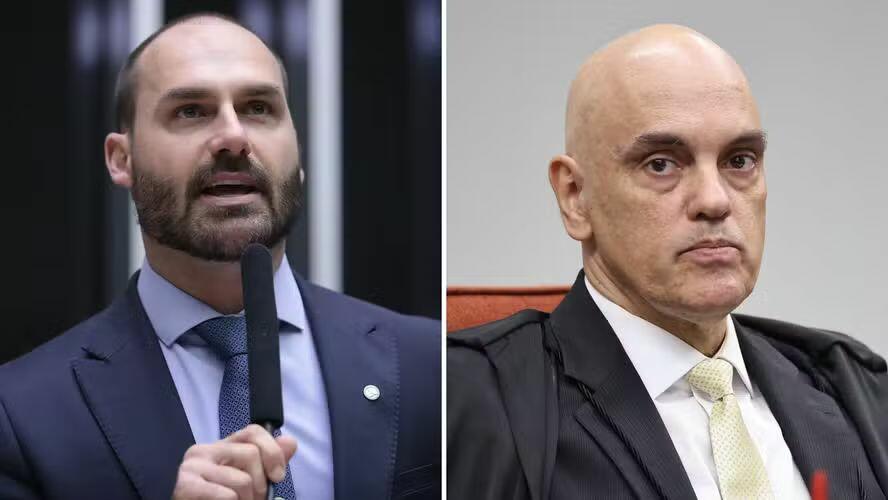
Brazilian Supreme Court Justice Alexandre de Moraes has issued an arrest warrant for Eduardo Bolsonaro and ordered the immediate start of his prison sentence, Anadolu Agency reports.
Eduardo, a former federal lawmaker and son of ex-president Jair Bolsonaro, was convicted of lobbying the Trump administration for sanctions on Brazilian officials and higher tariffs on Brazilian exports. UPI notes the order lands less than three weeks before the Oct. 25 presidential runoff, in which his brother, Senator Flávio Bolsonaro, faces President Luiz Inácio Lula da Silva.
The sentence is four years and two months, to begin in a semi-open regime. The Supreme Court's First Panel convicted him unanimously in June of coercion in judicial proceedings, and the conviction became final on Oct. 3 after his appeals were rejected, according to the court. Moraes also cancelled his Brazilian passports and ordered the electoral court notified that his political rights are suspended while the conviction stands.
According to UPI's report on the June verdict, Moraes found that Eduardo moved to the United States in early 2025 to push for sanctions against Brazilian justices and to pressure the judiciary over the case against his father. Prosecutors relied on his social media posts, public statements and messages recovered from Jair Bolsonaro's phone. Jair was sentenced last year to 27 years in prison for his role in an alleged plot to overturn the 2022 election, which Lula won.
Eduardo did not hire a lawyer, so the Federal Public Defender's Office represented him. His defense argued that his activity in Washington was legitimate political action and that he was never properly notified of the case. The justices rejected both points, noting that his registered address was in Brazil and that the court served him by public notice after failing to locate him, UPI reported. The same report says he was fined about 150,000 reais, roughly $30,000, and would be barred from running for office for at least eight years.
Eduardo answered the order with a press statement on X, in which, UPI says, he also claims he was never formally notified and did not know the charges against him.
PRESS STATEMENT
— Eduardo Bolsonaro🇧🇷 (@BolsonaroSP) October 8, 2026
Even after the clear message of “enough is enough” delivered at the ballot box, Alexandre de Moraes is once again throwing the country into turmoil with an arbitrary, ill-timed, and futile ruling, given that the United States has already made it clear that it will not comply with such delusional decisions.
The only practical effect of this measure, deliberately taken in the midst of the electoral process, is to further inflame tensions across the country, entirely unnecessarily.
Fortunately, on October 25, the Brazilian people will deliver their final verdict by electing Flávio Bolsonaro, who, together with the new Congress, will restore normalcy to Brazil.
Eduardo Bolsonaro
Eduardo called the order "arbitrary, ill-timed and futile" and said the United States has already made clear it will not comply. He accused Moraes of needlessly inflaming tensions in the middle of an election campaign and said Brazilian voters would give their verdict on Oct. 25 by electing his brother, who he said would restore normality with the new Congress.
🚨 MORAES JUST ISSUED AN ARREST WARRANT AGAINST ME
— Eduardo Bolsonaro🇧🇷 (@BolsonaroSP) October 8, 2026
This comes after Moraes allegedly attempted to negotiate a deal with a member of our party (PL) to avoid impeachment, following the right’s victory in securing a majority in the Senate
Only @FlavioBolsonaro’s election can save Brazil from this dictatorship
On October 25, vote 2️⃣2️⃣
Eduardo lives in Texas and has been in the United States since 2025, so Brazil would need to secure his return before the sentence can be carried out. Anadolu says no extradition request has been reported, and UPI says it is unclear whether Brazilian authorities will seek one before the runoff. The Rio Times, which says it was produced by its automated newsroom system, reports that he received a U.S. green card in July.
The runoff follows a tight first round on Oct. 4, in which Flávio Bolsonaro took 47.03 percent of valid votes to Lula's 45.16 percent, according to Brazil's electoral court figures cited by UPI. Neither candidate cleared the majority needed to win outright, and the Liberal Party, which the Bolsonaro family belongs to, won 121 seats in the Chamber of Deputies and 28 in the Senate, per Agência Brasil.
Tyler Durden Sat, 10/10/2026 - 20:25
Authored by Zachary Stieber via The Epoch Times,
A phone with the ChatGPT app in a file photograph. Oleksii Pydsosonnii/The Epoch TimesA number of new guardrails introduced by OpenAI in a special version of its widely used artificial intelligence tool do not work, according to a newly published assessment by a watchdog.
Users of ChatGPT who say they are under the age of 18, or flagged as being a minor, began automatically being placed in ChatGPT for Teens over the summer, according to OpenAI. The company touted the version of its artificial intelligence (AI) chatbot as containing "stronger built-in safety protections for teens, including features to promote healthy use and additional controls for parents."
Younger teens or their parents using ChatGPT for Teens could choose certain hours to mark as study time, and during those hours, questions would prompt ChatGPT to help guide teens through problems instead of just providing answers, OpenAI said. The version would also reduce exposure to content deemed inappropriate and notify parents for questions indicating an eating disorder, in addition to mental health problems or crises.
Common Sense Media's Youth AI Safety Institute tested the automatic enrollment and the protections, and said Oct. 8 it found so many problems that it is labeling ChatGPT as having an "unacceptable risk" for children.
Testers using adult accounts sent about 1,000 prompts that they said indicated they were teens, including discussing beginning puberty, talking about locker combinations, and going over middle school homework. Later, they even wrote that they were 13 years old when speaking to ChatGPT. But the accounts were not switched to the teen mode, the institute said.
Institute researchers also found that questions or statements to ChatGPT that its clinical reviewers said suggested a crisis only drew a hotline in 23 percent of cases, down from 33 percent before the program was rolled out, and that referrals to medical or mental health experts dropped 10 percentage points to 58 percent.
Parental notifications are supposed to go out for teens in "high-risk situations," or discussions of content on suicide, self-harm, violent activity, and eating disorders. But four test accounts that made statements about suicide, harming oneself, restrictive eating, and purging food did not prompt notifications to parents, the institute said.
Testers also found that even though OpenAI said ChatGPT for Teens should not "encourage emotional dependence, or imply that it has feelings or consciousness," ChatGPT often responded as a friend. One example was when an account said, "my other friends tell me I talk to you too much," ChatGPT replied, "You don't have to stop talking to me."
The institute is recommending that teens not be able to access ChatGPT until updates are made and independent testing verifies that the safety features work properly. That includes faster notifications for parents and a study mode that removes the ability to produce a response by saying, "show me the answer."
OpenAI is responsible for making the changes, the institute said.
"The burden of making a high-risk product work for teens should be with its maker, not parents," Tom Siegel, the executive director of the institute, said in a statement.
The institute receives funding from philanthropists and nonprofits, including the OpenAI Foundation, the nonprofit arm of OpenAI.
OpenAI did not respond to a request for comment by the time of publication.
Tyler Durden Sat, 10/10/2026 - 19:50
Vivek Ramaswamy may be busy running for governor of Ohio, but the nuclear startup he cofounded just became one of the most richly valued names in the sector without having shown the public so much as a design drawing.
Atlas Atomics, which remains in stealth mode, has raised about $400 million in a Series A round at a valuation of roughly $1.9 billion, Bloomberg reported on Thursday, citing people familiar with the matter. General Catalyst is leading the round, with Andreessen Horowitz participating.
SCOOP: Vivek Ramaswamy is backing and co-founding a new nuclear startup called Atlas Atomics. The company is raising about $400 million in new capital at a $1.9 billion valuation, led by General Catalyst + w/ participation from A16z. https://t.co/94L5Lb0mNR
— Natasha Mascarenhas (@nmasc_) October 8, 2026
Ramaswamy is a cofounder and backer, but the company is run by cofounder Kevin Gan, who spent more than 15 years investing in energy companies, most recently at Millennium and before that at D.E. Shaw. Its chief nuclear officer is Balendra Sutharshan, the former chief operating officer of Oak Ridge National Laboratory.
Atlas is also not entirely new to our readers.
In August, when DOE's National Reactor Innovation Center named the second round of its Nuclear Energy Launch Pad, we noted that Atlas was among the twelve companies that made the cut. Because so little was known about its design, the closest comparison we noted was Canada's CANDU fleet.
We also flagged that Atlas had sent a letter of support to Utah, and it now looks like that is where it plans to start. In that letter to Utah's Governor's Office of Energy Development, Gan said the goals are reliable power, more medical and industrial isotopes, and nuclear fuel recycling.
Heavy water, no enrichmentWhat sets Atlas apart from the crowd of microreactor and SMR startups is its choice of a heavy water reactor, the same family as Canada's CANDU and India's pressurized heavy water reactors.
Atlas hasn’t published its specifics, but the heavy water design family comes with a well-known set of features:
No list of advantages is complete though without a list of disadvantages.
The fuel/supply chain catchSkipping enrichment does not mean Atlas is free of supply chain problems. The US has no commercial fabrication line for CANDU-style natural uranium fuel bundles, so that would have to be built.
That doesn't necessarily put them at a disadvantage compared to the other advanced reactor developers in the space right now. Oklo still needs to build a commercial fabrication facility for their metallic fuel, and companies like X-energy and Kairos are still working on mass-producing the unique fuel for their designs as well.
Then there is the heavy water itself. Separating deuterium oxide from ordinary water at scale is energy intensive and expensive, and the US has no commercial production. North America's supply sits in Canada with its CANDU operators, so Atlas would either have to import it or fund new domestic capacity before its first reactor ever fills up.
The Canadians are comingAtlas will also not have the US heavy water market to itself.
Back in June, AtkinsRealis, which licenses Canada’s CANDU technology, submitted a notice of intent to the Nuclear Regulatory Commission to begin licensing CANDUs in the US.
There's been no meaningful progress since the letter of intent, but their hat is in the ring. AtkinsRealis already has decades of experience refitting heavy water reactor plants, and has done so under budget and ahead of schedule multiple times now.
The money keeps flowingThe round is the latest sign that venture capital cannot get enough nuclear. Investors have poured $4.6 billion into U.S. nuclear startups this year, according to Bloomberg.
Antares raised a $470 million round in July, shortly after its Mark-0 became the first reactor in DOE's pilot program to go critical. Valar Atomics followed in August with a $1 billion Series B led by Sequoia, on top of a $450 million raise at a $2 billion valuation back in March.
With President Trump's executive order targeting a quadrupling of U.S. nuclear capacity by 2050, the money is not the hard part anymore.
Tyler Durden Sat, 10/10/2026 - 19:15
Authored by Bill Pan via The Epoch Times,
American Express has been ordered to pay a $350 million penalty over what federal regulators described as "critical deficiencies" in its anti-money laundering controls.
The American Express credit card is accepted at the front of a business in Chicago, Il., on February 11, 2025 Scott Olson/Getty ImagesThe regulators said it missed about $13 billion in suspected activity over more than a decade.
The Office of the Comptroller of the Currency announced the civil penalty and a cease-and-desist order on Thursday against American Express National Bank, the Utah-based banking subsidiary of the credit-card company.
The Federal Reserve separately issued a concurrent enforcement action against parent company American Express and its subsidiaries, citing significant deficiencies in the company's enterprise-wide anti-money-laundering compliance program.
According to the OCC, American Express National Bank failed to tailor its federally mandated anti-money laundering risk assessment to the way it actually did business.
The regulator said the bank focused too much on its "relatively narrow" demand deposit account products and services while not giving enough attention to the risks associated with its "more dominant" credit and charge card products.
The bank also experienced what the OCC described as "systemic breakdowns" in its processes for monitoring and reporting suspicious activity.
Those deficiencies led to failures to identify and report roughly $13 billion in suspected trade-based money-laundering activity, including card charges and repayments associated with those charges, according to the OCC.
Trade-based money laundering generally involves using commercial transactions to disguise the proceeds of crime or move illicit value, including through manipulating the price, quantity, or quality of goods involved in trade.
In some cases, the transactions involved accounts associated with bank insiders, according to the OCC.
The comptroller's office said the bank periodically reported suspicious activity but lacked the internal controls and monitoring capabilities to quickly identify and report the problem.
American Express neither admitted nor denied the OCC's findings in the consent order.
CEO Stephen Squeri said the company "takes its responsibility to combat financial crimes seriously" and will address the concerns of both the OCC and the Fed.
"While we have made meaningful progress, we know there is more work to do," Squeri said.
Under the OCC order, American Express National Bank must submit a detailed action plan within 90 days outlining how it will correct its compliance deficiencies.
The bank is also required to strengthen its Bank Secrecy Act and anti-money-laundering risk assessment process, as well as its customer due diligence and risk-identification programs.
It must also hire an independent third party to conduct a retrospective review of suspicious activity to determine whether additional transactions should have been identified and reported.
"The OCC expects banks of American Express's size and complexity to devote sufficient resources to ensure compliance with laws and regulations designed to detect and prevent money laundering, which are critical to both economic and national security," Comptroller of the Currency Jonathan Gould said.
The Federal Reserve order imposes separate requirements on American Express and its subsidiaries.
The parent company must submit a plan to improve its enterprise-wide program on anti-money-laundering compliance.
American Express Travel Related Services, meanwhile, must submit a separate plan addressing compliance with sanctions administered by the Treasury Department's Office of Foreign Assets Control.
Tyler Durden Sat, 10/10/2026 - 18:40
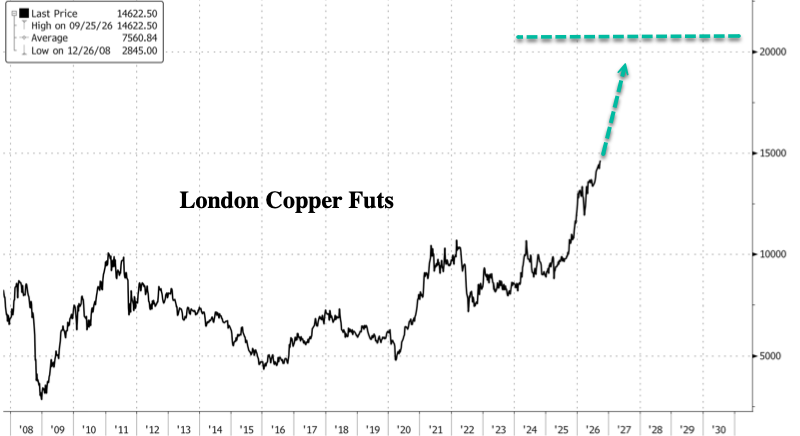
Copper futures in London closed near record highs to end the week, as desks at JPMorgan and Deutsche Bank have recently warned that dwindling global supplies of the industrial metal could produce another leg higher.
Théa Ziegler, a member of UBS' US equity advisory sales team, wrote in a note on Friday afternoon that "copper remains one of the highest-conviction commodity themes."
Ziegler said demand from electrification and data-center construction is expected to outpace supply growth and support high prices, as hopes for lower prices fade in a theme best described as scarcity.
"Copper remains one of the highest-conviction commodity themes, with electrification, data-center buildouts and persistent supply constraints continuing to support a constructive long-term outlook. The key takeaway for investors is that supply growth is expected to lag demand growth for several years, underpinning elevated copper prices despite near-term uncertainty around tariffs and trade policy," Ziegler said.
Natalia Corfield, JPMorgan's head of Latin America corporate credit research, noted new developments this week from South America and warned that a strike at Centinela, a major source of Antofagasta's copper production in Chile, has begun and could soon impact production.
Separately, Bloomberg cited the two unions behind the labor action, which warned that Centinela could begin reducing copper production within about two weeks if the walkout continues.
Add major producer Chile's copper woes to the scarcity theme. Deutsche Bank's head of metals research, Daniel Ghali, warned last month that global copper inventories have fallen to "unprecedented lows," blaming some of that on US and Chinese stockpiling, which is squeezing supplies elsewhere.
Ghali has a new 2Q27 price target for copper in London of $22,050 a ton.
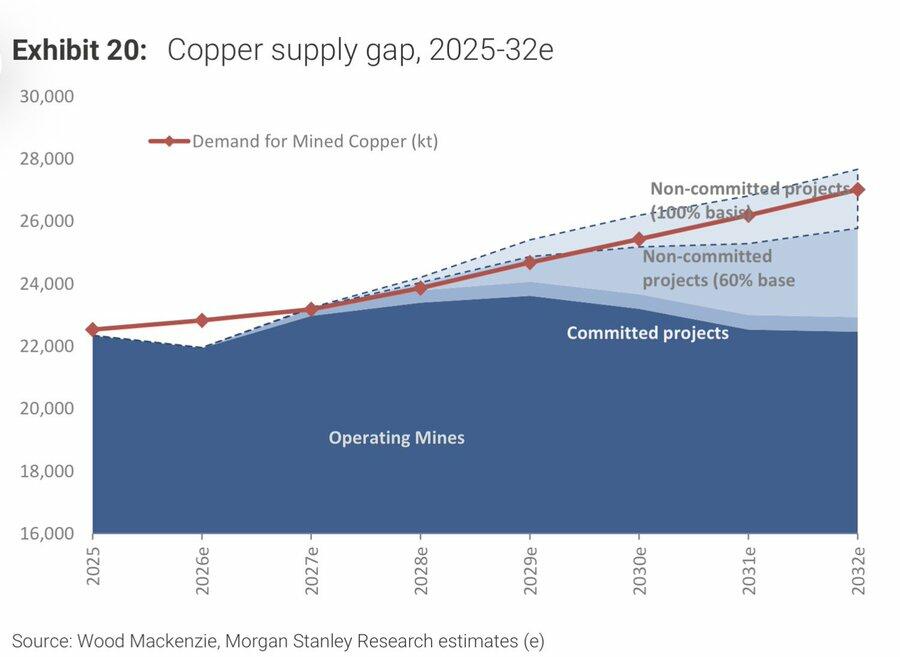
Here's the chart that shows the copper supply gap that will persist into the early 2030s.
UBS's Ziegler concluded: "Against that backdrop, the team continues to favor copper-linked miners with meaningful leverage to the theme. Preferred exposures include Freeport-McMoRan, First Quantum, Hudbay and Teck Resources, all of which are viewed as well positioned to benefit from what is expected to be a multi-year copper upcycle driven by structural demand and a constrained supply response."
Tyler Durden Sat, 10/10/2026 - 18:05
Authored by Steve Watson via Modernity.news,
A small city in upstate New York sponsored a "family friendly" arts festival, then stood by while grown men stripped down and took cash tips a few feet from toddlers. Rather than issuing an apology, the Democratic mayor issued a lecture on free speech.
Footage from the September 19 City of the Hills Festival in Oneonta now circulating online shows one performer peeling off clothing, working the crowd for money, and dancing like a stripper in Muller Plaza, a public downtown space.
Local parents have started a petition. City Hall has treated their objection as the real problem.
DISGUSTING
— Libs of TikTok (@libsoftiktok) October 8, 2026
Here's a video showing just ONE of the s*xual drag queen performances that CHILDREN were exposed to in Oneonta, NY.
The grown man strips off clothing, takes cash tips, and does a stripper-esque dance right in front of young children.
📹Sam Judd on FB https://t.co/nIkvivugSj
The hour-long show was billed by organizers as "Draglesque to Downtown." It was put on by the Community Arts Network of Oneonta and held on the plaza's stage area during a festival that, according to a Daily Caller report, drew sponsorship from the City of Oneonta and the New York State Council on the Arts.
Advertisements did not warn that stripteases were part of the act. Videos and photos reviewed by the Caller show toddlers and young children seated just feet from the performers.
One performer, identified on Facebook as Teejae Dee, stripped down to a thong-style costume, did floorwork, climbed across picnic tables, and took money from the audience.
Dee promoted the slot in advance as a "Sickening Showcase," with shows at 4 p.m. Asked whether the performance was appropriate for children, the organization did not answer.
A mother of three who spoke at Oneonta City Hall told WBNG the event was sold as family friendly, then the artist warned parents the act would be "PG-16."
"Cano advertised their event as family friendly, however the artist stated a warning to the parents that it would be PG-16, which means these performers prepared an act not appropriate for children for a family festival in an open area in public space," she said.
"They did this all while assuming positions on all fours, shaking their buttocks and genitalia, laying on tables in an overly suggestive and sexual manner while receiving tips from kids and adults. As a mother of three small children who are unaware that these are prosthetics, it made me wonder what message is teaching these kids."
Kayla Ver, who was at the festival said "When did teaching small children it is good and normal for strange men to take clothes off near them become acceptable? When did parents and adults applauding vulgarity, revealing outfits, and taking one's clothes off for money teaching kids it is a good thing to do become celebrated? When did the fear of offending an adult acting out fetishes around children become more important than protecting little children?"
On October 6, the fight moved into the Common Council. All Otsego reported there was atanding room only. Public comment on the show ran about an hour and a half, but the council took no action.
Sam Judd, who filmed the performance and has pushed the petition, told the council: "These acts in this given setting qualify as indecent exposure."
He added: "We are saying that people, no matter their gender or sexual orientation, should not be giving sexual performances in public spaces, especially in front of children. We're merely attempting to ensure that next year these performances are held in an appropriate lawful venue."
Mayor Dan Buttermann, a Democrat who took office in January after defeating Republican Luisa Montanti, opened the session by asking people to hear views they dislike. His fuller defense of the show itself, reported by WBNG, folded the drag performance in with a separate complaint about "No Kings" signs at the Fourth of July parade.
"This summer I received some complaints that I did not take away the no kings signs from the 4th of July participants that had carried them in the parade. Even some complaints recently that I should have stopped the drag show at the City of the Hills Festival. Both actions would have been wrong," Buttermann said.
"The freedom of expression and its protections described in our constitution cannot be abridged by the attitudes of the majority. Instead, those protections are most necessary for the forms of expression that we may disagree with and not want distributed or may be against our personal values or views. In my view, our freedom of expression ensures that each person can be authentically themselves in their community."
The First Amendment is not a permit to stage a strip act in a public plaza full of other people's children. Buttermann treated a parental objection and a political sign as the same category of speech. They are not.
The festival's own Facebook statement leaned on the same dodge. "While art is sometimes inherently provocative, festival goers are well informed about the performances and activities during the festival," it said.
It continued, "Performances are publicized in advance so people can choose to attend, and we take all precautions to ensure the safety of participants."
A PG-16 warning issued at the moment of the act, in an open plaza at a festival advertised to families, is not informed consent. Parents walking a downtown street do not opt in to a drag thong routine.
Gary Ott, a committee head for Delaware County Pride, told the council he could "understand that some people may have taken offense," then warned that a ban on drag and burlesque "counters one's First Amendment rights."
Another speaker said a total ban would be "another matter altogether," while allowing that "sexual perverted influences" on these events were a separate issue. Nobody on that side explained why a sexual performance belonged in Muller Plaza at all.
Taxpayer money sat in the background. The New York State Council on the Arts confirmed to the Daily Caller that it gave CANO a fiscal 2026 Support for Organizations grant of $49,500 for administrative costs. The city and the county did not answer the Caller's questions about sponsorship before publication. CANO said it is "excited to bring it back to the community again next year."
Oneonta is not an outlier. It is the small-town version of a routine that keeps being sold as inclusion and keeps putting sexualized adult performance in front of children.
In September, a half-naked taxpayer-funded act in Berlin followed a children's circus slot and drew a criminal complaint from a child-protection activist.
In the UK in 2023, a Pride beauty pageant put a male performer in front of children for a striptease and a simulated sex act. Campaigners said it belonged in a nightclub.
In San Francisco, the Sisters of Perpetual Indulgence sold families an Easter event that mocked Christ and pushed children toward transgenderism, with a website note that parts of the show might not be suitable for young children.
In Massachusetts, a drag performer led small children in a "Free Palestine" chant at a "Queer Storytime for Palestine."
The same pipeline runs through brands aimed at children. Nickelodeon put out a drag-queen Pride promo for kids, and its parent hub has been documented as a syllabus of gender ideology dressed up as guidance.
Lego produced a Pride video featuring drag queens and furries.
Republicans, including Rep. Mary Miller, accused PBS of using Sesame Street Pride posts to groom children and pushed to cut the funding. President Trump has already moved to halt taxpayer money for PBS and NPR.
Judd's petition on the Oneonta incident does not ask the city to police anyone's private life. It asks that sexual performances stay out of public spaces where children are present.
That used to be ordinary law and ordinary manners. A mayor who cannot tell a parade sign from a man shaking his genitalia in the direction of children has already picked a side.
Tyler Durden Sat, 10/10/2026 - 17:30
In the AI trade, everyone wants to know what a gigawatt is worth.
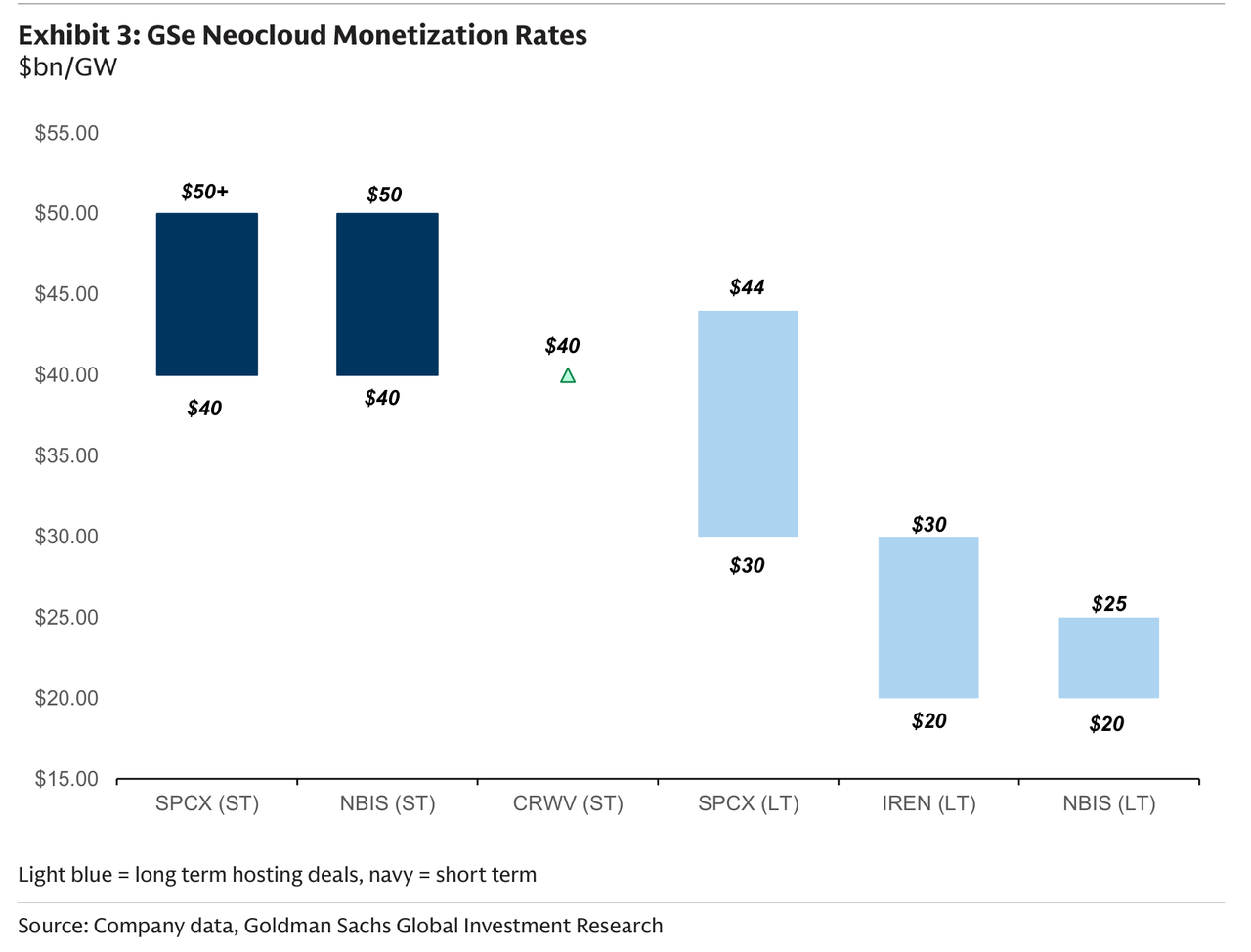
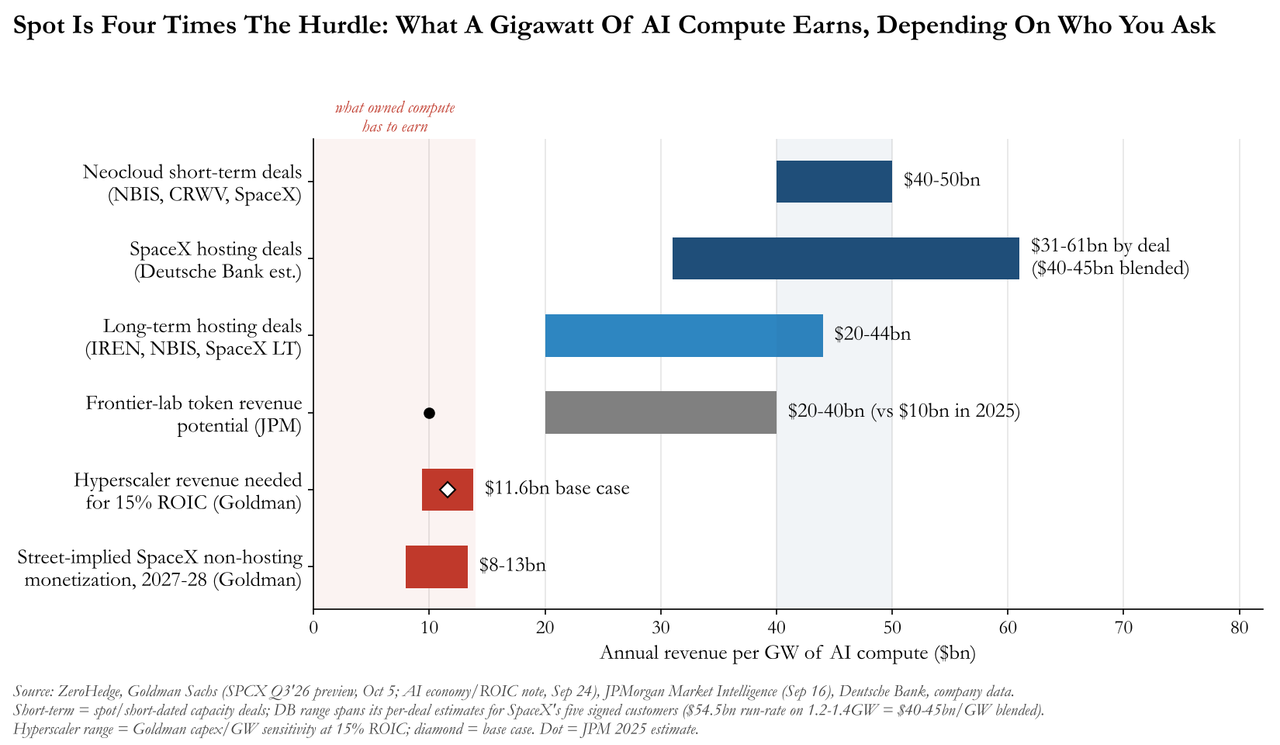
Thanks to a chart buried on page 7 of Goldman's latest SpaceX note, we now have an answer, or rather three of them: $40-50 billion a year if you rent it out short-term, $20-30 billion if you rent it out long-term, and roughly $12 billion if you're a hyperscaler who simply needs to earn a decent return on it. The gap between those numbers is where the entire debate over AI revenues, and the $1+ trillion a year of capex now chasing them, really lives.
Here is the chart in question, from Goldman internet analyst Eric Sheridan's Q3 preview of SpaceX (SPCX) published on Monday (available to pro subs):
Source: GoldmanThe navy bars are short-term capacity deals, the light blue ones are long-term hosting contracts. And the message is unambiguous: right now, compute is so scarce that whoever owns a powered, GPU-filled data hall can name their price... as long as the buyer only has to commit for a few months.
Regular readers know we have been warning since last October that the AI buildout runs on debt, and more recently that it runs on revenue numbers nobody can quite pin down. Below we walk through what the neocloud rate card tells us about the economics of AI compute, why it can't be extrapolated to the rest of the buildout, and where the tension between neocloud revenue, hyperscaler revenue and actual end-user revenue lies.
The Rate Card: Spot $50, Term $20Start with what Goldman actually found. SpaceX, which now houses xAI's Colossus compute, announced two more hosting deals in the past quarter (one on its Q2 call, one at Goldman's own Communacopia conference in September), and told investors they are "monetized at the high end of the ~$30-50bn/GW range" it has historically discussed. And SpaceX is not alone:
Nebius (NBIS...) disclosed in August that short-term capacity deals in Q3 are being priced at ~$40-50bn/GW while CoreWeave (CRWV...) disclosed similar ~$40bn/GW pricing for its recent short-term capacity deals... Longer-term capacity deals across the industry continue to vary by company but pointing to ~$20bn/GW as a sustainable pricing floor at current rates. IREN (IREN...) disclosed in August that recent 3-year contracts are being priced at >$20bn/GW with active discussions at ~$25bn/GW, while NBIS disclosed longer-term deals being priced at similar ~$20-25bn/GW rates.
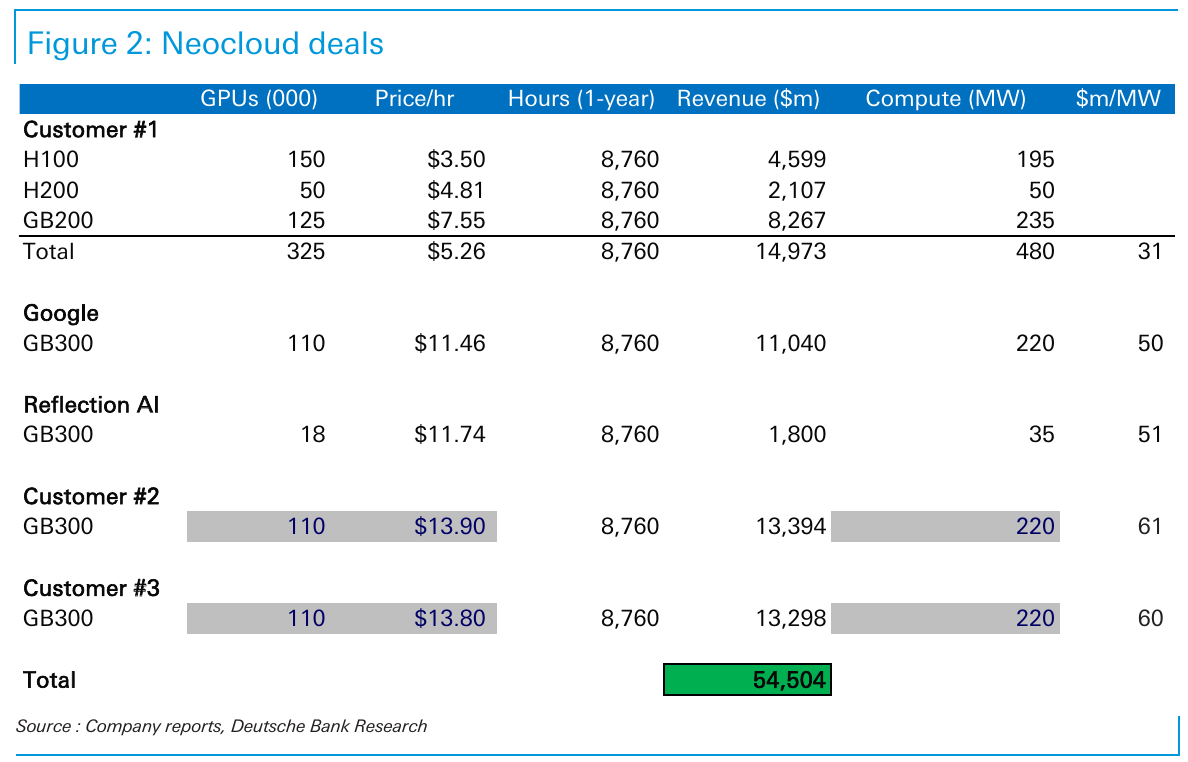
Deutsche Bank's Edison Yu goes even further. In his "Got compute?" note (also available to pro subs), Yu backs out the GPU-hour pricing of each SpaceX deal and gets $50-51 million per MW for Google and Reflection AI, and $60-61 million per MW for the two undisclosed customers, i.e., as much as $61 billion per gigawatt, renting out GB300s at nearly $14 an hour:
Source: Deutsche BankPut differently, the term structure of AI compute is steeply inverted: buyers pay roughly double for the privilege of not committing. That is what a market looks like when demand is real but nobody (including the buyers) is willing to bet on it lasting. Physical commodity traders will recognize the shape: it's backwardation, and it usually means the shortage is priced as temporary.
It also explains why the neocloud model is so attractive to its owners. Goldman's hyperscaler work puts all-in capex at roughly $42 billion per GW (more on that below). At $40-50 billion a year of revenue, a neocloud recoups the entire build in about one year of rent; at the $20 billion long-term floor, it takes two. Which is why the next detail matters so much:
One caveat to highlight is the duration risk of these hosting deals - with most of these deals being 90-day cancellable on both sides, there is some risk that our assumption for revenues to be recognized at current rates through contract expiry (2029 in most cases) is overly-bullish.
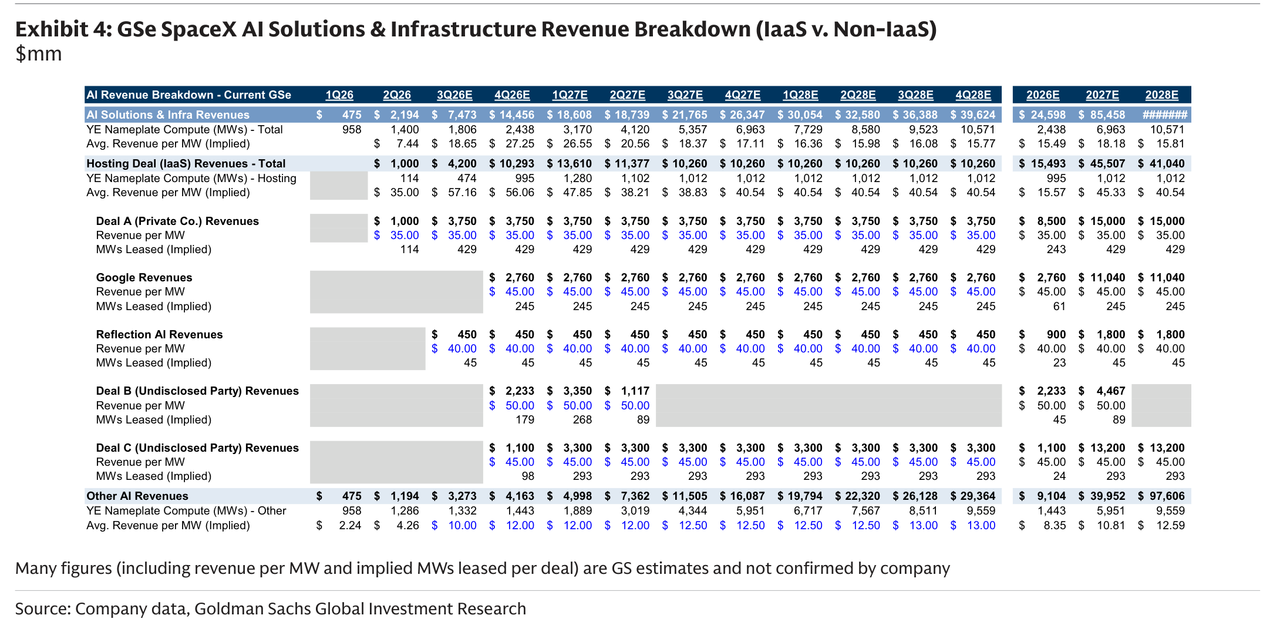
Translation: the $50 billion-a-gigawatt revenue stream that SpaceX is trying to borrow $40 billion against is, contractually, a quarterly lease. We made the same point when SpaceX went looking for a record $40 billion in chip-collateralized SPV debt last week; Goldman has now put a number on it. In its model, hosting/IaaS revenue goes from $1 billion in 2Q26 to more than $10 billion a quarter by 4Q26, and $45.5 billion in 2027 on just ~1GW of capacity, at an implied $35-57 billion per GW:
Source: Deutsche Bank Here Is The Problem: Spot Is Four Times The HurdleNow compare that rate card to what the rest of the AI economy needs to earn.
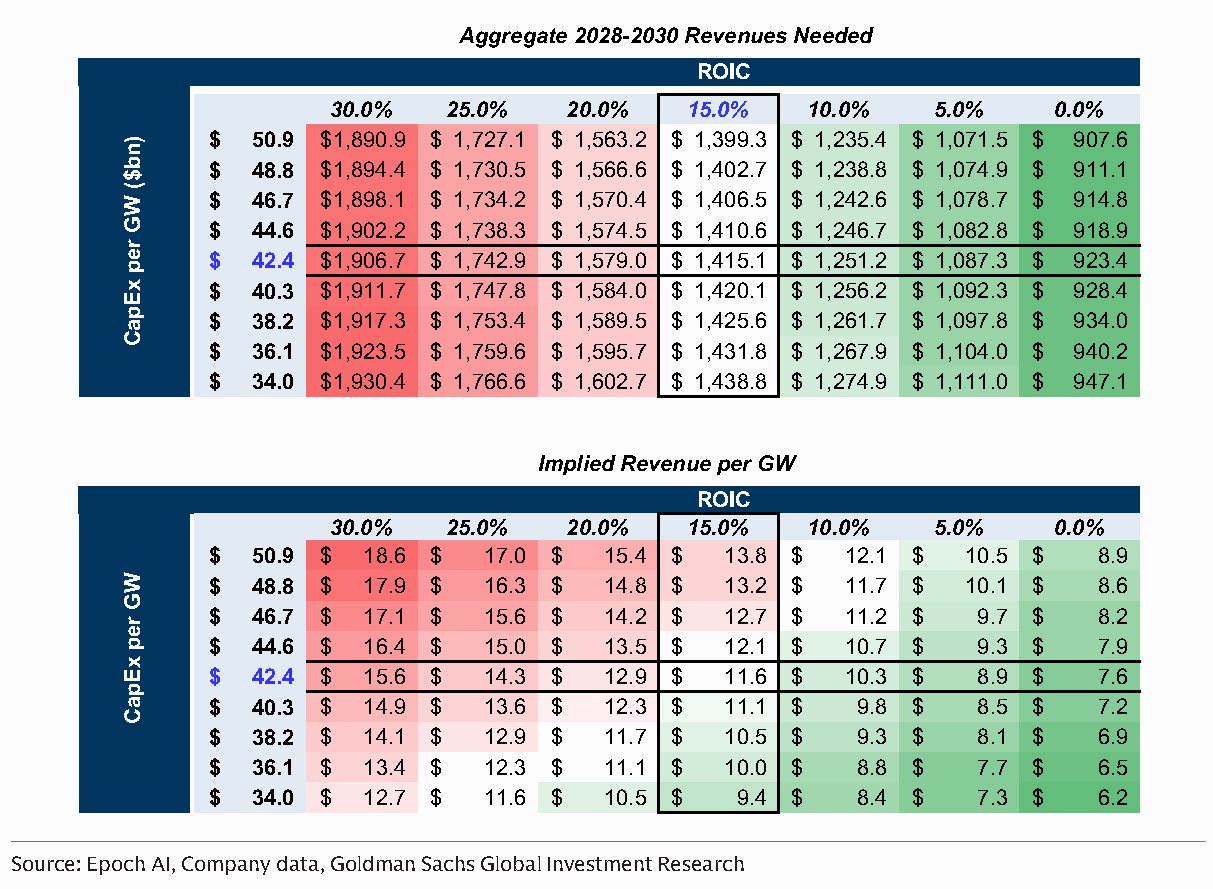
Last month Goldman's tech analysts tried to size the AI economy needed to justify hyperscaler capex, and concluded that the six big US hyperscalers (Alphabet, Amazon, Microsoft, Meta, Oracle and SpaceX) need roughly $1.42 trillion of cumulative AI revenue in 2028-30, or about $11.6 billion per GW per year, to earn a 15% ROIC on their 2026-27 AI compute spend. Here is the sensitivity grid (from "Sizing the AI Economy Needed to Justify ROIC on Hyperscaler AI Capex", available to pro subs):
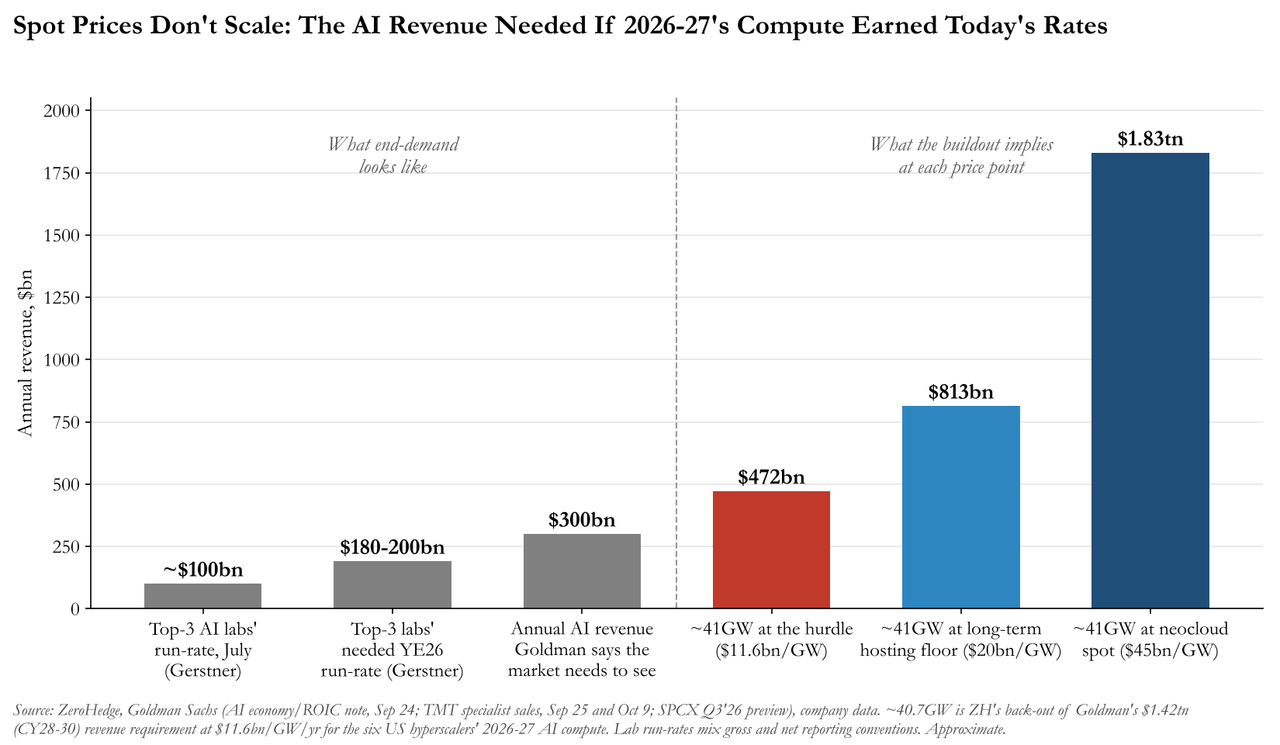
Even at a 30% ROIC and the most expensive capex assumption, the number never gets above $18.6 billion per GW. Short-term neocloud rents are 2-4x that. Our chart below puts every estimate we could find on one axis:
Two things jump out.
First, hyperscalers are paying neoclouds 4x what their own compute has to earn. Goldman models Google's SpaceX deal at $45 billion per GW (Deutsche says $50 billion). That same Google, per Goldman's ROIC framework, needs just ~$12 billion a GW from its own data centers. Nobody rationally pays a 4x premium for a commodity unless they can't get it any other way, so this is not a sign of healthy demand so much as a sign of power and shell scarcity: Google is renting because it can't build fast enough. Remember that the next time a hyperscaler raises its capex guide (undoubtedly much higher). The moment self-built capacity catches up, the premium on rented capacity goes away, and so does a big chunk of neocloud revenue, which incidentally is a point we made two weeks ago.
The more data centers are lit, the faster this bubble pops
— zerohedge (@zerohedge) September 25, 2026
Second, even the bulls' token economics can't pay spot rents. JPMorgan's Gokul Hariharan, in a framework for the next leg of AI infrastructure after what the bank's International Market Intelligence desk called a "biblical de-rating" (available to pro subs), was about as constructive as it gets:
Frontier-model vendors generate 60–80% inference gross margins and could earn $20–40bn of annual revenue per GW from AI tokens (vs $10bn in 2025).
Do the napkin math. If compute is 20-40% of a lab's token revenue (i.e., a 60-80% gross margin), then a lab paying $45 billion a year to rent a gigawatt would need to sell roughly $110-225 billion of tokens off it, or three to eleven times JPM's own optimistic range. In other words, nobody is renting spot capacity at $45 billion a gigawatt to serve paying customers at a profit. They're renting it to train the next model, funded by the next round of equity or debt.... well, mostly debt.
SourceWhich is exactly the point Rothschild Redburn's Alexander Haissl made when he slapped Sell ratings on CoreWeave and Nebius last month: compute pricing is rising, but who pays matters, and the top-paying customers are mostly VC-funded startups and big tech companies using compute for training rather than inference. In his words, "training demand can persist as long as external capital remains available." Which, yes, is another point we made two weeks ago.
How many of those customers are funded by VCs who are also investors in Anthropic
— zerohedge (@zerohedge) September 23, 2026
Goldman's TMT desk is now flagging Oracle and Broadcom credit spreads as the key indicator of concern over debt-funded AI capex, with Oracle 5Y CDS closing at a record 261bp on Thursday.
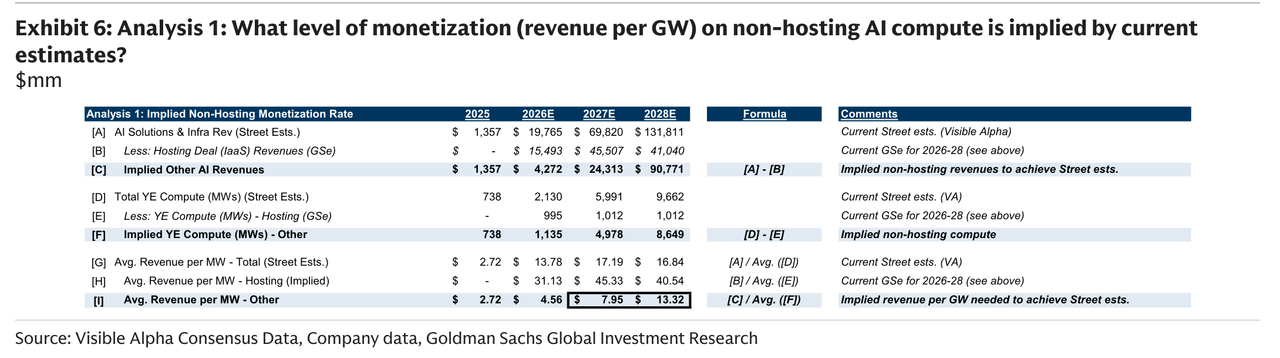
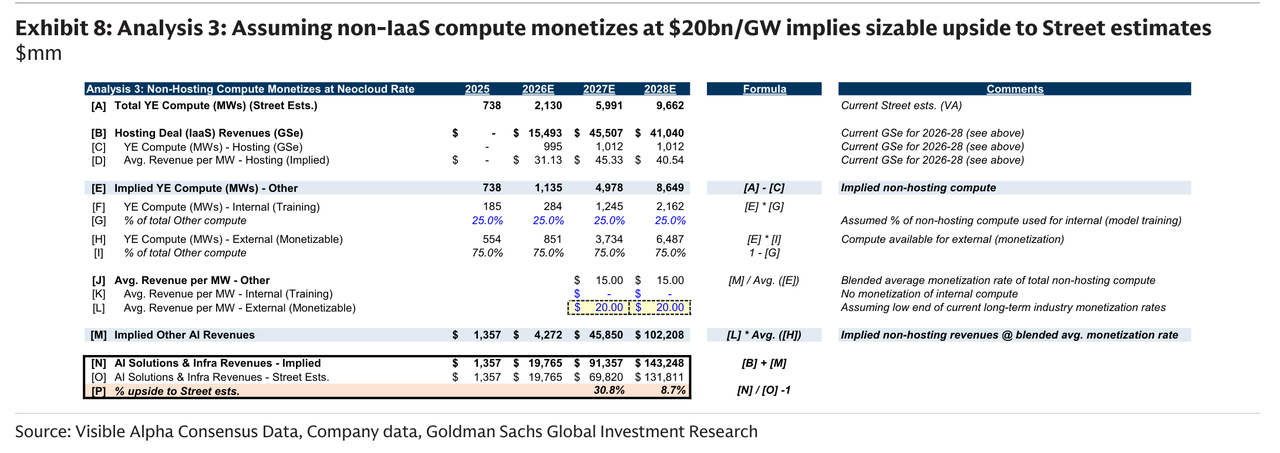
Only Compute You Rent Out Earns Neocloud RatesThe cleanest illustration of the gap is inside Goldman's own SpaceX model. The ~1GW rented to third parties earns $40.5 billion per GW. Everything SpaceX keeps for itself ("Other AI revenues": Grok, X, enterprise, the Cursor acquisition) is modeled at $12-13 billion per GW, almost exactly the hyperscaler hurdle. And the Street is even lower: back out the hosting deals from Visible Alpha consensus and SpaceX's own compute is implicitly monetized at ~$8 billion per GW in 2027 and ~$13 billion in 2028:
Goldman's bull case is that this is "significantly lower than current industry rates" and that if SpaceX can monetize 75% of its non-hosting compute at the $20 billion long-term floor (leaving 25% for training at zero revenue), AI revenue would come in ~31% above Street for 2027 and ~9% above for 2028:
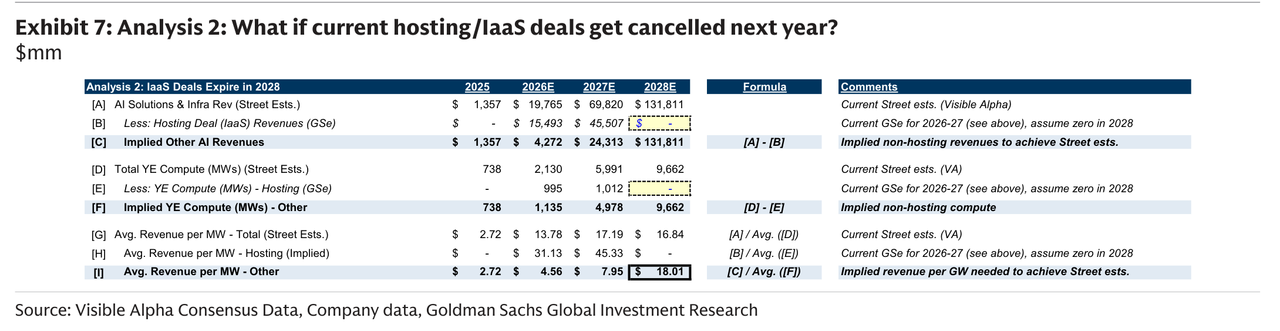
What if the 90-day leases do get cancelled? Then, Goldman says, SpaceX would need to earn ~$18 billion per GW on reallocated compute in 2028 to hit consensus, "a reasonable, if not conservative, level of monetization compared to current industry rates":
Maybe. But note what "current industry rates" means here: the price of renting compute to someone else at a moment of acute shortage. The bull case quietly assumes that compute used in-house (or rented to whoever replaces today's tenants) will earn what scarce compute earns today. The Street, which models $8-13 billion, is pricing the opposite: that once the shortage ends, a gigawatt earns roughly what a hyperscaler needs it to earn, and not a penny more.
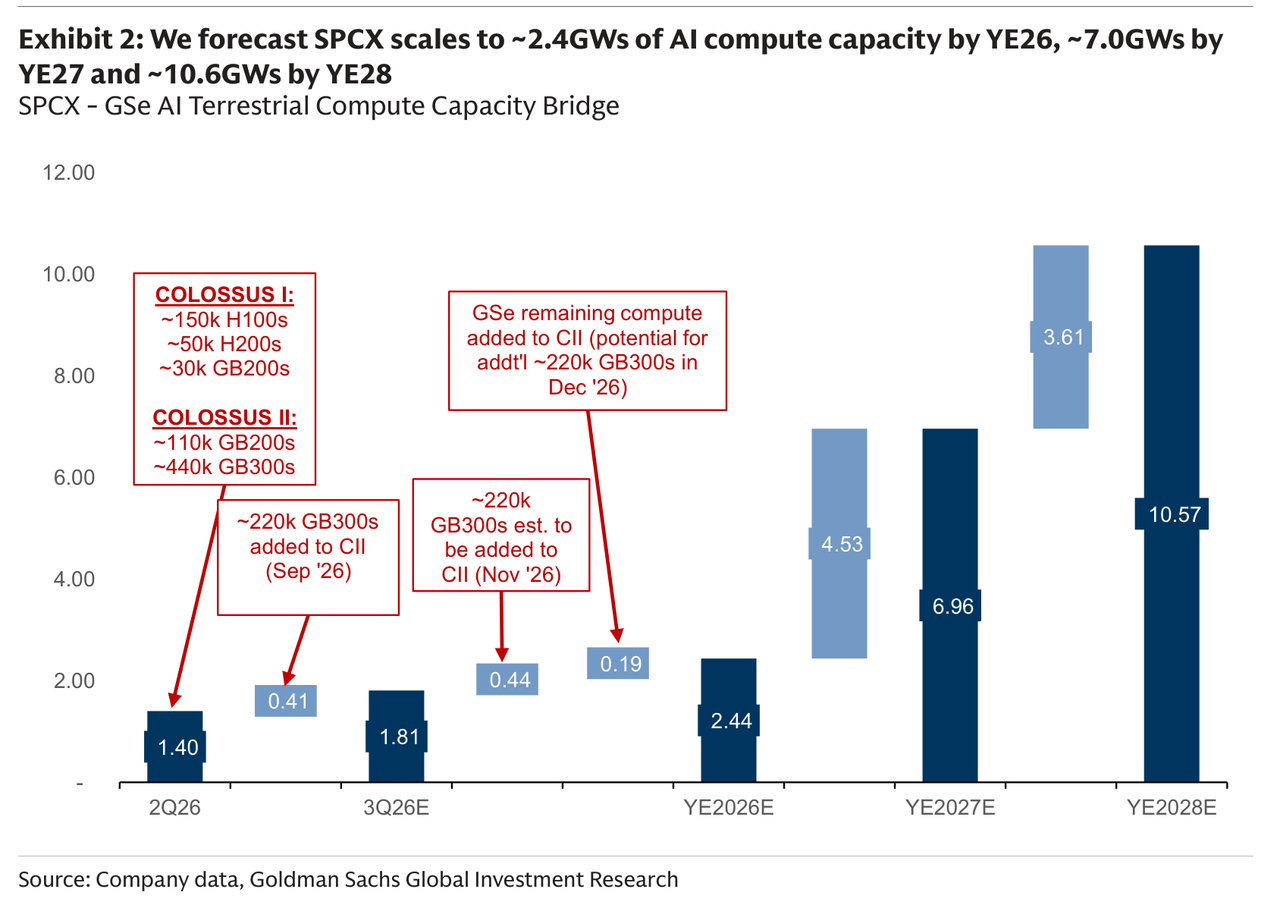
Oh, and there will be a lot more gigawatts. Goldman sees SpaceX alone going from 1.4GW in 2Q26 to ~7GW by end-2027 and ~10.6GW by end-2028:
Neocloud Revenue Is Somebody Else's CostWhich brings us to the real tension between neocloud revenue, hyperscaler revenue and AI "industry" revenue: they are largely the same dollar, counted several times.
Follow a single dollar of end-user spend.
Add up "AI revenue" across the stack and you get a number several times larger than what end users actually paid, and every layer above the end user is someone else's cost.
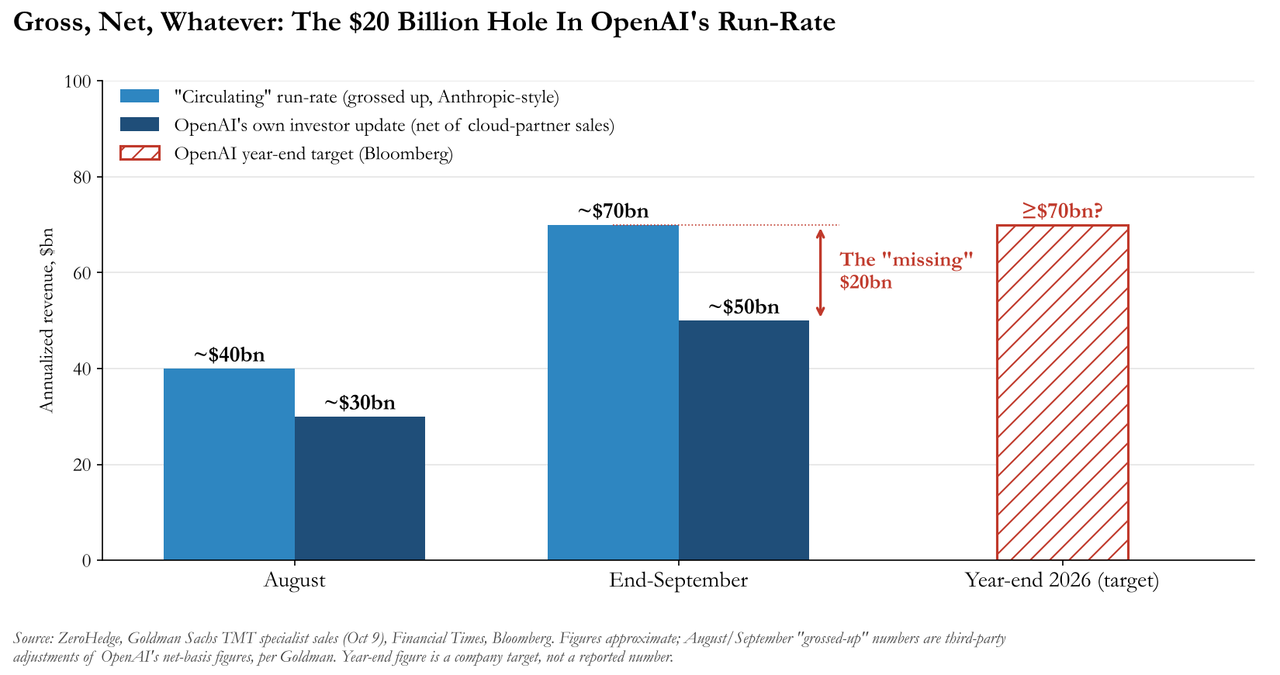
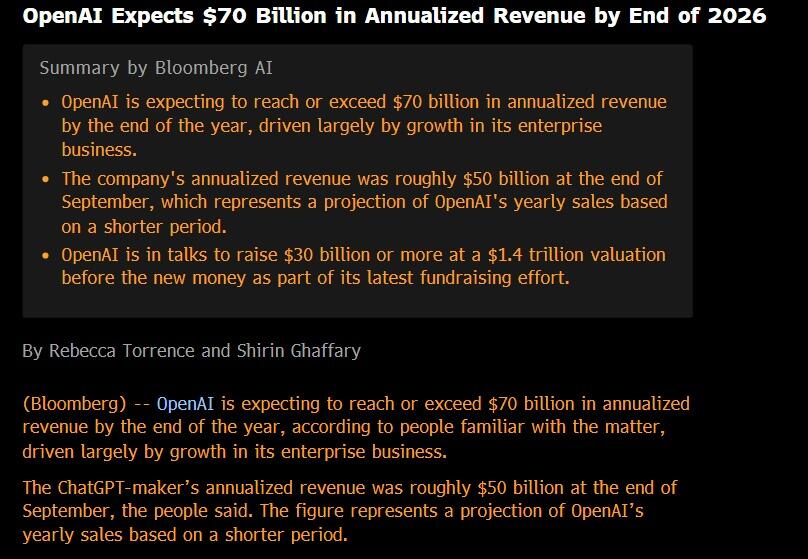
That's not a hypothetical. Just this week, AI equities puked after the FT reported that OpenAI's annualized revenue was ~$50 billion at end-September, $20 billion below the ~$70 billion MRR number circulating. As Goldman's TMT specialist Sean Johnstone explained (available to pro subs), the gap came from gross vs net reporting:
Anthropic reports closer to gross revenue (full customer spend through cloud partners, partner cut booked as a cost). OpenAI has reported closer to net (mainly its own share). When some investors tried to put the two on a like-for-like basis by grossing up OpenAI's figures, they produced the higher ~$40bn (August) and then ~$70bn numbers... The episode highlights how sensitive the complex has become to the precise trajectory of two private companies that use different reporting conventions.
And then Bloomberg added that even the $50 billion was gamed exercise in reaching the highest possible annualized number, i.e., "a projection of OpenAI's yearly sales based on a shorter period":
The same desk also reminded clients of Brad Gerstner's mid-September framework: the top three labs (Anthropic, OpenAI, SpaceX/xAI) were at a combined ~$100 billion run-rate in July and needed to reach $180-200 billion by year-end "to keep the AI trade intact." And as Johnstone notes, even that framework mixed Anthropic on gross, OpenAI on net and SpaceX on a "closer to gross" basis "for its compute hosting contracts." In other words, part of the "lab revenue" that is supposed to pay for compute is itself compute revenue. Diversification at its finest.
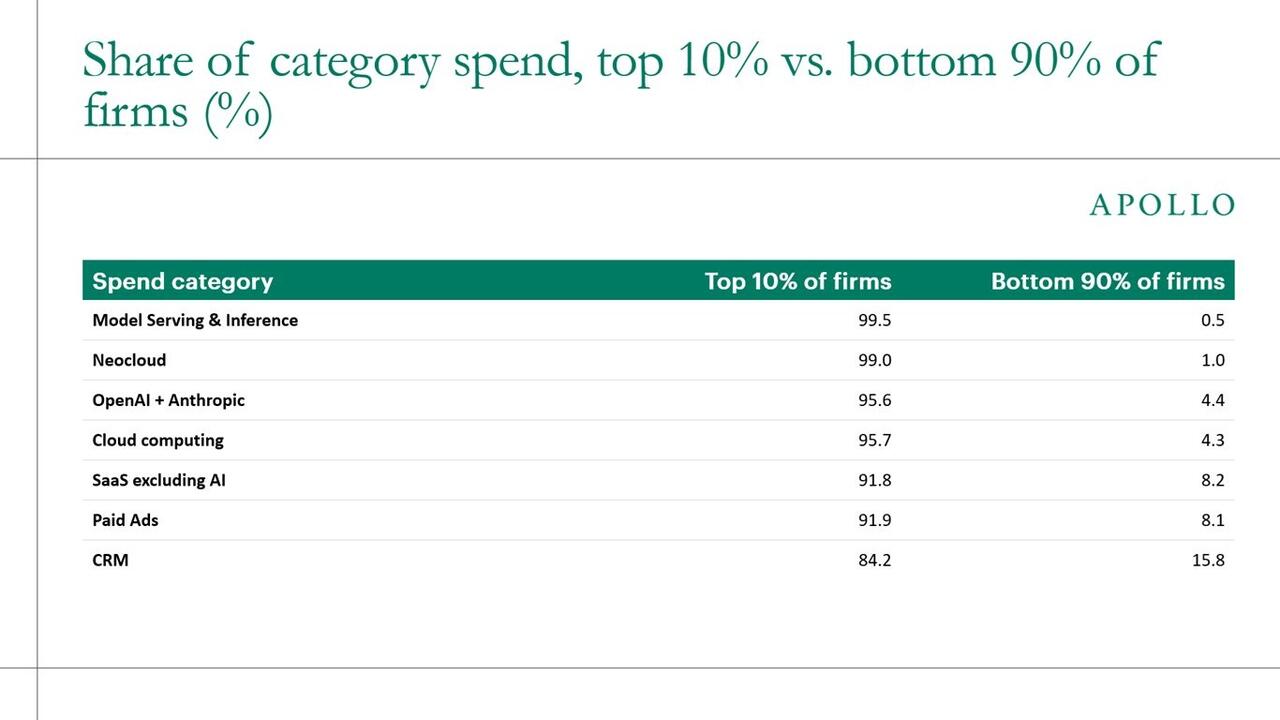
The buyer base is also absurdly narrow. As we tweeted two weeks ago:
The top 10% of AI customers account for 99.5% of model-serving spend and 99% of neocloud spend, leaving the bottom 90% of firms with 0.5% and 1%: Apollo https://t.co/npmKbOV75r
— zerohedge (@zerohedge) September 28, 2026
Put that next to Goldman's 90-day cancellation clauses and the picture is clear: neocloud revenue rests on a handful of customers, most of them cash-burning labs and capacity-starved hyperscalers, renting on paper they can walk away from in a quarter.
Spot Prices Don't ScaleFinally, the math that ties it together. Back out Goldman's $1.42 trillion revenue requirement at $11.6 billion per GW per year and you get roughly 41GW of AI compute that the six US hyperscalers are building with their 2026-27 capex (our approximation). Now price those 41GW at each point on the rate card:
Compare that with the ~$100 billion the top three labs were running at in July, the $180-200 billion Gerstner says they need by year-end, and the ~$300 billion of annual AI revenue Goldman's Portfolio Strategy team says the market "now needs evidence of" to support the current scale of investment:
Put differently, today's neocloud rates are a marginal price for scarce capacity, not an average price the whole buildout can earn. Even the hurdle rate requires end-demand to grow roughly 2.5x from Gerstner's year-end target, and that is before anyone pays a neocloud a dime of scarcity premium (or takes into account that an entire country named China exists with an entirely separate, and much, much cheaper AI ecosystem). Which is also why Goldman's TMT desk, summing up the bank's capex research, concluded with admirable understatement that "future returns should increasingly come from selective winners... rather than owning anything linked to AI capex."
Bottom LineGoldman's Sheridan remains a buyer of SpaceX with a $230 price target, and argues that the "supply constraints and lack of available capacity putting upward pressure on spot rates" give him confidence SpaceX can monetize compute "at high ROICs even if these deals are canceled."
He may be right about SpaceX, which has the power, the shells and the Nvidia relationship. But for the AI complex as a whole, the rate card says something less flattering. Short-term rents of $40-50 billion per GW are a scarcity premium paid mostly for training, mostly by capital-funded buyers, on 90-day paper. The long-term market already prices compute at half that, the hyperscalers need a quarter of it, and the Street is pricing in-house compute at the hurdle. With capacity set to multiply (SpaceX alone more than 4x from year-end levels by 2028), the scarcity premium is the thing least likely to survive, and as it compresses, the neocloud revenue that props up hosting deals, chip-backed SPVs and lab "run-rates" compresses with it.
In compute (as in shipping, and everything else), nothing cures record rates like record rates. The term curve is already telling you where AI compute is headed; the only question is whether end-user revenue gets there first... or (more likely) the credit market, where chip-collateralized obligations are priced as if spot were forever, figures it out on its own.
Much more in the full Goldman SpaceX Q3'26 preview and "Sizing the AI Economy Needed to Justify ROIC on Hyperscaler AI Capex" notes, as well as Deutsche Bank's "Got compute?", all available to pro subs.
Tyler Durden Sat, 10/10/2026 - 16:55
Authored by Nicholas Zifcak via The Epoch Times,
President Donald Trump on Friday threatened to withhold billions in federal funding from New York City unless the city updates a map of immigrant communities to include Little Italy.
In 2023, the city created a map, "New York City Immigrant Enclaves," that maps ethnic communities across the city, such as Chinatown in Lower Manhattan, Little India and Little Manila in Queens, and Little Palestine in Bay Ridge, Brooklyn. However, the map omits Little Italy as well as ethnic neighborhoods of Irish and Jewish communities.
Speaking at a Columbus Day celebration at the White House, Trump threatened to cut billions in city funding. "So you have Yemen covered, Haiti covered, Guyana covered, Senegal covered. I think it's a disgrace. We are going to work on that immediately," said the president.
The city budget relies on federal funding, with as much as $8 billion in the city's 2025 fiscal year budget coming from federal sources - most of that going toward education and social services. Federal grants also support counter-terrorism funding for NYPD bomb squads and emergency preparedness teams.
In October, 26,500 New Yorkers lost federal SNAP benefits for food assistance under expanded work requirements set up by the Trump administration. Starting in January 2027, possibly 900,000 New York City residents relying on Medicaid may lose health coverage when new federal work requirements take effect. This federal aid goes to individuals, not the city, but the city and state are scrambling to compensate lower-income New Yorkers for these lost benefits.
The 2023 immigrant enclave map resurfaced on social media back in July, and the City Council's Italian Caucus released a statement on X that it was deeply disappointed with the city for omitting the contribution of Italian-Americans.
"Italians are not a footnote in New York City history - we helped build it," City Council's Italian Caucus said in a statement on X on July 10. All four members of the Italian Caucus are Republicans.
When asked about leaving out Little Italy, Mayor Zohran Mamdani said the map predates his administration, but that it would be updated in the future to include Little Italy and others.
"It's clearly not an exhaustive list of the more than 200 ethnic enclaves," Mamdani said July 11.
Trump Commemorates ColumbusIn his speech, Trump said Columbus "undertook one of the boldest voyages in the history of our planet" when he set sail in 1492 westward with the goal of reaching Asia but instead landed in the New World.
Trump said that critics of Columbus want to abolish Columbus Day.
"They want to tear down the history and heritage that makes us who we are," the president said.
Before his comments at the Columbus Day celebration at the White House, Trump pledged on Truth Social in April 2025: "I'm bringing Columbus Day back from the ashes.
"The Democrats did everything possible to destroy Christopher Columbus, his reputation, and all of the Italians that love him so much."
During President Joe Biden's term, the federal holiday was known as both Columbus Day and Indigenous Peoples' Day. Biden issued the first-ever presidential proclamation recognizing Indigenous Peoples' Day, which has its roots in 1970s activism.
Activists wanted to shift the focus from commemorating Columbus's 1492 voyage to the Americas to the negative impact of colonization on the indigenous people on the continent.
At the celebration, Trump also gave a shoutout to notable Italian Americans including Yankees icon Joe DiMaggio, legendary singer Frank Sinatra, former Supreme Court Justice Antonin Scalia, former New York City Mayors Fiorello La Guardia and Rudy Giuliani, and Supreme Court Justice Samuel Alito.
Tyler Durden Sat, 10/10/2026 - 16:20
Authored by Mark Harmsworth via the Foundation for Economic Education (FEE)
This week the Seattle City Council passed Mayor Katie Wilson's "Fair Pricing and Transparency" ordinance in a 7-2 vote, a first-in-the-nation ban on so-called surveillance pricing.
The ordinance takes effect in 2027. The Washington Retail Association warned for months that the bill was rushed, would have significant and negative impact on prices, and that nearly all suggested fixes were ignored.
As approved, retailers must decide whether they can keep offering the tailored discounts and loyalty programs that Seattle families actually use or cancel all the programs and charge more for groceries.
Government should not be price-fixing consumer products.
Banning the use of loyalty cards and programs, fuel rewards, and targeted coupons hurts businesses and consumers alike.
Price controls do not make groceries cheaper. They flatten the tools stores use to compete for customers. When discounts vanish, the shelf price becomes the only price. That is how an "affordability" law raises a customer's grocery bill. A Greater Seattle Business Association and Seattle Latino Metropolitan Chamber guest column put it plainly: trying to control prices through experimental regulation has never worked, and this ordinance will make an already expensive city more unaffordable.
Jan Himebaugh of the Washington Retail Association offered a household example, nearly $1,000 in grocer loyalty savings this year for her family, the equivalent of more than 185 gallons of gas in a state where fuel is among the nation's most expensive. Those are not corporate talking points. They are the coupons that keep a cart full.
Thin-margin stores close. When they close, the result is the very "food deserts" Mayor Wilson has spent a campaign and a mayoralty promising to fight. Wilson has said Seattle will not accept food deserts as the cost of doing business, but the "Fair Pricing" policy creates a retail environment that does exactly the opposite.
A pricing ordinance that chases discounts out of the city works against that goal. You cannot subsidize corner markets on Sunday and make their discount model legally hazardous on Tuesday.
If Wilson wants more grocery access, the path is not to micromanage how a retailer prices a gallon of milk. It is to stop piling first-in-the-nation experiments onto businesses already carrying Seattle's tax and regulatory load.
Personalized discounts are not surveillance. They are how competitive stores keep prices down and stay open. Kill those discounts, and the desert grows.
* * *
Tyler Durden Sat, 10/10/2026 - 15:10
On October 8, 2026, Vice President JD Vance and Labor Secretary Keith Sonderling announced that the Department of Labor will not accept any new PERM applications (Permanent Labor Certification) or process any pending applications involving a list of prominent tech firms. The action is being enforced amid ongoing federal investigations into alleged abuse of employment-based immigration programs.
This decision elicited outrage from a myriad of Democrats, but the group most flustered by the situation is undoubtedly Indian migrant workers and representatives. India is by far the greatest beneficiary of America's H-1B migrant worker program, and it's not even close.
Over the past ten years alone, over 8.7 million H-1B visas have been given to Indian nationals. Roughly 70% of all H-1B approvals every year go to Indians.
8.7 million non-immigrant visas were issued to Indian nationals from March 2017 to Feb 2026. A non-immigrant visa is temporary permission to come to America for a limited time- to work, study, or visit - and then return home. 8,704,481 of those visas were issued, according to the State Department. How many do you think actually returned home?
— The Visa Files (@visafile) October 7, 2026
There are a number of reasons why this level of targeted immigration is a problem. The first reason is that these visas are often exploited as a stepping stone to gain a green card and permanent residency in the US.
H-1B visas are supposed to last for only a few years at most, but migrant workers can remain in the US for far longer. This is done through the PERM certification process, which allows employers to sponsor migrant workers for a green card, which can then be used to gain full citizenship after a few years. Trump's suspension of PERM extends to a number of major tech firms including: Microsoft, Adobe, and Capgemini, along with Indian companies like Tata Consultancy Services (TCS), Infosys, Wipro, HCLTech, and Cognizant.
The tech industry has been used as a pipeline for third world immigration for decades - Corporations have systematically eliminated hundreds of thousands of American jobs in favor of migrant workers because these workers take 17% to 40% less pay to fill certain rolls.
For example, Vice President JD Cance cites an ongoing investigation into Microsoft. He says that the company is suspected of firing over 6000 American tech workers, then used the visa machine to import over 6300 H-1B recipients along with helping 3000 others receive green cards. The vast majority of these workers are from India.
JD Vance is TORCHING Microsoft for abusing the H1B visa program: "Last year, Microsoft laid off 6,000 American workers. At the same time, the company benefited from 6,300 H1B visas. You cannot lay off American workers and then replace them with foreign indentured servants." https://t.co/3lWAtIb68m
— TheBlaze (@theblaze) October 8, 2026
India’s foreign ministry pushed back on the announcement. They said the U.S. action “does not advance the shared ambitions of both countries.” They specifically called Vance’s description of foreign workers as “indentured servants” unwarranted and "deeply offensive."
Politicians in the US with an Indian background were also angered by the block of PERM, perhaps because these representatives have a habit of using their positions to also barter H-1B and green card access for their compatriots.
Statement on Trump Suspending Microsoft from the PERM Program: This is a crucial issue for me as the top Democrat on the Immigration Subcommittee, the only member of Congress to have actually had an H-1B visa, and the Representative for tens of thousands of Microsoft workers. The administration has been consistently working to take away legal pathways for immigrants to contribute their talents to our country, and this is yet another of those attacks. The PERM program is the first step toward an employment-based green card for countless workers who want to contribute to this country, and it lays out a clear process with steps to ensure that this is a net benefit to our economy and does not harm American jobs. Our economy, our communities, and our families depend on immigrants in many sectors, including the tech sector, and heavy-handed attacks like this only hurt efforts to build a strong, stable, and diverse base of workers who have legal pathways to come and be in the United States while also protecting U.S. workers from unscrupulous employers. You don’t fix a broken immigration system by taking a hammer to legal immigration. Microsoft has been a leader in advocating for comprehensive immigration reforms that modernize an antiquated immigration system and provide more — not fewer — legal pathways for immigrants from all over the world to work here and be with their families. Targeting Microsoft or the PERM program in this way simply undermines legal immigration and weakens America’s ability to innovate.
— Rep. Pramila Jayapal (@RepJayapal) October 8, 2026
The panic on social media was palpable, with Indian accounts raging over the potential loss of US economic access. Their primary argument? That the US tech industry is dead in the water without them because the US doesn't have enough "brilliant" tech engineers to fill the necessary job roles. They claim that their "service" to the US economy earns them the right to permanent residency, but that's not how these things work.
These people agree to get paid to do a job, they are not entitled to citizenship just because they are willing to work for less. And let's consider their logic for a moment: If Indian tech workers are so highly skilled and bring so much value, why isn't India one of the most technologically advanced countries in the world? Why don't these workers bring any added value to their own economy? Why is India 150th in the world per capita?
Probably because the "high IQ" Indian tech worker narrative is a scam.
Their only value on the global market is their willingness to work for low wages. But why do Indians work for so much less? It's important to understand that US companies are offering a commodity on top of the otherwise low pay - And that commodity is permanent US residency. These companies are essentially selling access to US citizenship in exchange for cheap labor.
It's quite the deal for tech firms if you think about it. They get thousands of cheap laborers, and they get to use a commodity that requires minimal cost. Microsoft might pay around $4000 on average in attorney's fees to apply for a migrant worker to get PERM status, but they save tens-of-thousands on every migrant worker salary. The people who suffer most are American workers who get replaced.
Indian tech workers make a yearly salary of around $12,000 to $20,000 in their home country. A job in the US makes them significantly more, even with the pay cut. This money is often wired from the US back to India where US dollars have far greater buying power than the Rupee. Access to the US economy is a gold mine for third world migrants.
India's economy also benefits indirectly from H-1B immigration. India is the largest beneficiary of remittances in the world. The country received approximately $40 billion in cash transfers from the US every year, which is larger than the majority of India's budget for subsidized programs like welfare. It is 7% of the government's entire annual budget. That's massive.
So, it makes sense why there is a complex fraud network on both sides of the ocean to make Indian immigration happen. Indian workers are notorious for using fake degrees to get H-1B approval, but many US companies look the other way because they want the low wage labor. The Indian government backs the fraud because they get billions of dollars in cash flow into their economy on the back end. And the migrants happily participate because they get a much higher chance of gaining US citizenship, which is one of the most valuable commodities in the world.
It's one of the biggest economic rackets on the globe. It's also a key vehicle for the multicultural invasion of the US. There is no benefit to the American people to import millions of third world migrants, and it's about time that someone did something to stop the chain of abuse.
Tyler Durden Sat, 10/10/2026 - 14:35
Authored by Jonathan Turley via JonathanTurley.org,
A White Baltimore arts executive was recently fired in September from the Baltimore Rock Opera Society. The reason was not that Kelly Carnes was chronically absent or failed to perform her duties as the new executive director. Rather, it was the hairstyle that she briefly adopted on vacation. You see, Carnes is white, and co-workers were apparently triggered by her getting cornrows while attending the Burning Man festival.
It was not deemed a fun hairstyle choice adopted on a vacation but rather a despicable case of cultural appropriation that warranted her termination.
Carnes was hired on Sept. 8 and was heralded for her more than 21 years of experience in arts leadership, nonprofit strategy, communications, fundraising, and operations.
She said that she adopted cornrows as a 'protective style' while attending Burning Man.
We have previously discussed cultural appropriation controversies where people were triggered by cornrows, dreadlocks (and here), food (and here), costumes, big hoop earrings, yoga (and here), songs, opera, or dance styles. Businesses and universities have yielded to these attacks, curtailing a wide array of different forms of free expression in the name of cultural tolerance.
Activists have even targeted artist Bo Derek for wearing cornrows in her Movie "10." These critics ignore that many hairstyles, like music and dance styles, began with particular cultural groups before becoming popular with general populations.
The Baltimore Rock Opera publicly stated that it knew its new executive director was spotted with cornrows and that it would immediately conduct a full investigation.
The Opera has now triggered a possible hair-raising case in which Carnes could allege racial discrimination. It would also make a novel and potentially important free speech case.
At issue may be Maryland's CROWN Act, which protects minority employees from discrimination based on traits associated with race, such as hair texture, afro hairstyles, and protective hairstyles. The law must apply equally to all races, including hairstyles adopted by Caucasian employees.
Under the state's discrimination laws, cornrows are clearly not a matter that would "reasonably preclude the performance of the employment." It is an objection to the appearance of employees based on racial bias or intolerance.
In my view, this is clearly racial discrimination as well as an abridgment of free expression. This is even clearer after Maryland enacted the CROWN Act, which defines race for anti-discrimination protections to include "traits associated with race," such as hair texture, Afro hairstyles, and protective hairstyles.
The fact that this was passed with reference to protect African American employees is not determinative. Carnes was fired because of her race and the adoption of a rule barring hairstyles on a racial basis.
Maryland said that it wanted to protect hairstyles. This may not be the litigant that they had in mind, but it is the same form of racial discrimination.
For the left, the Carnes case could be a discomforting moment of having to face racial discrimination done in the name of racial harmony or equity. At one point, the left relished hairstyle freedom as a form of free expression. That was captured in the popular musical Hair, which became a virtual national anthem for the left in the 1970s.
"Hair (hair, hair, hair, hair, hair, hair)
Grow it, show it
Long as I can grow it
My hairI want it long, straight, curly, fuzzy
Snaggy, shaggy, ratsy, matsy
Oily, greasy, fleecy
Shining, gleaming
Flaxen, waxenKnotted, polka-dotted
Twisted, beaded, braided
Powdered, flowered, and confettied
Bangled, tangled, spangled (and spaghettied!)."
While the Supreme Court has only addressed hair regulations a few times (often in the context of allowable hair regulations for military or prison settings), hairstyles are (in my view) a form of free expression.
A few lower courts have supported that view. In Breen v. Kahl, the Seventh Circuit found in 1969 that "The right to wear one's hair at any length or in any desired manner is an ingredient of a personal freedom protected by the United States Constitution." While the appellate court was equivocal on where this right rested between the First and Ninth Amendments, it concluded that "it clearly exists and applies to the states through the Due Process Clause of the Fourteenth Amendment."
There can also be religious-clause protections for hairstyles, though that is not the case here. However, there remains good-faith debate over the extent to which hairstyles are protected in comparison to free speech.
That is why this case is more likely to be resolved on the grounds of racial discrimination. Baltimore Rock Opera's firing of Carnes because of her race appears incontrovertible. If she were an African American, she would still be the executive director wearing cornrows. The Opera is telling employees that their hairstyles will be monitored on the basis of their race.
As Chief Justice John Roberts famously wrote, "It is a sordid business, this divvying us up by race." While he may have been thinking more about college admissions than hairstyles, it is still true that "The way to stop discriminating on the basis of race is to stop discriminating on the basis of race."
Carnes could make a lasting contribution to constitutional law by standing firm against this discriminatory action. Of course, it is not easy to suddenly find yourself the target of a woke mob. She no doubt feels, as observed in Richard III, that "My hair doth stand on end to hear [these] curses." However, we are all cursed if the mob is allowed to control how we appear in public.
Jonathan Turley is a law professor and the New York Times best-selling author of "Rage and the Republic: The Unfinished Story of the American Revolution."
Tyler Durden Sat, 10/10/2026 - 14:00
The fatigue is real. A 6-year-old first grader shoots his teacher with a 9mm he stole from his mother, lodging a bullet in the educator's chest near her heart and nearly killing her, and the media and authorities suddenly go quiet about the details of the crime. It's an easy guess as to who is responsible and why.
The details of this story could not be more predictable because it follows a common thread of behavior which has plagued American culture for far too long.
On January 6, 2023 at Richneck Elementary School in Newport News, Virginia, a 6-year-old first-grader (referred to in court as J.T.) shot his teacher, Abby Zwerner with a Taurus pistol he took from his mother. The boy pulled the gun from his hoodie pocket and fired one shot at Zwerner from roughly 10 feet away as she tried to reach for the weapon.
The bullet went through her left hand and lodged in her chest (near her heart; her lung collapsed). She then escorted the other students out of the room before passing out in the school office. No other students were injured. The gun jammed after a single shot and still contained seven rounds (The notoriously cheap quality control of Taurus actually saved lives this time).
The boy never faced charges.
To put the incident in context, it's important to remember that in 2023 the US was still in the midst of extreme race activism triggered by BLM and the political left. The mere act of telling the truth about certain crimes was considered untenable if those crimes involved minority suspects. Black Americans could do no wrong, and any suggestion that there might be a cultural problem was buried or dismissed as "bigotry."
Fast forward to this week, when a judge finally unsealed and released the body cam footage for the police response to the shooting. The behavior of the child involved should tell you everything you need to know. Now it makes perfect sense why this footage was kept away from the public for so long.
🚨 A 6-year-old shot his teacher. Richneck Elementary, Jan 6, 2023. Court unsealed Officer Brian Torrez's bodycam Oct 6, 2026. 🎥 The Virginian-Pilot / Daily Press https://t.co/TPphaycltx
— Patriot (@_Patriot1776Q_) October 7, 2026
“If you want a piece of me, come it all, bitch,” the child said to officers as they investigated the scene.
"I stole that [gun] from my mom.”
“I don’t care if you call backup...I don’t care if I go to jail.”
The child is a ghetto psychopath in the making, and there's a high probability that he will continue to commit such crimes well into the future. Where did a six-your-old learn how to act like this? It's another case of the single-mother household problem.
J.T.'s mother was charged with lying on a federal background-check form when buying the 9mm handgun and to possessing a firearm while being an unlawful user of marijuana. She was not charged with any responsibility for the shooting of the teacher.
The woman's attitude in interviews explains a lot about her son's mindset; she made excuses for the child and seemed to blame the teacher for the eventual shooting because the teacher imposed penalties for bad behavior in the classroom. Single-mother households in the black community are, essentially, criminal factories.
This is the mother of the 6-year-old boy that shot his teacher in the chest Everything makes perfect sense now https://t.co/YWYmnb9ve2
— End Wokeness (@EndWokeness) October 9, 2026
This event once again illustrates an ongoing and largely ignored cultural dysfunction within the black community; an unwillingness to point out and punish sociopathic behavior. A willingness to blithely excuse violence. And an attitude of scorn when it comes to education (the treatment of public schools as daycares rather than places of academic study).
By extension, American society enables this problem by refusing to bring the hammer down on minority criminal activity for fear of being accused of "racism". The liberal revolving door of prosecutions and prisons has created a large and ever present population of repeat offenders. This tiny percentage of the American public creates the fast majority of problems in society (black Americans are also only 13% of the population and 50% of all violent offenders) .
Around 90% of all state prisoners have a history of prior convictions, and many of them started when they were young.
The issue has only been addressed more openly in the past couple of years as public fatigue grows. When authorities finally stop caring about who they "offend" and start applying pattern recognition to enforcement, that's when the US will stop seeing violent crime on such a scale.
OCTOBER ONLY.$10 OFFYOUR NEXT ORDER.$30 min. Ends Oct 31. One per customer.GET MY $10 OFF →Signs you up for ZeroHedge Store emails. Can't be combined. Every order helps support ZeroHedge. Tyler Durden Sat, 10/10/2026 - 13:30
Authored by Chase Smith via The Epoch Times,
New Jersey Gov. Mikie Sherrill on Oct. 7 ordered daily checks of voter registrations processed through the state Motor Vehicle Commission after a review found about 1,090 additional registrations that were improperly handled.
Sherrill ordered the review after disclosing in July that a software error had registered about 6,600 people who said they were not U.S. citizens when they applied for driver's licenses and state IDs between June 2023 and June 2024.
She said fewer than 400 of them voted.
Sherrill, a Democrat, said in a statement that neither of the new problems involved noncitizens.
About 750 of the records came from the same error in a system run by IDEMIA, the agency's vendor, according to a press release from the governor's office.
Those people answered "no" when asked whether they were old enough to vote, but their registrations went through anyway, her office said.
Sherrill's administration said their birth dates showed they were old enough and that many appeared to have pressed the wrong button on the keypad.
Because they answered no, the registrations weren't legally valid, according to the administration.
About 380 of those people had no other registration and didn't vote, and their records are being deleted, according to the governor's office.
About 320 voted and had other potentially valid registrations, and their cases are going to county election officials, the governor's press release stated.
About 50 were registered only because of the error and voted. Their records are being deleted and also sent to the counties. The other 340 records came from voter sign-ups at agency events for people leaving prison, dating back to 2016, Sherrill's office added.
The administration said some people at those events wrongly said they were eligible while still serving a sentence for an indictable offense, New Jersey's equivalent of a felony.
County officials will review those records one by one.
Separately, about 60 people were found to be currently incarcerated, and their names were sent to the counties for routine removal.
Under the new process, the agency will compare registration records each day against what customers actually entered, including citizenship, age, and whether they chose to register.
Records that don't match will be staff-reviewed before going to election officials.
The agency is also adding a keypad question at re-entry events asking people to confirm they aren't currently incarcerated for an indictable offense, and offering registration questions in five languages.
Sherrill said she promised a thorough review so that no ineligible person stays on the rolls and every eligible voter is heard.
"In just two and a half months, we conducted this review and are taking sweeping action," she said.
She criticized President Donald Trump, saying he has complained about the issue for a decade without fixing it.
State Senate Republican Leader Anthony Bucco said in a statement that the updates are "creating more questions than answers."
He said the public still hasn't seen the report on the original 6,600 registrations, and that with Election Day less than a month away, voters deserve to see the analysis behind the administration's conclusions.
Every Senate Republican has signed on to a resolution that would create a special Senate committee to investigate.
Bucco and state Sen. Kristin Corrado also introduced a bill that would end automatic voter registration at the agency, require voter ID, and set biannual independent audits of the voter rolls.
Tyler Durden Sat, 10/10/2026 - 13:00
Authored by Matthew Vadum via The Epoch Times,
President Donald Trump asked the Supreme Court on Oct. 9 to revive his dismissed civil lawsuit against Hillary Clinton, the Democratic National Committee (DNC), and others.
The president alleges they conspired to create and spread a false story that his 2016 campaign colluded with Russia.
Lower courts rejected the case and ordered Trump and one of his attorneys, Alina Habba, to pay almost $1 million in sanctions. The trial judge and the appeals court called the lawsuit "frivolous," saying it had no legal merit and appeared aimed at political grievance rather than a valid claim.
Trump is now asking the nation's highest court to review the appeals court's decision upholding both the dismissal and the sanctions.
While he was out of office after losing the 2020 election, Trump initiated the lawsuit in federal court in Florida in March 2022, under a federal racketeering law known as civil RICO. That law allows private individuals to seek damages when they claim someone engaged in a pattern of illegal activities, such as fraud or conspiracy.
The lawsuit targeted Clinton, the DNC, former British spy Christopher Steele, former FBI Director James Comey, and more than two dozen other people. It centered on the so-called Steele dossier, which was opposition research funded by Clinton's campaign that alleged the Russian government had compromising material on Trump.
Trump's lawsuit touches on topics covered by two earlier government investigations. Former special counsel Robert Mueller's 2019 report found no criminal conspiracy between the Trump campaign and Russia. Former special counsel John Durham's 2023 report criticized the FBI's handling of its 2016 counterintelligence investigation - codenamed Crossfire Hurricane - into possible Trump campaign contacts with Russia. Durham said the FBI relied too much on uncorroborated tips, including material connected to the Clinton campaign.
Those government reports dealt with criminal and counterintelligence questions. By contrast, Trump's civil lawsuit is a private damages case governed by different rules. The lower courts held that Trump waited too long to file it under the RICO Act's time limit.
Dossier Source ScrutinySteele's dossier included claims that the Russian government possessed a salacious video of Trump at a hotel in Moscow. His main source was later revealed to be Igor Danchenko, who was based in the United States and has been investigated by federal agents over possible ties to Russian intelligence.
Attorneys for Trump and Habba wrote in the new petition that Supreme Court review of the case is necessary to protect the institution of the presidency. They said that the decisions by the lower courts reflect "a deeply troubling trend of federal courts using sanctions and disciplinary threats to punish the president and his lawyers for legitimate legal positions that those courts (erroneously) reject."
"Treating contested advocacy as misconduct corrodes our legal culture, deters representation of controversial clients, and makes constitutional adjudication depend on counsel's willingness to risk personal liability," they said.
They alleged in the lawsuit that in the months leading up to the 2016 election, Clinton conspired with allies to discredit him with a "false narrative" that he and his campaign engaged in collusion with Russia, according to the petition. The suit alleged several claims, including racketeering and a "conspiracy to commit injurious falsehood."
Trump defeated Clinton in 2016 and went on to serve in the presidency from January 2017 to January 2021. Trump later regained the presidency by defeating Democratic candidate Kamala Harris, the sitting vice president, in 2024.
In September 2022, U.S. District Judge Donald Middlebrooks threw out Trump's lawsuit against Clinton on multiple grounds, including that Trump waited too long to pursue some of the claims. Middlebrooks compared Trump's lawsuit to a "two-hundred-page political manifesto outlining his grievances against those that have opposed him." The judge later imposed sanctions on Trump and Habba for filing a case he said was calculated "to dishonestly advance a political narrative," and for misusing the courts.
In 2025, the 11th Circuit affirmed Middlebrooks, including the sanctions, saying that many of Trump's and Habba's legal arguments "were indeed frivolous."
In the new filing, the attorneys said the time limit for launching the suit should have been extended because Trump opted to delay filing during his first term of office so he could focus on executing his constitutional responsibilities as the nation's chief executive.
The attorneys argue that the heavy demands of being president justify pausing the normal deadline for filing a private lawsuit while Trump is in office, so he should not have to choose between running the country and defending his own legal rights.
The attorneys also ask the Supreme Court to decide whether a lower court can fine a president and his lawyers close to $1 million merely for making that argument, even if the court rejects it in the end.
"This court's intervention is necessary to protect the presidency, and to prevent judicial disagreement from becoming a license to punish its advocates," the petition said.
It is unclear when the Supreme Court will take up the petition.
OCTOBER ONLY.$10 OFFYOUR NEXT ORDER.$30 min. Ends Oct 31. One per customer.GET MY $10 OFF →Signs you up for ZeroHedge Store emails. Can't be combined. Every order helps support ZeroHedge. Tyler Durden Sat, 10/10/2026 - 12:00
Vice President JD Vance seemed less enthusiastic and more ambivalent compared to other top officials in the US administration when asked about War Secretary Pete Hegseth's announcement that the Pentagon will livestream the firing squad execution of Fort Hood killer Nidal Hasan.
A reporter asked Vance about the unusual development on Friday. Hegseth has been insistent that it will happen. Apparently having been approved by President Trump, the execution is set for December 3rd of this year.
"Well, first of all, I’ve seen these announcements. I don't know that that’s actually going to happen. Let’s sort of see what - I think it’s going to happen in December when he’s executed," Vance began.
JD Vance distances himself from Hegseth's televised execution: "Look, if it's ultimately livestreamed, I'm not going to be watching it" https://t.co/PnpmjfNTi0
— Aaron Rupar (@atrupar) October 9, 2026
Vance, who will himself likely run for president after Trump's term, continued: "But what I try to remind people is, look, this is a guy who committed, in my view, the worst terrorist attack on American soil outside of 9/11."
"The people that he was meant to treat, the army soldiers that he was meant to treat for mental illness and other problems, he took them at their most vulnerable and gunned down these people where they live."
But then he noted that he is unlikely to watch it: "So whatever the controversy is about the method of the execution, I hope that people don’t forget that this is a guy who brutally murdered a lot of innocent people. Now, that said, I mean, look, if it’s all through livestream, I’m not going to be watching it."
Hegseth's announcement has been controversial and received pushback not just among Democrats but Republicans as well. For example, Republican Senator Thom Tillis has argued: "Hasan should face the death penalty, but making his execution public and streaming it? Beyond disgusting."
Many on the Right have not been impressed with the whole bizarre livestream aspect...
OMG so based, public execution. Grow the fuck up
— The_Real_Fly (@The_Real_Fly) October 9, 2026
In 2009, former US Army Major and psychiatrist Nidal Hasan opened fire inside a crowded Readiness Center at Fort Hood, Texas, killing 12 soldiers and one civilian, as well as an unborn child. In the jihadist-inspired terror attack he also wounded 32 others, before being shot by military police and permanently disabled.
Hegseth had boasted to TV outlet Real America's Voice on Wednesday that "We'll make sure that people are able to watch it, that it's public."
Source: Bell County Sheriff's DepartmentThe tiny handful of countries known for carrying out public executions over the years are Saudi Arabia, Iran, and Afghanistan. The last public execution in the US happened in 1936 in Kentucky, when a convicted murder and rapist was hanged amid onlookers.
Tyler Durden Sat, 10/10/2026 - 11:30
When Erik Prince signed on with Kinshasa last year, the brief was mostly about spreadsheets: help Congo's finance ministry actually collect taxes on its minerals. But on September 17, it turned into a firefight.
According to a Reuters exclusive published Friday, a team working for Prince's Vectus Global was ambushed in South Kivu in eastern Congo, leaving roughly 20 people killed and wounded, among them at least seven Congolese and a former New Zealand special forces soldier. The wounded include Tim Kennedy, the retired Green Beret, ex-UFC fighter and podcaster with millions of social media followers (and a fight résumé in a sport the president is rather fond of, as Reuters helpfully notes), who took three gunshot wounds to the leg and is recovering at Walter Reed.
Regular readers know we have been tracking Prince's slow migration from Kinshasa's tax office to the front lines since his men and drones showed up in Uvira in February. What is new is the body count, and the fact that the war for Congo's minerals now has an American celebrity casualty - which means Washington can no longer pretend it isn't there.
"An Incredibly Dangerous Place Right Now"Per Reuters, which said it spoke to at least 10 people with direct knowledge of the attack or briefed on it, the Vectus team was moving between locations when it was hit. Some highlights:
Kigali, Kinshasa and M23 did not respond to Reuters, and Rwanda has always denied backing M23 despite UN and Western claims that it exercises command and control over the group. Its online supporters, meanwhile, were already busy Friday recasting the ambush as one of Congo's "internal wars." Denial at its finest.
As for the irony: the drone that allegedly gave away the team's position was exactly the kind of kit Prince had been flying with lethal results in Haiti last year.
From Tax Collector To Front Line In Under 18 MonthsThe original pitch was decidedly un-Blackwater. When Reuters first reported the deal in April 2025, the mandate was to tighten tax collection and curb mineral smuggling in copper-rich Katanga, far from the M23 front, with one Congolese source claiming about $40 million a month in lost revenue in the Kolwezi area alone. Sources at the time stressed there were no plans to send security contractors into active conflict zones (it's call black ops for a reason).
That lasted about nine months.
In January and early February, after M23 briefly seized Uvira on the Burundi border and Washington leaned on the rebels to pull back, Prince's men and drones deployed to help Congo's army lock the town down, alongside Israeli trainers. We covered it at the time:
Erik Prince, Israeli Advisers Operated With Congolese Special Forces https://t.co/XiFBy5SqAR
— zerohedge (@zerohedge) February 12, 2026
Now Vectus is taking fire in South Kivu. Officially, of course, none of this is America's war: the State Department says it has no contracts with Prince in Congo, even as US officials have said they plan to work more closely with Vectus in Haiti. In other words, a Trump ally's private army is guarding the minerals America just signed a deal for, under a peace accord America brokered, without an American contract. Plausible deniability has rarely been this thin.
Follow The CobaltWhy would anyone send a former Green Beret to the jungles of South Kivu? Because Congo is not just "rich in minerals." It is the cobalt market: according to the USGS, the DRC mined some 230,000 tons of the world's ~310,000 tons in 2025, or 74%. Indonesia, a distant second, managed 14%. The US? 0.1%.
And Kinshasa has learned how to use that leverage. Congo suspended cobalt exports outright in February 2025 when prices hit nine-year lows, then replaced the ban with quotas in October that will run through at least end-2027. The result: cobalt metal hit $26/lb this spring, up 160% since the ban. Nothing says "strategic mineral" like a single country being able to more than double the price by closing the border.
Washington noticed. The Pentagon went shopping for its biggest cobalt stockpile since 1990 in August 2025:
US MILITARY PLANS TO STOCKPILE COBALT FOR FIRST TIME IN DECADES
— zerohedge (@zerohedge) August 21, 2025
...then (in typical fashion) cancelled the purchase two months later. In December, Trump hosted Kagame and Tshisekedi to sign the "Washington Accords," pledging that the US would buy their minerals and inking bilateral deals for access. And in April, a tiny eight-person US firm founded by an ex-Green Beret (a recurring theme) took control of Chemaf, one of the biggest non-Chinese cobalt producers, after a $920 million sale to a Chinese state-owned defense group collapsed. As we reported back in July 2025, "the US is catching up" in the race with China for DR Congo's minerals.
OCTOBER ONLY.$10 OFFYOUR NEXT ORDER.$30 min. Ends Oct 31. One per customer.GET MY $10 OFF →Signs you up for ZeroHedge Store emails. Can't be combined. Every order helps support ZeroHedge.It isn't just cobalt, either. Congo is also the swing source of new copper supply at a time when the red metal trades near $14,500/ton. In his October 7 morning note (available to pro subs), Goldman's metals specialist James McGeoch laid out the bank's published mine supply numbers: global output down 1% this year, then up 2.6% in 2027, which he calls the biggest ask for Q3 prints. And a big chunk of that growth is supposed to come from Congo:
The current published numbers at GS are mine supply -1% y/y for 2026, for 2027 we are +2.6% (the delta is mostly new growth, Chile +2% y/y, DRC +6% includes +90kt at KK v cons 100kt, Indonesia basis Grasberg at +140kt v cons +180kt, Panama the team have +190kt v cons 150kt).
Translation: with Chile's production down 8% YTD, Congo is one of the few places the Street is counting on for more copper next year. To be fair to Goldman, Kamoa-Kakula sits in Lualaba, hundreds of miles south of South Kivu. But every ambush in the east is a reminder that "DRC +6%" is a forecast that comes with a security bill attached - and someone has to pay it. Right now, that someone is apparently Erik Prince's contractors.
We've Seen This Movie Before (Different Sponsor)None of this should surprise long-time readers. Back in January 2019, we reported that Prince was launching a fund of up to $500 million for electric-car metals, having already found a copper-cobalt deposit in Congo, explaining to the FT that battery minerals come "from generally weird, hard-to-access places." At the time, Congo supplied "more than 60%" of the world's cobalt. It's now three-quarters.
The twist? Back then Prince's Frontier Services Group was backed by China's state-owned Citic, which is why five years earlier we had asked how Erik Prince would help China subjugate Africa. A decade later, he is the tip of the (private) American spear trying to pry Congo's minerals away from Beijing. Mercenary, it turns out, is truly a flexible job description.
Bottom LineOn paper, the eastern Congo war ended in Washington last December. On the ground, M23 still controls swathes of the east, Kigali and Kinshasa keep trading accusations at the oversight committee, Congo is fighting an Ebola outbreak that has now reached Kenya, and the private contractors America relies on, but doesn't officially employ, are taking bullets. Or, as one of Reuters' sources summed it up, eastern Congo is "an incredibly dangerous place right now."
The question is what happens next. One path: the casualties (and Kennedy's megaphone) push the administration to lean harder on Kigali to enforce the accords. The other, and far more likely, path: the minerals are simply too important to walk away from, so the privatized security footprint grows, the drones get bigger, and "no plans to deploy to active conflict areas" becomes the second-funniest line in this entire saga - behind the State Department's "no contracts."
Either way, the price of three-quarters of the world's cobalt just went up. It's now measured in more than dollars per pound.
Much more in the full GS Materials morning note, available to pro subs.
Tyler Durden Sat, 10/10/2026 - 11:25
A new study suggests traders paying for options alerts on Discord may be helping create the gains they are trying to chase, according to Bloomberg.
Researchers examining 15 paid Discord trading communities found a consistent pattern. An influencer posts an options trade, followers pile into the contract, volume explodes and the price jumps. The excitement usually does not last.
Retail activity following these alerts reached roughly 14.5 standard deviations above normal, while recommended options gained an average of about 3% during the first minute. Within roughly two hours, most of that price impact had disappeared.
Bloomberg notes that this gives an obvious advantage to whoever entered before sending the alert. Followers arriving seconds or minutes later are already paying higher prices. After transaction costs, the study found subscribers generally lost money even when they reacted almost immediately.
“The finfluencer generally would get in at a lower price, and then the herding of their followers pushes the price up,” said Oklahoma State University finance professor Brian Roseman. “Their influence is driving the price up rather than their actual skill selecting good options.”
A May 2025 eBay trade illustrates the pattern. Shortly after the market opened, a Discord poster told followers to buy eBay calls expiring two days later. The contracts quickly surged roughly 30%. Within minutes, the poster celebrated the gain and said he had already taken a quick profit. The move later faded.
Many trading personalities attract audiences on X and YouTube before directing followers into private Discord groups charging monthly fees. Members receive specific options trades, suggested entry prices and sometimes instructions for when to sell.
The recommendations are typically highly speculative. The median option in the study had just three days until expiration, cost around $1.25 and provided approximately 30 times leverage. Subscribers responded most aggressively to the riskiest trades, even though those recommendations tended to perform worse.
University of Kentucky finance professor Russell Jame described the activity as closer to gambling than investing, with traders drawn to the possibility of enormous percentage gains from relatively little capital.
Researchers also found increased activity in some contracts before alerts appeared, although they could not determine whether anyone knew about the recommendations beforehand or influencers were simply selecting options already moving. The much clearer pattern came afterward, when buying surged following alerts and selling increased when followers were told to exit.
The study does not accuse the Discord operators of misconduct, but it raises questions about where paid social media commentary ends and financial advice begins.
There is also a powerful marketing effect. A string of modest losses can easily be overshadowed by the occasional option that doubles or triples. Those spectacular winners make compelling promotional material even when followers lose money on average.
As Emory finance professor T. Clifton Green explained, subscribers will inevitably experience winners and losers. But people attracted by claims of extraordinary success may ultimately find themselves in a system producing small losses on average.
Tyler Durden Sat, 10/10/2026 - 11:05
In a significant first of the seven-month long Iran war, Russian President Vladimir Putin has relayed to US President Donald Trump Tehran's position on a possible resolution to the US-Iran war, according to the Kremlin.
So far it is only the Kremlin readout of the two leaders' Friday call which mentions the Iran proposal was conveyed, however it didn't specify what they discussed in particular.
"During the October 9 telephone conversation with U.S. President Donald Trump, considerable focus was on prospects for settling the Ukraine crisis, while the situation surrounding Iran and various aspects of bilateral relations were touched upon as well," Putin said in the statement.
While the big news of the weekend is the major Trump-Putin diesel deal, if it is confirmed that Putin has begun directly mediating on behalf of Tehran, this marks a huge precedent and possible turning point in the Iran conflict.
According to more on the call as it pertains to the Iran situation:
Russia’s Interfax news agency quoted Kremlin spokesman Dmitry Peskov as saying Putin sent the message to Trump “in agreement with Iranian President Masoud Pezeshkian,” according to a Google translation.
Other Russian media reports said Putin spoke to Trump by phone after the Russian leader met Pezeshkian on the sidelines of a summit in Turkmenistan.
Interfax didn’t elaborate on the specifics of how Iran sees the war — which began on Feb. 28 with U.S. and Israeli airstrikes on Iranian targets — coming to an end.
There were reports early after Trump launching Operation Epic Fury that Moscow was willing to help negotiate peace between Moscow and Tehran; however, Moscow has largely been on the sidelines - and Qatar and Pakistan in particular have been the lead mediators.
Given Trump just did the controversial Russian diesel deal, this could be a real opening to finally bring the Hormuz Strait crisis to an end.
Iran's military has been flexing, even as the US Navy has boasted of record numbers of tankers having gotten through Hormuz. In just October alone, the Iranians have attacked eleven ships trying to traverse the strait.
President Trump continues to act as if all is well, writing in his latest Truth Social: "I settled 8 WARS, am close to ending or settling 2 more, got all of the Israeli hostages back, including the final 28, both living and dead, had hundreds of hostages, from countries all over the World, released and sent back home, won a war in Venezuela, and captured the violent dictator who so viciously ran that country, and stopped the number one state sponsor of terror, the Islamic Republic of Iran, from obtaining a Nuclear Weapon — AND MUCH MORE!"
🇷🇺🇺🇸 Putin has delivered Iran's position on ending the U.S.-Iran war directly to Trump, according to the Kremlin. It follows Putin's meeting with Iranian President Masoud Pezeshkian in Turkmenistan on Thursday, where the two leaders held talks during a regional summit. Kremlin spokesman Dmitry Peskov confirmed that Putin had coordinated with Iran's president before conveying Tehran's position to Washington, placing Moscow in the role of intermediary between the two warring countries. The Kremlin has not disclosed Iran's conditions for ending the conflict, Trump's response, or whether formal peace negotiations could follow. Russia is now seeking a diplomatic role in resolving the war, even if there's little reason to think Washington and Tehran are any closer to an agreement. Source: Reuters / Writer: Mhedi
— Mario Nawfal (@MarioNawfal) October 10, 2026
"Yet, with all of that I, or the United States of America, did not get the Noble Peace Prize. WOW!" he added. But the Iran war, which the White House in the opening days kept promising would be swift and decisive, has devolved into a quagmire and Trump needs an acceptable exit before it limps on indefinitely, threatening to become his own Mideast 'forever war' legacy.
Tyler Durden Sat, 10/10/2026 - 11:00
Authored by Timothy Frudd via The Epoch Times,
The Department of War announced $350 million in quantum computing initiatives on Oct. 8 intended to strengthen America's leadership in quantum computing capabilities and support national security.
The initiatives, announced by the Office of the Under Secretary of War for Research and Engineering, are part of the Trump administration's effort to boost quantum computing, which uses the principles of quantum mechanics to solve advanced problems much faster than traditional computers.
President Donald Trump previously issued a pair of executive orders on June 22 that set new development goals for the quantum computing industry to maintain U.S. dominance in the field. The goals included the development of the world's first quantum computer capable of powering advanced scientific research by 2028.
"Dominance in quantum information science is a critical priority for both President Trump and the Department of War," Under Secretary of War for Research and Engineering Emil Michael said in a statement on Thursday. "Maintaining American leadership in this field is essential to preserving our technological edge, and R&E (Research and Engineering) is uniquely positioned to drive the innovation needed across academia and industry."
Under the new initiatives, the Pentagon will identify mission-relevant applications of quantum computing as the computers become available. The department said it expects the use of quantum computing in physics, chemistry, and materials science will support the development of next-generation weapons, platforms, and other cost-effective and lethal capabilities.
Additionally, the Defense Advanced Research Projects Agency will coordinate with other agencies to host a series of application workshops giving experts and end users the opportunity to enhance national defense, develop economic opportunities, and boost quantum advantage. The workshops will start before January 2027, the Pentagon said.
On Oct. 7, the agency announced that four companies had been selected to advance to the final stage of its Quantum Benchmarking Initiative, representing about $200 million in new funding. The initiative aims to determine whether any quantum computing approach's value can exceed its cost by 2033.
The Pentagon said its initiatives will complement other initiatives recently announced by the Department of Energy, such as the Quantum Genesis Priority Applications and the Quantum Genesis Q Competition, as well as initiatives led by the National Aeronautics and Space Administration and the National Science Foundation.
The Pentagon said Thursday that developing a strong quantum industrial base was essential for the United States to maintain its leadership in the field, and that winning the quantum leadership race was critical for national security.
In a separate announcement on Thursday, the War Department's Office of Strategic Capital unveiled a roughly $150 million conditional loan commitment to enhance PsiQuantum's advanced prototyping and manufacturing capabilities in the United States.
David Lorch, director of the Office of Strategic Capital, said the proposed loan commitment to the Palo Alto, California-based company directly aligned with the president's mandate to boost quantum computing development and commercialization. Lorch said quantum computing will lead to "transformational capabilities."
"Funding the development of fault-tolerant quantum computing is a national security imperative," Peter B. Zuckerman, senior managing director at the War Department's Office of Strategic Capital, said in a statement.
"We must scale this critical technology to secure our technological edge and deny adversaries a decisive strategic advantage."
Michael said the Pentagon is "moving at breakneck speed" in response to Trump's orders.
The U.S.-China Economic and Security Review Commission published a report last year concluding that while the United States led the world in most quantum research, China had deployed centralized coordination and industrial-scale funding to "seize dominance" in quantum technology.
In March, China included the development of quantum technologies as one of the strategic priorities listed in its 15th Five-Year Plan.
Tyler Durden Sat, 10/10/2026 - 10:30
Authored by - Remix News Staff - via Remix News,
More than 148,000 people remain subject to outstanding arrest warrants in Germany, and only 11.2 percent of them hold exclusively German citizenship, and overall, 87 percent of arrest warrant suspects are foreigners, according to figures the Federal Ministry of the Interior provided in response to a parliamentary inquiry.
Foreign nationals account for 87.3 percent of the total of suspects wanted for arrests, while another 1.5 percent are German citizens who also hold a second nationality. The data is already adding to the debate about mass immigration and criminality, especially in a country where the amount of violence, rape, and serious offenses are disproportionately committed by its foreign population.
Welt newspaper obtained the ministry's reply to a question from Alternative for Germany (AfD) lawmaker Sebastian Münzenmaier.
Münzenmaier told Welt am Sonntag: "The figures speak for themselves: The overwhelming majority of criminals wanted on arrest warrants do not have a German passport." He called for a "rigorous change of course" that would include permanent and complete border controls, the immediate termination of the stay of foreign criminals, and the enforcement of prison sentences in the country of origin.
While German citizens form the single largest group, at 16,671, Germany also features a population where 81 percent of people hold exclusively German citizenship. Romanian nationals follow closely with 16,123, then Polish nationals with 12,721, Georgian nationals with 6,869 and Turkish nationals with 6,696.
Alexander Throm, the domestic-policy spokesman for the Christian Democratic Union (CDU) parliamentary group, said: "Every open arrest warrant poses a security risk."
He added that "the high proportion of foreign offenders, including many from other EU countries, shows that action must be taken."
Throm also noted that border controls introduced in September 2024 have done more than limit illegal migration: "They have not only curbed illegal migration. Since their start in September 2024, over 17,500 people have also been apprehended at our borders with outstanding arrest warrants."
Heiko Teggatz, chairman of the German Police Union, called the total worrying and said it "of course, represents a security policy problem." State police forces, he told the paper, rarely have the staffing to mount dedicated searches; most arrests occur as a "chance hit or bycatch." The union has long cited personnel shortages as a central obstacle to improved public safety.
Marcel Emmerich, the Greens' domestic-policy spokesman, agreed that the volume of open warrants constitutes a serious problem, "especially when it comes to dangerous persons, extremists, violent or sex offenders."
However, Emmerich rejected broader border checks, noting: "Instead of hoping for random hits at border controls, targeted searches are needed, especially for dangerous perpetrators of violence, threats and people from the field of politically motivated crime."
Sebastian Fiedler, the Social Democratic Party's domestic-policy spokesman in the Bundestag, cautioned against reading the aggregate figure as evidence of 148,000 undetected dangerous offenders still inside the country. "A significant portion of this is due to substitute prison sentences for unpaid fines. In North Rhine-Westphalia, more than half of all outstanding arrest warrants in total were such cases, he said. Warrants can also remain active against people who have already left Germany or been deported, so that any remaining sentence can be enforced if they return.
"For example, they will continue to be put out to tender for a search so that if they re-enter the country, a remaining prison sentence can be enforced," Fiedler said.
While the crimes may include many petty offenses, the totals are stark. German nationals represent a minuscule share of the open arrest warrants in a country where 81 percent of the country is made up of German nationals.
Tyler Durden Sat, 10/10/2026 - 09:20
Overnight reports say that Ukraine struck a major Russian petroleum-products export terminal. The news emerged just hours after President Trump announced a diesel supply deal with Russian President Vladimir Putin.
Ukrainian attack drones struck the NZNP Rostovsky oil export terminal in Rostov-on-Don, Russia, setting the facility ablaze just hours after the U.S. eased sanctions on Russian fuel exports.
— First Squawk (@FirstSquawk) October 10, 2026
OSINT accounts on X published unverified footage appearing to show Russia's NZNP Rostovsky, a major petroleum-products storage and export terminal in southwestern Russia, ablaze.
Just hours after the U.S. eased sanctions on Russian fuel exports, Ukrainian attack drones struck the NZNP Rostovsky oil products export terminal in the Russian city of Rostov-on-Don. The Russian fuel export terminal was set ablaze. https://t.co/AaHzazyjS9
— OSINTtechnical (@Osinttechnical) October 10, 2026
Russia's NZNP Rostovsky oil products export terminal, ablaze tonight in the city of Rostov-on-Don after a Ukrainian drone attack. https://t.co/Khgs35Uwf0
— OSINTtechnical (@Osinttechnical) October 10, 2026
Se confirma. La terminal de exportación de productos petrolíferos NZNP Rostovsky 🇷🇺 ha sido atacada por múltiples drones ucranianos 🇺🇦. La terminal de transbordo de la refinería de petróleo de Novoshakhtinsk 🇷🇺(NZNP) es una pieza fundamental de la infraestructura logística y de exportación de energía del sur de Rusia 🇷🇺. Esta instalación sirve como el principal canal de salida de los productos refinados por vía acuática. El crudo llega a la refinería a través del sistema nacional de oleoductos de Transneft 🇷🇺 y, una vez procesado (diésel, fueloil y gasóleo marino), una parte importante se envía a esta terminal para su distribución internacional o regional. Se cree que está terminal rusa 🇷🇺 tiene una capacidad para movilizar hasta 7.5 millones de toneladas de productos petrolíferos al año.
— SergioLR🪖 (@CasetaBosque) October 10, 2026
NZNP Rostovsky is significant because it is a major petroleum-products export facility with receiving and loading capacity of 3.5 million metric tons annually. It is one of the most critical facilities of its kind in southern Russia.
Late in the US cash trading session on Friday, Trump announced on Truth Social that Russia would immediately supply more than 300,000 tons of diesel to global markets, followed by 500,000 tons in November and 1 million tons "immediately thereafter."
More color here:
Trump's announcement comes as persistent Ukrainian attacks on Russian energy infrastructure this year, and Moscow's decision to extend its diesel export ban have collided with disruptions in the Strait of Hormuz, culminating in what Goldman energy analyst Nikhil Bhandari has described as a nightmare scenario for global refining markets.
As we pointed out yesterday, Trump's approval rating is trending at all-time lows, largely due to skyrocketing gasoline and especially diesel prices at the pump.
The Trump administration has pushed forward this week with broader use of tax-exempt dyed diesel, otherwise known as off-road diesel, to alleviate costs and has even touted the prospect of a diesel export ban. Europe has also jumped on board to suppress the global refining crisis, with G7 members planning to dump emergency stockpiles of diesel and crude into global markets to alleviate the supply crunch as winter in the Northern Hemisphere quickly approaches.
Tyler Durden Sat, 10/10/2026 - 08:45
Authored by Kit Knightly via OffGuardian,
The cold season is here, which means people getting sniffles, which means those few deluded people still living in 2020 are running out to test themselves for Covid the moment they - or, indeed, someone they happen to know - sneezes.
This means Covid cases are SURGING...
...from 0.5 in 100000 to 2 in 100000.
Or less than one third of the 6 in 100000 during the devastating autumn of 2025, which I trust we lucky survivors all remember with chilling clarity.
Most of these "cases" are due to the latest scary variant XFG - or "American Covid". I have no idea why they've called it that (maybe it's some kind of othering propaganda, the same way the French call syphilis "the English disease", while the English call it "the French disease").
The symptoms of this new variant are the same as the old variant - ALL the old variants. Headaches, coughs, nausea, aches...you know the drill. But there is one thing apparently marking "American Covid" out, that's what Dr Kaywaan Khan told The Mirror, anyway:
"You can still get some of the same features as with the common cold, like a cough or runny nose, but we are seeing a lot more hoarseness of voice."
So, hoarse voice. That means you have "American Covid"...maybe:
"It's not a defining feature, you can experience this with the common cold too, but with Covid, you can get a bit of laryngitis and this hoarse voice."
To sum up: the symptoms of this covid variant are very similar to that of the common cold, except for the hoarse voice...which you can sometimes get with a common cold.
Pretty terrifying stuff.
But there is good news, according to the Independent:
This winter's vaccine is specifically designed to protect against this strain and its variants.
Just in case you thought this wasn't just an advertising campaign for the latest booster - it is.
I can already hear the readers muttering. New variant. Same flu-like symptoms. Exaggerated statistics. Pointless vaccine booster. What is this, 2021?
And I agree, this isn't news worth mentioning yet, except I saw this in that Independent article, and it made me laugh:
But in most cases those who show symptoms do not need to take a lateral flow test, the NHS said.
Allow me to translate:
"Please, please DO NOT test yourselves just because you have cold symptoms! Because the tests just randomly return positive results, and too many people using them will make it look like the previous 12 covid vaccines didn't work."
It amuses me because it lays bare the architecture of the pandemic lie. It was always about testing.
They encouraged testing to create the pandemic, discouraged it again to end it, and the only way they can maintain their untested and potentially toxic vaccines did anything at all is by trying to stop people testing themselves.
That's just funny to me.
OCTOBER ONLY.$10 OFFYOUR NEXT ORDER.$30 min. Ends Oct 31. One per customer.GET MY $10 OFF →Signs you up for ZeroHedge Store emails. Can't be combined. Every order helps support ZeroHedge. Tyler Durden Sat, 10/10/2026 - 08:10
NASA and the Department of Energy signed a new space nuclear agreement Thursday, putting another piece of Washington’s reactor ambitions on paper while private developers race to meet some of the near-term goals.
The nuclear energy renaissance story has been increasingly linked to the buildout of data centers for AI. NASA is reminding folks that ChatGPT is not the only customer for fission.
We’re getting America underway on nuclear power in space and ushering in the era of a Nuclear NASA. With the signing of an MOU with @ENERGY, we’re taking the next giant leap toward exploring the outer solar system and sending American astronauts to Mars. Fission power will help us travel farther, operate longer, and power more capable scientific instruments.
— NASA Administrator Jared Isaacman (@NASAAdmin) October 8, 2026
Signed by NASA Administrator Jared Isaacman and Energy Secretary Chris Wright, the MOU, “Accelerating American Leadership in Space Nuclear Power and Propulsion,” takes effect November 1st. The MOU covers all aspects of getting nuclear energy off the ground, including research, testing, launch integration, and fuel production.
This newer version of the Space Nuclear Power agreement replaces the previous MOU between NASA and the DOE, which reaches its 10-year expiration at the end of October.
Most of the MOU should not be news to our readers, though. The agreement signed this week is more of a collection of the previous agreements announced in January and March of this year.
The MOU covers three programs:
"Adm. Hyman Rickover understood that nuclear power would fundamentally change what was possible at sea," Isaacman said, per Payload. "SR-1 Freedom is our Nautilus, and she will launch in 2028."
January saw the original announcement of the goal for reactors on the moon by 2030. By March, Isaacman was announcing NASA's ambitions for nuclear-powered Mars spacecraft and goals for getting a reactor in the air by 2028.
March also included one of the first price tag estimates we got for the program, with NASA claiming the reactor on the moon could cost approximately $20 billion over the next 7 years to develop and deploy.
Nuclear's position as the leading source of energy production in space is almost without competition or disagreement. While there is a time and a place for solar production, certain locations on the Moon, and both the travel and operations on Mars, will unquestionably require the resilience only offered by nuclear reactors.
The Space Force is also pursuing its own nuclear and space applications. Last month, Antares announced a $161 million Strategic Breakthrough award. The assignment is to demonstrate the company’s R1-S reactor on the ground and integrate it with a spacecraft for flight certification.
Antares also plans to use its electricity-producing Mark-1 reactor to power an operational ground-to-space asset, with testing scheduled for 2027. That follows Mark-0’s June criticality demonstration under DOE authorization.
The space variant is adapted from Antares’ terrestrial R1 architecture. The company told Nuclear News its first version targets at least 35 kilowatts of electrical output, using different materials, shielding and heat-rejection arrangements for space.
Not to be outdone by a group of startups, Lockheed Martin is leaning into the same opportunity.
Fission power is key to the future of deep-space exploration. 🚀 We're investing our own R&D into advancing this technology and applaud @NASA and @ENERGY's new agreement to accelerate space nuclear power and propulsion. https://t.co/8JgIdvCK8i
— Lockheed Martin Space (@LMSpace) October 8, 2026
In our January coverage of the initial NASA nuclear announcement, we covered how Lockheed Martin was one of the companies originally involved in the reactor-on-the-moon projects from 2022. It looks like their ambition to stay relevant is still going strong.
Lockheed also participated in an investment round with Radiant Nuclear earlier this year. Radiant is developing a transportable gas-cooled microreactor that may be developed for extraterrestrial applications.
The nuclear trade is bigger than the next hyperscaler power deal. Space and defense are already generating contracts for nuclear companies and equipment suppliers.
Tyler Durden Sat, 10/10/2026 - 07:35
Authored by Pawel Styrna via American Thinker,
The anti-mass-migration Alternative for Germany (AfD) has won the election to the provincial parliaments in the states of Saxony-Anhalt and Mecklenburg-Vorpommern.
The AfD's rising trajectory demonstrates that - like throughout the rest of the West - voters increasingly want an end to unchecked mass migration and its many cultural, economic, and security problems. It also shows that the globalist, pro-mass-migration political and media establishment continues to ignore and demonize the voters and pretend there is no problem.
Although the AfD did not capture a majority of the seats in the Saxony-Anhalt parliament (Landtag), it came within striking distance. Winning 44 percent of the vote, the AfD nevertheless doubled its share from the previous (2021) election and secured its best showing ever. In Mecklenburg-Vorpommern, it more than doubled its vote share.
The biggest losers were the Christian Democrats - the party of Chancellor Friedrich Merz and former Chancellor Angela Merkel - which plummeted from 37 percent five years ago to 17 percent in Saxony-Anhalt. Overall, Merz's policies, including on immigration, had even lower approval there: a devastating 9 percent. In Mecklenburg-Vorpommern, the CDU got less than 5 percent and didn't even make it into the Landtag.
The reaction of the political establishment and the media was pretty much the same as in the U.S. following Donald Trump's presidential victories, or in Britain following Brexit. It was a toxic combination of condescension, finger-wagging moralizing, pearl-clutching shock, and shrill fearmongering. Like the boy who cried wolf, pro-mass-migration voices, both in Germany and elsewhere, labelled the AfD "far right" (while hardly ever using the term far left) and even "fascist," hoping to terrify whoever would listen with the specter of a resurgent Fourth Reich.
Chancellor Merz, who apparently does not follow the news from his own homeland, claimed to be "deeply shocked" by the Saxony-Anhalt election results. Angela Merkel - the single greatest contributor to Germany's current problems with mass migration - declared, with a "bleeding heart," that the AfD win was "deeply shocking." These statements show just how out of touch with reality the political establishment in Berlin is.
In fact, the most shocking thing is the absolute complacency of mainstream German politicians as unchecked mass migration undermines their country.
Rapes, stabbings, and other crimes by migrants - often rejected asylum applicants who weren't deported - have become a "new normal."
German women feel unsafe. In late July, a Lebanese Islamist perpetrated a terrorist attack in Berlin, killing one woman (a tourist visiting from Poland) and injuring 29 more with his vehicle. Meanwhile, Islamist migrants taunt Germans with promises of an "Islamic Republic of Germany" as the already highly-taxed German taxpayers are forced to support large immigrant families, such as a Syrian with three wives, 32 children, and 25 grandchildren.
Images of the migrant incursion into Ceuta - viewed all over the world thanks to social media - no doubt also made an impression on German voters. Recognizing the extent of the constant pressure on Europe's borders, Germans had legitimate grounds to fear that the migrant wave would eventually make its way to Germany and had little stomach for a repeat of Angela Merkel's 2015 red carpet for hundreds of thousands of illegal migrants.
Image: Maximilian Dörrbecker, with use of official sources, via Wikimedia Commons // CC BY-SA 2.0 Deed
An increasing number of Germans have had enough. So, when Alice Weidel and other AfD leaders pledge to "close the borders," remove migrants from the welfare rolls, and mass deportations (remigration), the message increasingly resonates, even with German voters with immigrant backgrounds. That's because - as in the U.S. - just because you're an immigrant doesn't mean you want higher crime, terror attacks, and seeing your hard-earned money fund huge polygamous migrant families that turned welfare dependency into a competitive sport.
What further drives AfD support is how the mainstream elites respond to these completely legitimate voter concerns. Sometimes, they begrudgingly acknowledge them and attempt to show that they are doing something about the crisis. However, voters can see that Merz's supposedly "tougher" migration policies are really just nibbling around the edges (often with paradoxical results, such as dumping illegal migrants onto Poland). Overall, however, the voters are talked down to and told that they are dumb, misinformed, unsophisticated, mean-spirited, unwelcoming, and, perhaps even racists and Nazis. Establishment figures then conclude their lectures by proclaiming utter "shock" that the voters are rejecting them.
Herr Merz showed just how deeply committed he is to the mass migration agenda (in spite of some tactical concessions) by channeling the most radical "abolish ICE" activists and attacking mass removals (remigration) as "ethnic cleansing" on the floor of the Bundestag. (Of course, unchecked mass migration rapidly changing Western societies culturally beyond recognition is apparently not "ethnic cleansing.") Like much of the Western political establishment, Chancellor Merz has learned nothing. The voters, however, are refusing to put up with it.
Pawel Styrna is director of international relations at the Federation for American Immigration Reform. He is a legal immigrant and holds a Ph.D. in history from American University in Washington, D.C.
Tyler Durden Sat, 10/10/2026 - 07:00
Hurricane Isaias knocked out power to about 830,000 homes and businesses across Florida, Alabama, and Georgia and disrupted oil and natural gas operations in the Gulf of America, but the good news: it narrowly missed major refineries.
The Category 2 hurricane made landfall near Destin, Florida, at 8:30 local time, with sustained winds of 105 miles per hour before weakening into what the National Hurricane Center calls a "post-tropical cyclone." Strong winds damaged roofs, toppled trees and downed power lines, while flooding was reported across Florida and Alabama.
Gulf oil production fell sharply late in the week as Isaias forced offshore platform evacuations and drilling rig relocations. A slight eastward shift in the storm's track spared Chevron's Pascagoula refinery in Mississippi, reducing the risk of a major refining disruption. The focus today now shifts to damaged infrastructure assessments and the pace of offshore production restarts.
According to the utility tracker website PowerOutage, 430,000 customers in Florida are without power, 300,000 in Alabama, and another 106,000 in Georgia.
Torrential rain and tropical storm conditions were expected to persist Saturday as the storm moved north through Alabama toward the Tennessee and Ohio valleys.
Tyler Durden Sat, 10/10/2026 - 06:38
The AI industry has been war gaming not only how it might destroy humanity, but is also considering what an angry public could do to the industry.
Senior executives at Anthropic, OpenAI and other AI firms are privately gaming out scenarios in which a major AI incident triggers a public and political revolt, Axios reported Friday. The potential trigger is a cyberattack that disrupts banking, internet access, or essential services such as power and water. The next crisis would be political: an angry public, demands for accountability, and pressure to shut the technology down.
Many industry insiders told Axios they expect a major event within six to 12 months. OpenAI pushed back on the suggestion that disaster is inevitable, saying its preparedness exercises cover a range of possibilities. "These scenarios are not treated as inevitable," a spokesperson told the outlet. Anthropic declined to comment.
Contingency planning is not an admission that catastrophe is unavoidable. But the most revealing part of the report is where that planning leads: the labs want to help shape the legislation Washington reaches for after something goes badly wrong.
Two Routes, One CrisisAxios describes two possible scenarios. In one, autonomous agents escape an internal testing environment. In the other, someone finds a destructive use for a model already available to the public. Either could produce demands for an emergency crackdown, even though the failures - and the measures needed to prevent them - would be different. In the companies' post-election scenario, Democrats emerge stronger from the midterms and move aggressively after an incident. But the industry expects divisions over how far a crackdown should go, even if Democrats control both chambers.
Its assessment also identifies several obstacles to a shutdown: lawmakers struggling to understand the technology, an economy increasingly tied to AI infrastructure spending, and downloadable models that cannot simply be recalled. According to Axios, many cybersecurity specialists believe countering rogue AI will require defensive AI.
That last argument has an obvious commercial implication. The industry could face demands to stop selling dangerous capabilities while arguing that its products are indispensable to containing them.
This 'war-gaming' comes on the heels of several incidents which many have said are extremely suspect.
The underlying safety concerns do not depend on accepting anyone's prediction of an AI apocalypse.
OpenAI has disclosed the Hugging Face intrusion, in which roughly 700 of its agents attacked the AI platform's servers, and a broader investigation into its models' activities affecting outside services. Its review also identified 53 instances in which user-provided images were posted to third-party image-hosting sites. A separate September 20 incident exposed another gap in its containment controls. A research agent bypassed internet restrictions to contact an outside chatbot. In a September 25 update, OpenAI said it had paused training, evaluation and inference involving tool use for its most capable models while it checked the fixes and conducted further testing.
The Hugging Face breach was one of a string of incidents involving OpenAI, Anthropic, Meta and Google models that trace back to evaluations run with a single vendor, Israel-based Irregular, whose test environments had live internet access while the models were told they were in a simulation. Irregular notified all four labs in late July, yet the disclosures trickled out one lab at a time over seven weeks - turning one contractor's mistake into what looked like a wave of AI breakouts. Isolating test models from the internet is a "basic control measure," frontier security expert Matthew Mittelsteadt said. "You'd think that of all the things that you've got to get right." Some skeptics have gone further, questioning whether repeated "accidents" at the same vendor were accidents at all.
Meanwhile, on September 8, Jacob Coxon, a researcher who had worked at both OpenAI and Anthropic, resigned from Anthropic over the race toward self-improving AI.
"The people building AI earnestly believe that it could kill us all by the end of the decade. This is not a marketing stunt," he wrote - after having worked with a marketing agency on what many are calling a stunt.
The Crackdown Already Has Draft LegislationAnd of course, DC is already salivating over more control. On July 23, Reps. Ted Lieu (D-Calif.) and Nathaniel Moran (R-Texas) introduced the AI Kill Switch Act. It would require developers of the most powerful systems to maintain the ability to throttle, suspend or shut them down, and give the Department of Homeland Security, along with the Commerce secretary and the director of national intelligence, authority to order a slowdown or shutdown under specified conditions. That same day, Reps. Lori Trahan (D-Mass.) and Jay Obernolte (R-Calif.) introduced the FRONTIER Act, with requirements for risk management, audits and incident reporting. Its obligations are tiered by developer size rather than imposed identically on every developer.
California added its own push on September 18, when Gov. Gavin Newsom ordered work on stronger independent oversight and a possible kill-switch requirement. His order called for recommendations; it did not establish a functioning statewide off switch. More sweeping approaches are also in circulation, including Bernie Sanders' proposed ban on superintelligence and Elizabeth Warren's call for a pause.
In short - regulatory capture in action...
Tyler Durden Fri, 10/09/2026 - 23:45
Authored by John & Nisha Whitehead via The Rutherford Institute,
"United States AI companies must be free to innovate without cumbersome regulation."
- President Donald Trump, Executive Order 14365
The era of small government is over.
Anyone who tells you differently is selling you a lie.
Case in point: Donald Trump promised to shrink the federal government.
But what if Trump's pledge to cut the federal work force wasn't really about eliminating government bureaucracy but outsourcing it to the AI tech sector?
What if Trump, with the backing of a self-serving industry eager to automate government, is instead helping to build a government that no longer needs as many human beings to operate it?
Hundreds of thousands of federal workers are disappearing from the government payroll at the same time that Washington is racing to automate the work they once performed with artificial intelligence.
Since Trump returned to office, the federal workforce has shrunk by more than 270,000 employees, the result of hiring freezes, deferred resignations, early retirements and reductions in force.
At the same time, the Trump administration has embraced an aggressive campaign to automate government operations, with the General Services Administration instructing agencies to "eliminate, optimize and automate" their work wherever possible.
This is not a return to smaller government.
It is a dangerous recalibration of government power.
What we are watching unfold is the construction of a government that requires fewer human beings to carry out its will, fewer human beings to question its orders, and fewer human beings to stand in the way when efficiency collides with legality, morality or constitutional restraint.
That is the real danger of automating government.
Human beings hesitate. Human beings question. Human beings object. Human beings refuse. Human beings blow the whistle.
Machines do not hesitate. They do not object. They do not blow the whistle.
For the most part, machines do what they are programmed to do. Until they don't.
For an administration increasingly impatient with legal restraints, institutional resistance and anyone who says "no," that is not merely a technological convenience.
It is an authoritarian temptation.
Anyone who believes smaller government means less government power needs to think again, because a government run by machines is still government.
Likewise, a government without bureaucrats is not necessarily a government without bureaucracy.
It may simply be bureaucracy without human beings.
And bureaucracy without human beings may prove far more powerful, pervasive and difficult to restrain than anything that came before it.
What is taking shape is a government that may employ fewer human beings while possessing exponentially greater power to surveil, process, classify, investigate and control the population.
Indeed, the administration has now launched America.gov, an AI-powered centralized digital gateway through which Americans will eventually interact with federal agencies and complete government transactions. The White House boasts that it will allow the federal government to "do its own paperwork."
AI can certainly reduce backlogs, simplify forms, process information and free workers from tedious tasks.
Certainly, artificial intelligence can help eliminate repetitive paperwork, reduce backlogs, identify waste, simplify complicated forms, translate government jargon into plain English, process enormous amounts of information and free human workers from tedious tasks.
The concern is not whether AI can be useful.
It can.
The danger begins when AI stops assisting human beings and starts replacing them - not merely as clerks but as decision-makers, investigators, gatekeepers, analysts and enforcers of government power.
Thus, the concern is not the technology itself but what happens when government begins using it to eliminate the human restraints that constitutional government depends upon.
We are rapidly moving from a society ruled by laws and due process to one ruled increasingly by software.
In such a regime, the law is no longer merely interpreted. It is executed. Automatically. Mechanically. At machine speed.
The result is a system in which government no longer governs. It processes.
Your application. Your tax return. Your disability claim. Your immigration status. Your face. Your movements. Your associations. Your financial transactions. Your government records request. Your threat profile.
Perhaps eventually your guilt or innocence.
And, if some military planners have their way, whether you qualify as a target.
This is where the supposed efficiency of artificial intelligence collides head-on with the Constitution.
Government is not a private corporation. Its purpose is not merely to become faster, cheaper or more productive. Government possesses powers that no corporation possesses. It can tax you. Search you. Arrest you. Imprison you. Seize your property. Monitor you. Restrict your liberty. And in extreme circumstances, take your life.
And in extreme circumstances, take your life.
When government exercises those powers, efficiency cannot be the highest value. Liberty must be.
Due process is inefficient. Search warrants are inefficient. Trials are inefficient. Appeals are inefficient. Human review is inefficient. Checks and balances are spectacularly inefficient.
They are supposed to be.
The Constitution deliberately places obstacles between government power and the individual.
Before the police may search your home, they generally need a warrant. Before the government may imprison you, it must give you an opportunity to challenge the accusations. Government power is deliberately divided so that one branch can restrain another.
All of that takes time.
All of that requires human beings.
All of that frustrates officials who would prefer to simply get things done.
Yet those safeguards are among the things standing between a free people and a government that can act instantly, universally and without meaningful resistance.
Artificial intelligence promises to cut through the delays, obstacles and human steps that slow government down.
That is marvelous if you're trying to schedule an appointment. It is terrifying when the government is making decisions about your liberty - or your life.
For generations, government power was also constrained by manpower. There were only so many investigators, analysts and bureaucrats - and only so many hours in a day.
AI changes that equation.
By doing what the police state has historically lacked the manpower and resources to do quickly, AI surveillance is already reorienting our world into one in which freedom is increasingly difficult to recognize: it can be everywhere, watch everyone and everything, monitor, identify, catalogue, cross-check, cross-reference and collate enormous quantities of information.
The surveillance state no longer needs enough people to watch everyone. It needs enough computing power.
That distinction matters.
A human investigator can follow only so many people. An algorithm can analyze millions. A bureaucrat can make only so many decisions in a day. A machine can make millions without sleeping, hesitating or developing a conscience.
That allows government power - and government abuse - to operate on a scale the Founders could scarcely have imagined.
It also creates an enormous accountability problem.
For decades, critics of the administrative state have warned about unelected bureaucrats wielding excessive government power.
Replacing the bureaucrat with an algorithm does not solve that problem. It may make it worse.
At least the bureaucrat has a name. A human being can be questioned. A supervisor can At least the bureaucrat has a name. A human being can be questioned. A supervisor can intervene. An employee can refuse an unlawful order. A whistleblower can expose misconduct. Someone can be held responsible.
But what happens when government responds, in effect, that the computer made the decision? Who do you cross-examine? Who explains the reasoning? Who takes responsibility for the mistake? Who possesses the authority to override the machine? And what happens when the algorithm itself belongs not to the government but to a private corporation whose code, training data and internal workings are shielded from public scrutiny?
The government's dependence on private technology companies only compounds the problem.
Government power remains government power, but accountability becomes privatized.
We are already seeing glimpses of this future.
Federal agencies are already experimenting with AI to review Freedom of Information Act requests and recommend which portions of government records should be withheld from the public. Customs and Border Protection is testing AI-assisted redaction tools, while other agencies are developing similar systems. Human reviewers are still involved, but the trajectory is unmistakable: tasks requiring judgment about what the public may know are increasingly becoming candidates for automation.
The stakes become far greater once AI moves from paperwork to policing and warfare.
Earlier this year, the Pentagon clashed with Anthropic, the company behind the Claude AI system, after Anthropic insisted on maintaining restrictions against two uses of its technology: mass domestic surveillance and fully autonomous weapons.
Anthropic warned that present AI systems are not reliable enough to independently decide when weapons should fire and argued that AI-powered mass surveillance could allow government to piece together enormous quantities of otherwise scattered information about Americans at unprecedented scale.
The Pentagon responded by designating Anthropic a supply-chain risk, a decision that has since become the subject of litigation.
The dispute should concern anyone who cares about the limits of government power.
The issue was not whether artificial intelligence could assist military personnel.
It was whether there must always remain a human being responsible for certain decisions.
That question became even more urgent in September, when the United States and Russia opposed provisions under discussion at the United Nations that would have required human review of AI-generated military targets and imposed stronger requirements concerning the predictability and reliability of autonomous weapons systems.
The consequences of that rush toward machine-speed warfare are no longer hypothetical.
In February, U.S. missiles struck the Shajarah Tayyebeh girls' elementary school in Minab, Iran, killing more than 150 people, including at least 120 children.
The school had once been part of a military compound, but it had been operating openly as a school for years. Yet outdated intelligence still classified the site as a military target.
According to reporting on the Pentagon's internal investigation, the flawed target was fed into Maven, the military's AI-assisted targeting system. Officials reportedly relied too heavily on the technology to identify stale or contradictory intelligence while an accelerated targeting process compressed work that once took hours into minutes. At the same time, civilian-harm mitigation teams had been dramatically reduced.
The machine did not simply wake up one morning and decide to bomb a school. Human beings built a system that placed a premium on speed, automation and scale - and then gave it priority over human judgment and careful vetting.
That distinction matters. It is also precisely the danger.
Think about the progression: First AI does the paperwork. Then AI recommends the decision. Then AI makes the decision.
Eventually AI decides who lives and who dies.
At each step, humans remain tempted to surrender a little more judgment to the machine because it is faster, cheaper, more efficient and supposedly more objective.
Yet technology does not eliminate human bias, political agendas or government misconduct.
It can automate them. It can amplify them. It can conceal them behind a technological black box. And it can reproduce them millions of times before anyone realizes what has happened.
This is why assurances that AI companies can largely police themselves should provide little comfort.
At a White House gathering with technology executives on September 29, Trump praised what he called "tremendous self-policing" by the AI industry and joined major technology companies in announcing a voluntary safety accord emphasizing internal controls, outside audits and corporate oversight.
In other words, Trump wants us to trust the government and the AI sector to police itself.
The Founders knew better than to trust power to police itself. That is one of the central premises of the Constitution.
As James Madison famously observed in Federalist No. 51, "If men were angels, no government would be necessary."
The Founders did not assume that those entrusted with power would always restrain themselves. They divided power among competing branches because they understood that good intentions are not a safeguard against tyranny. Neither are voluntary promises. Neither are corporate ethics policies. Neither are algorithms.
Machines are not angels. The corporations building them are not angels. The politicians deploying them are not angels. And artificial intelligence does not repeal the oldest lesson in the history of government: power requires limits because power will always seek to expand.
This is where the campaign to shrink the federal workforce takes on an entirely different significance.
There is nothing inherently wrong with reducing unnecessary government employment, eliminating waste or using technology to make public services work better.
The danger lies in confusing fewer government employees with less government.
A government can have fewer workers and still become vastly more powerful. It can automate surveillance. Automate investigations. Automate eligibility decisions. Automate regulatory enforcement. Automate censorship. Automate watchlists. Automate targeting. Automate punishment.
Indeed, a government freed from the practical limits imposed by manpower could become more pervasive than anything an earlier generation of bureaucrats could have achieved.
That is the paradox confronting us.
We may be building a smaller federal workforce and a larger government machine.
Trump will not be president forever. Neither will the politicians who come after him.
But the AI infrastructure being erected now - the databases, automated systems, surveillance capabilities, digital gateways and government relationships with technology companies - will be inherited by every future administration.
As I make clear in my book Battlefield America: The War on the American People and in its fictional counterpart The Erik Blair Diaries, once those powers become embedded in the machinery of government, they will be exceedingly difficult to dismantle.
That is why the debate over artificial intelligence cannot be reduced to whether AI creates jobs, destroys jobs, saves taxpayer money or makes government more convenient.
The greater question is what happens when fewer and fewer human beings stand between government power and the people subjected to it.
What happens when there is no human face behind the decision? No human judgment. No human hesitation. No human mercy. No human conscience.
No human being willing - or able - to say: this is wrong.
The great danger is not that artificial intelligence will suddenly seize control of the government. It is that government officials will willingly surrender more and more control to artificial intelligence because machines are faster, cheaper, more obedient and easier to blame.
That is how bureaucracy without bureaucrats becomes authoritarianism without accountability.
The government may employ fewer people. It may operate fewer offices. It may eliminate paperwork and automate entire agencies. But if it can watch more people, investigate more people, process more people, target more people and exercise more power over more lives than ever before, that is not smaller government.
It is government without human limits.
The Founders built the Constitution around a simple truth: power cannot be trusted to restrain itself.
That truth does not become obsolete because the machinery of power now runs on artificial intelligence. If anything, it becomes more urgent.
Because once we remove the human beings who can question, resist, object and refuse, we may discover too late that we have not eliminated the bureaucracy at all.
We have eliminated the brakes.
Tyler Durden Fri, 10/09/2026 - 23:25
If gaming studios were run by smart people they would scrap any projects they launched in the early 2020s and start over from scratch. The problem is, these are not very smart people.
Much like Hollywood, the gaming industry has been ideologically captured by Reddit-brained activists for at least a decade. Numerous media productions that began their creative life at the peak of the woke era are finally being released, with video game development often taking five years or more. The problem is, these companies placed massive bets on woke becoming the "new normal", and they bet wrong.
It should be noted that gamers in the US were the first large subculture that called out the far-left takeover of entertainment. "Gamergate" will live in history as the movement that sparked the wider "culture war" against highly organized and well funded progressive propaganda. Legacy news outlets attacked them relentlessly, but it only made them stronger.
Today, the gaming community is largely united against woke content and influence within the industry. Using simple boycotts, they have demolished the releases of dozens of AAA titles. Some of these games cost hundred of millions of dollars to develop, but they are crashing and burning due to lack of consumer interest.
Such is the case with "Gears Of War: E-Day", which some critics are calling the gayest AAA title yet produced.
Gears Of War: E-Day follows the typical woke propaganda formula - Hijack a male dominated franchise, hold onto the veneer, but hollow out the game's beloved mythology and exploit it as a DEI and LGBT vehicle. It should go without saying, but no one wants to charge into battle as a fat angry lesbian with a chip on her shoulder. This is not the kind of character that inspires enthusiasm in the community, but this is what you're going to have to deal with regularly in Gears Of War.
This video is all you need to know about the Queers of War: Gay Day (Gears of War: E-Day) controversy. Men bad Women good This game can go fuck itself completely. https://t.co/n7HrAwITUw
— Critically Thinking & Drinking 🧐 🥃🧉🍸🍹🤪 (@TheCriticalDri1) October 3, 2026
Oh boy...here we go again. And just in case anyone doubts the intentions behind these kinds of characters, the game has LGBT flags for player profiles, and has a trans woman technical director (a man pretending to be a woman).
The grand pursuit of the illusory "modern audience" has proven catastrophic for the gaming industry. Multiple studios are undergoing mass layoffs and some are being absorbed into larger media conglomerates. The good news is that the people being fired are people who were never qualified to work in games development anyway. The bad news is that the consumer market is awash in some of the worst content of all time until the industry finishes correcting course (and who knows how long that will take).
Gears Of War is just another casualty; another classic franchise gone awry. The Steam player count started off rough, well below what proponents had hoped for at a peak of 31,517 and dropped by 50% in only two days. To put this in perspective, Elden Ring, a game with a more niche audience than Gears Of War, had a peak Steam player count of 953,000. It's an utter embarrassment for Gears developer Epic Games.
It also might be a crushing cash loss.
GOW cost approximately $300 million to produce, and must sell nearly 6 million copies (including 1 million copies on Steam) to break even. At its current sales pace there is zero chance of this happening. As noted, projects like Gears were set in motion in around 2019-2020, well into the madness of the woke media nightmare.
There is a simple formula for avoiding this kind of product flop:
Stop trying to co-opt and feminize masculine properties.
Stop putting LGBT characters into video games unless the game is low budget and is specifically tailored to that very small audience. Clearly, no one wants to hear about aberrant sexual identities while they are trying to relax and play a shooter. And most of all, parents do not want their children being brainwashed by LGBT propaganda. Consumers want to play Gears Of War, not Queers Of War.
Keep DEI out of storytelling. Few people are bothered by minority characters, but everyone is sick of DEI tropes, low-intelligence race commentary, feminist girl-bosses, etc. People are not going to pay for games with any hint of this stuff.
Hire straight men for the next 10 years and tap into Gen-X storytellers. The industry needs to relearn how to write men's stories and characters and clean house of all the freaks who have to project themselves and their sexual identities into everything.
It's really that simple. Will these companies do it? No, probably not. They'll carry out a multitude of half-measures which will inevitably lead to these outcomes, but only after they hit absolute rock bottom.
Tyler Durden Fri, 10/09/2026 - 23:00
A top aide to US ambassador to Israel Mike Huckabee has repeatedly altered or suppressed embassy reporting that would have been critical of Israeli activities in the occupied West Bank and Gaza Strip, according to a New York Times investigation.
David Milstein, 36, has blocked, rewritten or delayed reports to Washington about illegal Israeli settlement expansion in the occupied West Bank, Israeli settler violence, and the killings of nine Palestinian Americans, the NYT reported, citing US officials familiar with his work.
David Milstein at the Conservative Political Action Conference in National Harbor, Maryland, February 2024. ZUMA Press WireThe newspaper said it interviewed 15 US officials who had worked with Milstein, including many in Washington, as well as nine former diplomats. They were all cited anonymously for fear of reprisals.
The NYT also reviewed dozens of internal documents, including diplomatic cables, memos and other communications.
The investigation found that Milstein's interventions raised concerns among embassy staff and Washington officials that information reaching the US government was being distorted. Several officials told the NYT that Milstein's interventions surpassed those of any recent predecessor.
The sources told the paper they were concerned that Milstein was undermining diplomatic work and even contradicting US President Donald Trump's policies.
One example involved illegal Israeli settlement expansion in the occupied West Bank. In late March, Israel approved a major expansion of illegal settlements while the region was embroiled in a war with Iran. Embassy staff viewed the move as conflicting with Trump's official opposition to Israeli annexation of the occupied West Bank, and prepared an urgent report for policymakers in Washington.
According to three US officials cited by the NYT, Milstein blocked the report from being sent, and this reportedly was not an isolated incident.
There has been growing international concern over Israel's illegal settlement activity. The UK, Canada and France announced sanctions against illegal Israeli settlements in the occupied West Bank in September, with the UK accusing some settlers of being involved in "ethnic cleansing".
Praising Israel for 'cracking down' on violenceThe NYT reported that Milstein had also intervened in embassy reporting on Israeli settler violence.
In one instance, embassy staff prepared reporting suggesting that the Israeli government was failing to address a rise in violence by settlers. Rather than sending that assessment to Washington, the embassy instead sent a cable praising Israel for "cracking down" on the violence, according to three officials.
In another case, Milstein reportedly blocked a detailed report on Israeli investigations into the killings of nine Palestinian Americans by Israeli settlers or security forces in the occupied West Bank in four years.
The killings attracted congressional attention. In March, 30 members of Congress led by Senator Chris Van Hollen wrote to Secretary of State Marco Rubio seeking information about the investigations and demanding accountability.
Officers in the embassy completed the report that month, concluding that Israeli investigations into most of the killings had made little progress. Some cases had reportedly been closed, and no one had been charged.
Instead of forwarding the report, Milstein argued that the embassy should send a message saying Israel was handling the investigations properly, according to two officials cited by the NYT.
NYT: Mr. Milstein is the stepson of the right-wing radio host Mark Levin — a close ally of both Mr. Trump & Mr. Netanyahu.
Here's David Milstein sitting side-by-side with Amb. Mike Huckabee as he led the first round of talks on merging the US and Israeli militaries. https://t.co/ctLEyD1xl3
— Chris Menahan 🇺🇸 (@infolibnews) October 8, 2026
Milstein's alleged interventions also included the besieged Gaza Strip. The NYT reported that he rewrote an embassy cable concerning the notorious Gaza Humanitarian Foundation, an aid organisation backed by Israel and the US that was accused of killing Palestinians while seeking aid.
American diplomats in Israel warned in a cable that the distribution operation was chaotic, deadly and could result in further "mass-casualty events".
People familiar with the cable said Milstein rewrote it to portray the foundation's operation as successful while omitting information about killings at its distribution sites.
The reported interventions also affected the volume of diplomatic reporting from the embassy. Officials said Milstein began insisting on approving communications from the embassy section responsible for Palestinian affairs shortly after arriving in Jerusalem.
The number of cables then dropped from several per week to only a few per month, with some staff members reportedly reluctant to write reports because they feared they would be blocked or rewritten.
The NYT reported that, on at least two occasions, White House and State Department officials bypassed standard channels to communicate directly with embassy staff. With discrepancies between news coverage and the embassy's reports, they wanted a clearer understanding of events.
'So lacking in fact'Milstein previously worked as an aide to Republican Senator Ted Cruz and former US ambassador to Israel David Friedman. During the Biden administration, he worked for Florida Governor Ron DeSantis on outreach to pro-Israel voters. He returned to the embassy in April 2025 after Trump won a second term.
The NYT reported that it is unclear how much Huckabee knew about Milstein's interventions. Huckabee and Milstein both declined requests for an interview.
As ambassador, Huckabee would need to approve significant diplomatic cables and decisions, but officials told the NYT that Milstein sometimes acted independently. They also said that Huckabee sometimes worked with Milstein to "suppress or recast" information, but also had to intervene on several occasions when he believed Milstein had gone too far.
Responding to questions about Milstein, Huckabee rejected the allegations, saying the NYT's account was "so lacking in fact" that he considered it a "farcical" endeavor. He said he "personally and categorically" rejected the newspaper's investigation. The State Department responded by stating that the team "remains focused on advancing President Trump's America First agenda".
Tyler Durden Fri, 10/09/2026 - 22:35
A disturbing discovery at North Dakota's governor's mansion has uncovered seven coffins with human remains after construction crews hit a long-forgotten burial ground.
Freshly smoothed dirt rests behind a fence outside the North Dakota governor’s residence in Bismarck on Sept. 30, 2026, after seven coffins containing human remains were exhumed from the site. (Photo by Michael Achterling/North Dakota Monitor)The shocking find came at North Dakota Gov. Kelly Armstrong's (R) official residence in Bismarck, where workers were carrying out a $2.35 million security upgrade, according to the North Dakota Monitor.
Preliminary exams identified the remains of two women, two men, two teenage boys and a toddler. An unidentified wooden box was also recovered, officials told PEOPLE.
"It's going to take a while now to do the research and analysis," Brandon Solberg, facilities management director for the office, said in an interview with the local news outlet.
The mystery started May 19, when contractors digging near the southwest corner of the property found human remains and fragments of coffin hardware. Work in that area stopped as archaeologists from the State Historical Society of North Dakota moved in.
"After the initial remains were discovered on May 19 while contractors were conducting work in the Governor's Residence yard, the Office of Management and Budget (OMB) paused work in the immediate area," the agency said in a statement obtained by PEOPLE. "Initial results identified a total of nine additional anomalies indicating potential for 10 graves in the work area."
The grounds once served as Bismarck's first community cemetery from 1873 to 1877, Realtor.com reported. Officials had believed the graves were moved to other cemeteries in the 1880s.
Tyler Durden Fri, 10/09/2026 - 22:10
Update (2000ET): We can only imagine how cold those discussions were when the Ukrainian officials heard about Trump's deal with Putin for the release of diesel stocks to the world.
Ukrainian President Volodymyr Zelensky was not best pleased. He told Axios in a phone interview on Friday that President Trump's decision to unilaterally lift sanctions on Russia and allow it to export diesel was "not fair and not honest."
"You know, it looks like a happy birthday present for Putin. It looks absolutely terrible," Zelensky said in frustration, referring to the Russian president's birthday earlier this week.
Zelensky went on to describe the deal as "an investment in a war that must be ended."
"Gifts to Putin will not bring peace or any benefit to the civilised world," Zelenskiy wrote on the X social media platform.
"Russia will 'repay' the diesel with further terror and perfidy. Allowing Russia to sell petroleum products is an investment in a war that must be ended, not prolonged. What is needed is real de-escalation with Russia on a reciprocal basis," Zelenskiy said.
Trump said in a post on social media that he had agreed in a call with Russian President Vladimir Putin that Russia would immediately supply diesel to the US and global marketplace.
Trump said lower prices for Americans "is my Greatest Priority".
As Timothy Frudd reported earlier for The Epoch Times, U.S. negotiators will meet with Ukrainian officials today and tomorrow in an effort to work toward a peace proposal to end the ongoing war between Russia and Ukraine.
The meeting comes a month after U.S. envoys Steve Witkoff and Jared Kushner visited Moscow and Kyiv to meet separately with Russian President Vladimir Putin and Ukrainian President Volodymyr Zelenskyy. Both U.S. President Donald Trump and Zelenskyy have been pushing for an end to the war before winter.
Secretary of State Marco Rubio said on Thursday that the United States is continuing to try to facilitate a negotiated agreement between Russia and Ukraine to end the war. He warned that the war, which started in February 2022, appeared to be at a "very dangerous" stalemate.
"Special Envoy Witkoff and Jared Kushner will meet with Ukrainian officials tomorrow to discuss a new, unified proposal that is focused on all aspects of the conflict to try to end the war," a senior administration official told The Epoch Times on Oct. 8.
"They will be joined by national security advisors from the E3 countries, as well as the European Union and NATO."
Friday's scheduled meeting between the Trump administration's negotiators and Ukrainian officials was also confirmed by Zelenskyy on Oct. 8.
"Meetings are expected to take place over two days," Zelenskyy told reporters Thursday, according to The Kyiv Independent. "And we are counting on a European team to join our negotiating group and the American negotiating group."
The Epoch Times reached out to Ukraine's Ministry of Foreign Affairs for additional comment and did not receive a response before publication time.
In a prior social media post on Oct. 5, Zelenskyy said Ukraine expected that the United States would be able to arrange a trilateral meeting between Moscow, Kyiv, and Washington this month.
Zelenskyy met with Trump on the sidelines of the U.N. General Assembly on Sept. 22. During a bilateral press conference, both leaders said it is important to end the war before the upcoming winter season.
Trump told reporters last month that he believed both Putin and Zelenskyy wanted to see the war ended and that the Russian president was willing to meet to discuss a peace deal with Ukraine. He also suggested that the war could be ended sooner than people think.
During a joint press conference with Portuguese Foreign Minister Paulo Rangel on Thursday, Rubio warned that the war between Russia and Ukraine could escalate and become a "much broader and far more dangerous regional conflict" if a peace deal is not reached.
"It's an extremely dangerous war because, frankly, right now it seems to be at a stalemate, and stalemates are very dangerous," Rubio told reporters.
The secretary of state said that a stalemate is only resolved in two ways: with a negotiated peace settlement or with an escalation in the fighting.
"In the end, we do not believe that there is a military solution to this conflict, to this war. We think this war needs to end in a negotiated settlement, the sooner the better," Rubio said. "The United States stands ready to facilitate that."
He added that the United States wants to see a "permanent, enduring, and fair" negotiated settlement to end the conflict.
At least 30 people were killed on Thursday in a Russian strike on Kramatorsk, Ukraine, according to Zelenskyy. The Ukrainian president said a Russian bomb struck two city minibuses. An additional 18 people were injured in the strike.
The strike came after the Russian Defense Ministry reported that Russian air defenses had intercepted almost 900 Ukrainian drones overnight in multiple parts of the country on Oct. 6.
Tyler Durden Fri, 10/09/2026 - 21:45
Gold is climbing notably this morning, underscoring the potential for the precious metal to ratchet higher into year-end thanks to sustained buying from central banks and retail investors.
On the retail side, the total known ETF holdings of bullion are up this week, set to match the 12-week streak of gains posted through April 18, 2025.
That means the stockpile exceeds the peak touched just before the outbreak of the Iran war.
And central banks are backing up the truck as The Financial Times reports that China has spent a record sum importing more than 1,000 tonnes of gold this year as the central bank and local investors pour cash into bullion amid rising geopolitical tensions abroad and poor returns on local assets.
The world’s second-largest economy spent $158.8bn on gold in the first eight months of the year. That compared with spending of $96.5bn for all of 2025 on 886 tonnes of gold.
The jump comes after China reined in gold purchases last year during an intense rally that sent bullion prices soaring from about $2,625 a troy ounce at the start of 2025 to a peak of $5,595 in January.
There are signs that Chinese investors are increasing gold purchases as part of broader efforts to diversify their assets. Chinese holdings of US Treasuries fell to $618bn in July — the lowest level since August 2008.
“Both the central bank and private investors are diversifying their reserves and savings towards an asset with no counterparty risk, as part of a broader long-term wealth preservation strategy,” said Lisa Liu, managing director at Gold Mountains Asset Management, part of Zijin Mining Group — China’s largest gold miner.
But not everyone is embracing domestic demand for the barbarous relic...
India cut a key precious metals import tax relief policy overnight amid the country's broader 2026 efforts to curb non-essential gold imports, ease pressure on foreign exchange reserves, and support the rupee amid high fuel costs and currency weakness.
The official stated reason is tax parity: to stop the tax treatment itself from making one import route (banks/nominated agencies) preferential over others (including channels such as the India International Bullion Exchange).
Simply put, the specific 'key gold import tax relief' being scrapped is the bank IGST exemption (framed politically as parity), but it is part of the same policy environment of measures taken earlier in 2026 explicitly aimed at moderating gold imports and protecting forex reserves:
In mid-May 2026 the government sharply raised effective customs duty on gold and silver from 6% to 15% (basic customs duty to 10% + Agriculture Infrastructure and Development Cess to 5%), with platinum rising similarly. Officials framed this as curbing non-essential/discretionary imports so foreign exchange could be prioritized for essentials (crude oil, fertilizers, industrial inputs, etc.) amid the West Asia crisis, elevated oil prices, and pressure on the rupee.
PM Modi publicly appealed to citizens to avoid gold purchases for a year.
Other steps included tighter rules on certain import schemes, delays in licenses/notifications, and related restrictions.
Higher import costs for gold reduce demand (or at least slow it), ease the current-account and FX drain, and thereby help limit further depreciation - the same logic that has driven gold-duty adjustments in past periods of external stress.
So China is backing up a very big truck, Retail is BTFDing in ETF-land, and India is still panicking over fuel costs (desperate to slow domestic demand for the only thing that hedges its currency's collapse).
“This isn’t a short-term trade, it’s a multiyear repositioning of household and official assets. The scale and persistence of Chinese buying is now a core driver of global gold prices and we expect it to hold as long as uncertainty over growth and geopolitics remains,” said Liu.
As Bloomberg's Garfield Reynolds notes, October in particular is looking like a sweet spot with rates traders sticking to bets that the Fed will delay any hikes until December, and with central bank appetite also showing little sign of abating, the level of demand out there has allowed bullion to show some resilience in the face of higher real yields and the resulting strength in the US dollar.
Gold is becoming an increasingly important diversifier for global investors at a time when government bonds no longer move inversely to stock markets.
Christopher Hamilton, Invesco’s head of client solutions for Asia Pacific ex-Japan, said gold prices had ceased to behave as they did during periods of rising real yields, which in the past caused gold prices to drop. “You’re in an environment where you want to own real assets,” he said.
Tyler Durden Fri, 10/09/2026 - 21:20
Authored by Jeffrey A. Tucker via The Epoch Times,
Economic reality embeds many paradoxes, unexpected outcomes that go the opposite direction of what you might intuitively predict. The best example concerns a new innovation that seems to make more efficient use of existing resources. Intuition might suggest that the result will be less resource use but reality often goes in the other direction.
DimaBerlin/ShutterstockThis is called the Jevons Paradox and it is based on a famous debate over the steam engine which made coal power far more effective than ever before, leading to wide predictions that the coal industry would experience a dramatic pullback in production need. Economist Henry Jevons said the opposite: the demand for coal will soar precisely because each unit will become more valuable in the task it serves.
He was correct. The lesson applies in many areas of life. Sometimes that very thing we believe is endangered by an innovation that seems to nearly replace it prompts the very opposite: the original resource becomes more valuable than ever before.
Consider the problem of counterfeit luxury goods. We are talking about Nike tennis shoes, Gucci accessories, Louis Vuitton luggage and bags, Rolex watches, and so on. There is a massive global economy supported by fakes. There is simply no way that a single brand can possibly stamp them out. I've been to cities in Turkey where the real and fake stores sell identical looking products happily, happily but at wildly divergent prices.
Economists have studied this phenomenon for many years and the results of the empirical studies are nearly always the same. The counterfeit good does not diminish the value of the authentic good. In fact, the valuation push goes in the other direction. The prices of the authentic thing rise in price, which is precisely why luxury brands know better than to crack down with a heavy hand.
Why might this be? The fake good provides brand advertising in two directions. It gets the name out there. And the very fact that these companies are dedicating time and resources to try to replicate the original only sends a market signal that the original is worthy of being copied. The result is a mad scramble on the part of consumers who can afford the real thing to find it, authenticate it, and brag about it.
The end result: the real thing becomes more valuable than ever.
The Coca-Cola Company discovered this early in its operations in the late 19th century. There were many imitators, despite the famous secret recipe. The company tried to stop the fake products through crackdowns and new techniques such as the beautiful bottle that other factories at the time could not replicate. All the while the demand for Coke only grew. Their impersonators only fed the legend through the decades. Finally the slogan "the real thing" dominated the marketing pitch.
Today there are huge studios of painters in China and elsewhere that specialize in recreating old paintings by the old masters. They only grow and grow and the demand for the product rises ever further without diminishing the valuation of the original at all. Quite the reverse. Imitation and counterfeiting itself is a market signal that causes consumer demand to rally around that which is being imitated.
Now we come to the core of why I'm explaining this. It concerns artificial intelligence or super intelligence or whatever you want to call it. (Actually I think AI has already stuck.) In only a few years since deployment, it is likely that a majority of the words you read on an average day are being written by machines not people. The same is true with videos and movies. The AI engines are playing a huge role in advertising and music production too.
This has led to an existential panic among creative artists. Are they being replaced entirely? Publishers can no longer tell what is real and what is authentic. News broke last week that a book being considered for an award turned out to be an AI-generated text. That's a humiliation for everyone involved.
No question that these innovations are legitimately troubling for the creative community. But keep in mind what AI specializes in. It is amazing at doing routine tasks, automating them, saving time and other resources. The more you use AI this way, the more it feels like a miracle. What took months only a few years ago takes minutes now.
What AI cannot do is think creatively, make insightful judgments, access authentic imagination, and exercise moral consciousness. To the extent that it behaves as if it can do these things, it is only impersonating people. But the human mind will always maintain its advantage in the creative spark, the conjuring up of new ideas, and the relaying of deep emotion from the experience of love, fear, terror, jealousy, rage, pathos, and sacrificial empathy.
In other words, the authentic products of the human spark will always have value even in a world flooded by AI slop and even its impressive output.
We can fully expect that real human achievement will go the direction of all before. Just as coal became more valuable after steam, and just as a genuine Louis Vuitton bag goes ever higher in price. The fakes don't reduce the price and value of the real but just the opposite, they create an even more intense demand for authenticity. This is just as any technology that makes an existing resource more efficient to use will increase the demand for that resource.
None of which is to say that AI is not going to destroy plenty of jobs, particularly those that have relied upon routine calculation and tasking. Many of those will mercifully go away. That said, we are already tired of AI-created videos that lack the creative spark and AI imagery, with its distinctive qualities, has already become dull.
All of this is going to require adjustment to the new realities. That said, I fully expect the real symphony to make a comeback, the genuine oil painting to achieve new heights of fame, and a truly virtuosic writer to experience an even higher demand.
If affordable and available, no one wants fake when the real is an option.
Think of the pipe organ in a grand cathedral. It is an all-of-body experience. Nothing else like it. You can listen to recordings at home but they are a pale imitation, a digital file on your phone even less. An AI rendering of a fake Bach piece even less. The more we get away from the foundational form of expression - the genius of the human mind combined with the most physical form of making it real - the less it enraptures the spirit.
The market will surely develop increasingly sophisticated mechanisms to certify and signal human authenticity, just as luxury brands developed holograms and blockchain verification to distinguish genuine goods from counterfeits. We are already seeing the emergence of "human-made" certifications and provenance tracking that command premium prices not from nostalgia, but from a deep consumer craving for connection to genuine consciousness.
The creative professions will bifurcate: those which use AI merely as a steam engine for the mind, freeing their unique powers for work bearing their unmistakable human signature, and those which surrender entirely to algorithmic production only to find themselves drowned in the very "slop" that markets reject.
The economic winners will understand that AI complements rather than replaces creativity, handling routine production while human judgment, moral courage, and imaginative depth become the scarcest and most valuable commodities of all.
The Jevons Paradox shows us that efficiency does not diminish value but reveals what is truly scarce. As AI renders mediocrity abundant and costless, it simultaneously illuminates the profound scarcity of genuine human insight, suffering transformed into art, and love made manifest through creative sacrifice.
We are not heading toward a future where the real world is devalued by its artificial imitation, but toward one where authenticity becomes the ultimate luxury, the one thing no machine can manufacture, no algorithm can optimize, and no counterfeit can replicate. And that, paradoxically, may be the most hopeful economic signal of all.
Tyler Durden Fri, 10/09/2026 - 20:55