2026-10-11T19:32:29+00:00
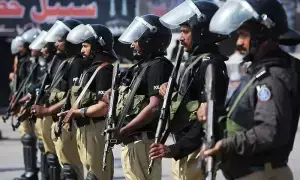
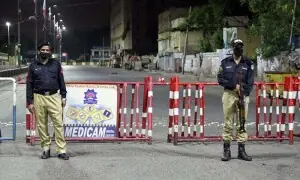
Authorities impose Section 144 in Karachi, ban gatherings of more than 5 people till Oct 20
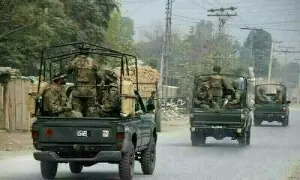

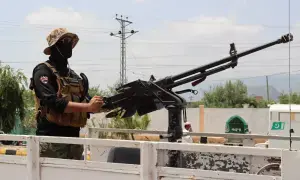
A soldier was martyred and 12 terrorists killed in an exchange of fire in Khyber Pakhtunkhwa’s Kurram district, the army’s media wing said on Sunday.
The Inter-Services Public Relations (ISPR) said that the movement of a group of khawarij attempting to cross the international border from Afghanistan into Pakistan was detected in Kurram district on Sunday, where security forces engaged them effectively.
Fitna al Khawarij is a term the state uses for terrorists belonging to the banned Tehreek-i-Taliban Pakistan.
Security forces, “maintaining a high state of alertness and vigilance, effectively thwarted the infiltration attempt”, the statement added.
It further said that Afghan Taliban posts had also opened fire to support the infiltration attempt by the khawarij.
“The skilful and precise engagement by vigilant troops resulted in the killing of 12 khawarij and Afghan Taliban,” the statement said. During the exchange of fire, Naib Subedar Hidayat Aman was martyred after “fighting gallantly”.
This incident along the Pakistan-Afghanistan border vindicates Islamabad’s “objective and factual stance regarding the willful abject failure of the Afghan Taliban regime to deny the use of Afghan soil to the terrorist organisation”, the statement added.
“The security forces of Pakistan remain resolute and unwavering in their commitment to defend the nation’s frontiers,” said the ISPR, adding that sanitisation operation is being conducted in the area to eliminate any other Indian sponsored khawariji found in the area.”
“The relentless counter-terrorism campaign under vision Azm-i-Istehkam as approved by Federal Apex Committee on National Action Plan by security forces and law enforcement agencies of Pakistan will continue at full pace to wipe out the menace of foreign sponsored and supported terrorism from the country.”
“These sacrifices of our brave soldiers further reinforce our unwavering commitment to safeguarding our nation and its frontiers at all costs,” it said.
In a statement on X, Interior Minister Mohsin Naqvi paid tribute to the security forces for “foiling the infiltration attempt”.
He expressed “heartfelt condolences and expression of sympathy” to the bereaved family of the martyred Naib Subedar Hidayat Aman, adding that nation takes pride in the “professional capabilities and courage” of the security forces.
KP has been witnessing terrorist attacks and security challenges for a long time
September particularly witnessed a significant deterioration in Pakistan’s overall security environment, accompanied by growing political, economic and regional pressures, according to Pakistan Institute for Conflict and Security Studies (PICSS).
Terrorist violence increased substantially, with 225 attacks recorded nationwide, compared with 199 in August, representing a 13.1 per cent increase and the highest monthly total recorded in 12 years.
On Sept 27, 14 people, including two rescue officials, were martyred and 35 sustained injuries after a suicide bomber rammed an explosive-laden vehicle into a police checkpost in and then targeted an ambulance taking bodies to hospital in DI Khan.
On Sept 18, a major attack in the old Police Lines in KP’s Kohat claimed 23 lives and injured about 100 others. Eight terrorists were killed during an overnight clearance operation.
This opinion piece was originally published on Dec 25, 2022.
WITH each passing day, the state of animosity between the PTI, along with the two provincial governments it controls, and the federal government, that is composed of a multiparty coalition, is getting more intense.
Both parties are trying all weapons available in the constitutional armoury. Constitutional provisions are, at times, stretched to the limit — and even beyond — but when the courts adjudicate disputes, despite the disapproval of and grumbling by the losing party, the verdict is generally respected and enforced.
No-confidence resolutions have been tabled and, in the case of the National Assembly, passed too, culminating in the exit of prime minister Imran Khan. The Punjab chief minister has been asked by the governor to prove that he still commands a majority in the provincial assembly.
In the escalating confrontation, at least two senior leaders have alluded to the possibility of using the ultimate weapon of emergency provisions. The Punjab chief minister had referred to ‘financial emergency’ after his short trip to Rawalpindi recently and earlier Interior Minister Rana Sanaullah had hinted at moving a summary for ‘governor’s rule’ in Punjab when the PTI spokesperson Fawad Chaudhry had mentioned the possibility of arresting him in the province.
There is no doubt that emergency provisions are very much a part of the Constitution, but their use usually indicates a shattered polity and a part of the provisions dealing with ‘financial emergency’ may deliver a deathblow to an already fragile economy. These provisions, therefore, better be left unused. Since provincial governors generally assume executive power of a province during an emergency, it is also referred to as ‘governor’s rule’.
There is no doubt that emergency provisions are a part of the Constitution, but their use indicates a shattered polity.
Part 10 of the Constitution covers emergency provisions and comprises six articles — Article 232 to Article 237. Three of these articles are of prime importance.
It is usually a province which bears the brunt of an emergency proclamation. This is why these provisions have assumed importance during this time of confrontation between the federal government and the Punjab provincial government.
Article 232 deals with the emergency, which is pronounced in two distinct situations. One, war or external aggression and, two, internal disturbances beyond the power of a province to control. If an emergency is to be pronounced because of internal security conditions of a province, then the provincial assembly concerned is required to pass a resolution. The president can also proclaim an emergency, but in this case the proclamation would need to be placed before parliament, whose two Houses should approve it within 10 days.
During the emergency under this article, the provincial assembly can continue to work, but a law passed by parliament for the province will have precedence over provincial laws. The executive authority of the federal government extends to the province which will be exercised either by the president or the provincial governor. The powers of the courts will, however, remain unchanged during the emergency.
The proclamation of an emergency needs to be placed before a joint sitting of parliament within 30 days of the proclamation. Its validity is for two months, unless the joint sitting approves an extension through a resolution. If the joint sitting disapproves the proclamation, it will cease to be in force.
An important aspect of the emergency under this article is that parliament, during the emergency, may extend the term of the National Assembly for a period of up to one year, but this extra term cannot extend beyond six months after the proclamation ceases to be in force.
Article 233 explains that the president will have the power to suspend certain fundamental rights under the emergency proclamation.
Article 234 deals with the power to impose emergency in case of failure of the constitutional machinery in a province. This probably is the article which provinces should be most concerned about.
The imposition of this emergency may happen after the president receives a report from the provincial governor and the president is satisfied that a situation has arisen in which the provincial government cannot carry out its duties out in accordance with the Constitution. In case the two Houses of parliament pass a resolution separately demanding that such an emergency be imposed, the president is bound to proclaim the emergency. The powers of the courts, however, will remain intact even during the emergency.
A proclamation issued under Article 234 has to be laid before a joint sitting of parliament and is valid only for two months, unless the joint sitting extends the validity for a further period of two months. The maximum validity of such a proclamation is six months.
The proclamation under this article may declare that the powers of the provincial assembly are exercisable by or under the authority of parliament. The joint sitting of parliament can also confer power on the president to make laws for the provincial assembly. The president, when parliament is not in session, may also authorise expenditure from the provincial consolidated fund to be later sanctioned by a joint sitting of parliament.
Article 235 deals with proclamation of a financial emergency by the president if he is satisfied after consultation with the governor or governors that a situation has arisen whereby economic life, financial stability or the credit of Pakistan or any part of it is threatened.
While such proclamation of emergency is in force, the executive authority of the federation extends to giving directions to any province to observe such principles of financial propriety as may be specified in the directions. These directions may include reduction of salaries and allowances of all or any class of persons serving in connection with the affairs of a province or the federation. This proclamation is also required to be laid before a joint sitting of parliament and may be extended up to six months as in the case of proclamation under Article 234.
The writer is president of the Pakistan Institute of Legislative Development And Transparency.
president@pildat.org
Twitter: @ABMPildat
Published in Dawn, December 25th, 2022

Pakistan will meet Sri Lanka on Sunday evening for the second of a three-match Twenty20 international series, where the Green Shirts will look to take an unassailable 2-0 lead and seal the series.
Pakistan’s standout performers, Maaz Sadaqat and skipper Sahibzada Farhan will look to replicate their respective strong outings from Friday, with both declaring their commitment to playing their natural game in a way that the modern format demands.
In the post-match press conference after the first match on Friday, top-order batter Maaz said that he planned on backing his natural game and play the way he has been playing,
Pakistan beat Sri Lanka by four wickets, accomplished with a largely untroubled chase of the 183-run target which they achieved with seven balls remaining, despite a cluster of wickets falling at the toe-end of the innings.
“It was my first 50 so I am very happy,” said Maaz, who scored a maiden, blistering T20 international half-century off 26 balls at one-drop. “The plan for upcoming matches is to play the way I have been playing and back it.”
Maaz’s rich vein of form can be traced back to last month’s Caribbean Premiere League (CPL), where he scored 363 runs in seven matches at a strike rate of almost 175. His campaign also included two centuries, one of which came in the competition’s final.
In the second match of the series, Maaz can potentially cement his spot in the side further. It could also be interesting to note whether Maaz remains at one-drop, or if Pakistan want to test him as an opener.
Maaz himself believes the two positions are interchangeable, which he said whilst answering a question about whether taking over the position Babar Azam normally played in was a source of extra pressure.
“I am comfortable in this position, but for Pakistan I am prepared to bat at any position,” he said.
Farhan, too, backed Maaz.
“I think, the sort of form Maaz is in, he is one of the best players,” he said after the first match.
“I told him to take advantage of his current form,” he said, adding that he was “very happy” as his captain.
“Today I told him, now that you have the opportunity, you should complete your 50. If you complete your 5o, we can finish this match three or four overs earlier,” Farhan later told the broadcaster in the post-match show.
The skipper was named player of the match himself for his 53-ball-89, in his third match as T20I captain following the two matches that were part of the team’s silver-winning Asian Games campaign.
He added that he had changed the way he played over the last year to strike at at least 150-160 instead of the lower strike rates he used to record before, because such is the demand of the modern game.
Echoing Maaz’s sentiment, he added that he will continue to bat the way he has been batting and not change it as long as the game demanded it, “whether I am captain or not.”
The series is his first assignment at home as captain, and its outcome and findings could be formative for a Pakistan T20 side that is somewhat in the process of a re-build, with senior mainstays like Babar Azam, Mohammad Rizwan and Shaheen Afridi not currently part of the squad. It provides an opportunity for the management and the new skipper to further assess team combinations and line-ups.
“It would be a lie to say there is no pressure, because when you are representing your country, people have expectations from you,” the captain said.
‘‘As a captain, I am very happy with this team… (In T20s) I think three or four boys perform and it is enough to turn the tables in a match.”
“If you look at it, we have Arafat Minhas as a backup. We have Abdul Samad, Sufiyan Muqeem. So, our back-up strength is very strong,” he said, adding that this bench strength also meant that the playing combinations were not fixed and that they could always experiment and change in upcoming matches.
Whether Pakistan chooses to actually test the strength of its bench could be another interesting element to look out for, going into this second match.
All of them have made a case for themselves: Arafat bowled a disciplined spell of 2-23 in three overs in the Asian Games semi-final. And though not in the same format, he has already starred in the greens, picking up a Player of the Series award in his debut One-day International series against Australia earlier this year.
Abdul Samad’s clinical 15-ball-30 against Bangladesh played a starring role in the team reaching the gold-medal match in the Asian Games.
And while Sufiyan’s returns against India were not entirely prodigal, he is still coming off the back of a T20 season that saw him named Player of the Tournament in Peshawar Zalmi’s Pakistan Super League title-winning run and, more recently, be named Player of the Final in the CPL for a record spell of 4-14.
Pakistan’s previous T20 sides were often criticised for not using bilateral fixtures to amply experiment and give match time to young players, focusing too much on the results as opposed to the long-term process.
Maaz, for example, was asked in the press conference whether Shadab Khan was occupying a space that could potentially have gone to a younger player (to which his response was simple: “He was selected on merit.”)
Whether Pakistan seek to play a fresher XI tonight, or chooses to not fix what was not broken in the first match, remains to be seen.
MUCH has changed in just a little over a decade.
In 2015, when the question of Pakistan’s involvement in the conflict between Saudi Arabia and Yemeni rebels last arose, the then defence minister, Khawaja Asif, opened the issue for debate before a joint sitting of parliament.
Days later, after a marathon session, it was the then finance minister, Ishaq Dar, who presented the parliamentary resolution affirming Pakistan’s support for Saudi Arabia’s territorial integrity, while conveying a desire to “maintain neutrality in the Yemen conflict so as to be able to play a proactive diplomatic role to end the crisis”.
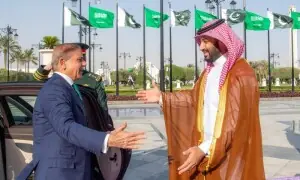
In 2026, the Foreign Office tells us that the recent signing of the Makkah Joint Defence Agreement and the commitment of military capabilities under it are executive functions that do not necessarily require parliamentary approval.
That is a rather large departure.
Ironically, in his Friday briefing, the FO spokesperson, while rejecting criticism of the apparent lack of political consultation on the matter, pointed to the participation of Defence Minister Khawaja Asif and Deputy Prime Minister and Foreign Minister Ishaq Dar in the Strategic Political and Defence Committee.
He mentioned it in support of his assertion that members of parliament and the federal cabinet had not been completely cut off from the decision-making process.
But the two ministers ought to be asked: is the risk calculus of the conflict any different from before?
And if the policy is the same as in 2015, why not say so in parliament, as they did then?
One hopes they have satisfactory answers to these questions. The secrecy surrounding the matter gives the impression that, in 2026, parliament is being deliberately sidelined in a matter in which it was deliberately involved in 2015.
Meanwhile, the third party in the trilateral Makkah defence agreement, Turkiye, is taking the agreement to its parliament.
Regardless of what the law allows, it would be better if Pakistan took the same route.
The fact that our troops are already on Saudi soil, and have been so for decades, is no answer, especially since the terms of the new joint defence agreement have not been made public, and, therefore, their consequences cannot be judged.
A handful of ministers in a committee deliberating behind closed doors cannot be claimed as a substitute for a parliamentary debate.
Where Pakistan’s involvement in a foreign conflict is concerned, the public’s representatives should have been taken into confidence.
Pakistan has always been unequivocal about its commitment to protect Saudi Arabia’s territorial integrity and the holy sites — that is not in question here.
The concern is about process, and respect for parliament as the people’s representative.
Published in Dawn, October 11th, 2026

With the advantage of hindsight, one has the opportunity to study the historical cycles in a nation’s life. Thanks to this newspaper’s unique, extensive archive of back issues, one can examine the major political, economic and social trends that have shaped Pakistan and the world over the last seven decades and counting.
Cliched as it may sound, history repeats itself, and we — as a state and as a polity — largely refuse to learn from it.
Through this platform, we will look back at the ‘big’ stories that made it to the front pages of Dawn, as well as significant developments tucked away in the inside pages, from the birth of Pakistan onwards, and try to put them in perspective. We will study the critical issues of the week, starting from Aug 14, 1947 and examine the major themes and issues that made it to the paper.
Though Dawn’s archive goes back further, we have chosen to start from the day Pakistan was born. The news items have been selected for their relevance — in the eyes of this writer — to the modern day as well as their historical impact.
‘Friendship with Britain and Hindustan’The front page of the Dawn Delhi edition of Aug 14, 1947 captured the zeitgeist of the time: a fond farewell to empire, and hope for the future. Quaid-i-Azam Mohammad Ali Jinnah, while delivering a speech at a state dinner in honour of Lord Louis Mountbatten, the last viceroy of India, spoke of the British warmly, saying Pakistan would “endeavour to create and maintain goodwill and friendship with Britain and our neighbouring dominion — Hindustan. …”
Though relations with Britain saw ups and downs, they have remained generally cordial. The same, obviously, cannot be said for India. Mere months after the Quaid would express his desire for good relations with India, both nations went to war over Kashmir, as Maharaja Hari Singh signed the Instrument of Accession to India, a process that would spark a dispute that remains unsolved to this day; despite how New Delhi may spin it, Jammu and Kashmir remains a disputed region. Moreover, Pakistan and India have fought numerous major and minor wars, with the last conflict breaking out in May 2025 after the Pahalgam incident. The unfinished business of Partition remains unfinished, and has resulted in a permanent state of hostility between Pakistan and India.
A single-column news item on the front page reflected another, forgotten territorial dispute that has now become a part of history. It mentioned that the princely State of Junagadh, in the Kathiawar region of what is now India’s Gujarat state, had decided to join Pakistan. Mr. Ismail Abramani, Secretary for Constitutional Affairs to Junagadh State, “met Mr. Jinnah … and communicated to him the decision of the State.”
Interestingly, when the Muslim nawab of Junagadh decided to accede to Pakistan, India did not accept it and occupied the state in November 1947. Yet the Kashmiri Hindu maharaja’s accession to India was perfectly acceptable to New Delhi. The Indian rulers of the time clearly shifted the goalposts when it suited them.
Trouble in LahoreBut with great hope there was also trepidation. The inside pages carried reports of communal disturbances which reflected the frenzy that accompanied Partition. A grim report from Lahore told the reader that “most of the sectors in the Walled City are on fire and burning unchecked”.
It added that the military and police had been “firing incessantly in several places, where arson and looting was rampant”. So volatile was the situation that the district magistrate clamped an 11-hour curfew on many parts of the Punjab capital; three military brigades had to be moved in to control the situation. Disturbances had also been reported from Amritsar (East Punjab) and Moradabad (UP).
Though Independence held great promise for the people of the subcontinent, freed as they were from colonial subjugation, as the record shows, the bitter rivalry between the erstwhile dominions of Pakistan and Hindustan has persisted, while communalism remains entrenched on both sides of the border.
The pages of Dawn would over the decades tell these — and other — stories that shaped the future of Pakistan, and made it what it is today. It is these stories we will seek to examine every week.

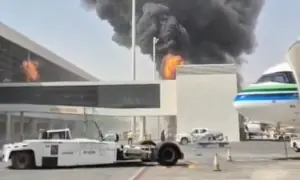
At least 12 people were killed and more than 300 wounded in an attack on Riyadh’s international airport on Saturday, the deadliest in the kingdom in more than a decade, as the Houthis escalate a campaign they launched this summer.
The dead from the third attack this week on the airport included four Saudis, two people from Bangladesh and one person each from the US, Jordan, Palestine, Syria, Sudan and Egypt, the Saudi civil aviation authority said. At the latest count, 309 were wounded, officials said.
President Donald Trump said Washington was considering joining Saudi strikes on the Houthis in the conflict, a spillover from the war on Iran that the US and Israel launched in February.
Hospitals were flooded with wounded brought by ambulance and helicopter, some in critical condition after the attack, which occurred without warning.
Prime Minister Shehbaz Sharif condemned the Houthi attack on Sunday, reiterating Pakistan’s commitment to Saudi Arabia’s security under the Makkah Joint Defence Agreement.
The Saudi-led coalition in Yemen blamed the group for the strike on King Khalid International Airport, describing it as a “full-fledged war crime” that a diplomatic source attributed to a missile.
Earlier in the day, authorities had suspended operations at Riyadh’s international airport. The Saudi civil aviation authority had initially confirmed an attack had injured several people at the sprawling King Khalid International Airport, with a diplomatic source attributing it to a missile fired by Yemen’s Houthi rebels.
The situation prompted health officials to activate a rare mass call-up of doctors to deal with the “serious emergency”, a medical source said, while foreign embassies warned their citizens to avoid the facility.
Houthis have repeatedly targeted the facility, claiming a series of strikes on Thursday that killed three people and damaged a plane, though they did not announce any new attacks on Saturday.
Air traffic monitor Flightradar24 said 155 arriving and 161 departing flights had been cancelled, while a total of 222 flights were delayed.
At around 6pm local time, Flightradar24 noted that flights bound for the airport were “diverting elsewhere, mainly to Jeddah at the moment”. It later shared a notice to airmen (Notam) for operations suspended till 12am.
A witness at the airport reported hearing an explosion while waiting to board a flight, and another said they saw a strike that left people wounded and fleeing in panic.
“I was on gate 403” at the domestic terminal, the witness told AFP. “I saw 401 hit, I saw injured [people] in front of my eyes. Everyone was running.”
A medical source told AFP that the health ministry had ordered ER doctors to report to hospitals around the capital to treat the wounded on Saturday.
“We were told we are dealing with a ‘serious emergency situation’. Injured are being moved to hospitals across Riyadh”, with many in critical condition, the source said.
The aviation authority said the number of injured from the attack was still being assessed, adding that airport “operations had been temporarily suspended pending the completion of an assessment of the damage and verification of the safety of the facilities”.
The Houthis have repeatedly attacked Saudi airports, oil facilities and tankers after a truce in their long-running war with Yemen’s coalition government unravelled in July.
A source at a local hospital said five people were in intensive care there after being wounded at the airport, with “dozens of people injured” in all.
A relative of one wounded person said they had been hit in the shoulders and arms by shattered glass. Three witnesses confirmed people being evacuated from the airport.
Two doctors told AFP that several pilgrims headed to Makkah had been injured while waiting to board their flight.
A diplomatic source briefed on the matter told AFP the airport was hit by “a missile around 3:00pm” (5pm PKT).
“Houthis are attacking civilian targets. Riyadh airport is a civilian target,” the source said.
‘War crime’The Saudi-led coalition spokesman Major General Turki al-Malki described the strike as a “cowardly terrorist attack” against a civilian facility.
“The cowardly terrorist attack by the terrorist Houthi militia… which resulted in deaths and injuries among civilian passengers and airport staff, constitutes a full-fledged war crime,” he said in a statement on X.
US ‘may’ join Saudi strikesAsked on Saturday whether he had changed his mind about joining Saudi strikes on the group, US President Donald Trump said: “We may.”
He said he would be speaking with Saudi Crown Prince Mohammed bin Salman, calling what happened in Saudi Arabia “not acceptable”.
US media outlets have reported that previous Saudi requests for US military assistance in dealing with the Houthis have been rebuffed.
Embassy warningsThe Yemen conflict flared back to life after a four-year, UN-brokered truce collapsed, months into a wider Middle Eastern war that has rocked the region and roiled energy supplies and markets.
The scale and frequency of the recent strikes targeting Riyadh are unprecedented in the eight months of war in the region.
Saudi Arabia leads an international coalition that supports Yemen’s government militarily, and has found itself drawn deeper into its impoverished neighbour’s civil war.
Both Riyadh and the Houthis have signalled a willingness to keep fighting rather than pursue diplomacy.
The US embassy in Saudi Arabia said it was “aware of attacks” on Riyadh airport on Saturday and called on American citizens to avoid the area.
The Canadian, German and Spanish embassies also warned their citizens to avoid the facility. Spain’s embassy, in a message on X, alerted nationals to a “new attack… by the Houthis”.
A senior Western diplomat told AFP that several embassies “indicated that they had decided to prohibit their staff’s travel to/from Riyadh Airport over the next week as a prudential step”.
Near the airport, passengers carrying luggage could be seen standing on the pavement at a metro station.
Yemen fightingMeanwhile, in Yemen, Saudi-led government forces were advancing against the Houthis in areas they captured last month around the Bab al-Mandab strait, military sources told AFP.
The Yemeni government last week announced a counter-offensive aimed at retaking all areas held by the Houthis, after the group seized the country’s entire western coastline in a lightning offensive.
The Houthis confirmed that government forces had attacked in the Bab al-Mandab area — a key chokepoint for Red Sea oil and cargo shipping — but they claimed to have repelled the assault.
Claims by the warring parties have been impossible to independently verify, with the situation moving fast on the ground and access for journalists difficult.
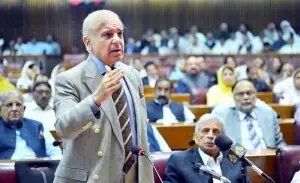
ISLAMABAD: The death of student Laiba Aijaz on Friday drew the attention of the government, with Prime Minister Shehbaz Sharif meeting the Islamabad police chief and chief commissioner and directing them to arrest the accused.
Sources in the police and Federal Investigation Agency (FIA) told Dawn that the prime minister called Inspector General Mohammad Sohail Chaudhry and Chief Commissioner Islamabad Sohail Ashraf and directed them to apprehend the man accused of defrauding the deceased student. The IG briefed the prime minister on the incident during the meeting.
The capital police registered a case against the accused under Sections 322 and 34 of the Pakistan Penal Code on Saturday, following a complaint lodged by Mohammad Aijaz, a native of Sargodha residing in G-10.
The accused allegedly defrauded the student of millions of rupees, following which she reportedly took her own life.
Orders arrest of accused agent
The minister of state for interior and narcotics control also contacted FIA officers and directed them to take strict action against the accused.
The FIA Islamabad Zone has initiated an investigation and is conducting raids at various locations to trace and arrest him, according to a statement issued by the agency.
The FIA Islamabad Zone director also visited Laiba’s residence, met her family and gathered details about the incident.
According to the FIA, the accused allegedly gained the family’s trust by misrepresenting his identity and professional status before obtaining money from them for different purposes.
He was not a registered visa agent but claimed to work as an accountant at the Supreme Court of Pakistan.
He later made conflicting claims about his identity and employment, the agency said.
The FIA statement said Rs550,000 was paid to the accused for securing employment for Laiba’s brother, while Rs7.2 million was handed over to him on the pretext of securing Laiba’s admission to Harvard University in the United States.
The agency said the payments and claims made by the accused were being examined and further legal action would follow as the investigation progressed.
Laiba had recently completed her BS degree from the International Islamic University Islamabad (IIUI). The accused allegedly defrauded her with the help of a female accomplice.
According to a police report, her father contacted the police helpline after she went missing, saying she was under extreme psychological distress.
Following an analysis of call detail records and location data, a joint police and family search found her body hanging by a scarf from a tree inside a fenced enclosure on the G-10 Sunday Bazaar green belt.
The body was taken to the Pakistan Institute of Medical Sciences (Pims) in an Edhi ambulance.
After the autopsy, the victim’s clothes and biological samples were secured and sealed for forensic examination. The formal autopsy report is awaited.
Investigators have secured the visa documents allegedly provided by the accused. A special police team has also been formed to trace and arrest him and his female accomplice. His name has been placed on the stop list to prevent him from leaving the country.
Police sources said Laiba’s family had arranged money for the agent by selling a plot and gold ornaments.
Published in Dawn, October 11th, 2026

THE Indus River is moving east in central Pakistan. Along an 85-kilometre stretch from upstream of Layyah city down to Taunsa Barrage, it is pressing hard against its eastern bank.
In this year’s flood season, it destroyed Basti Kanjal, a riverine settlement of more than 500 houses some 15km northwest of Layyah. It did not stop there, washing away several more settlements. Since June, close to 5,000 acres of cultivated land have been lost; according to news reports, 100,000 people have been displaced. A close analysis of 38 years of satellite imagery shows that the river is not wandering. It is being pushed.
Ask any elder in the riverside villages of Churkin or Basira which face the Vehowa hill torrent’s mouth 30km upstream of Layyah about the river of his childhood, and he will tell you the Indus was 10 miles (16km) wide. He will also tell you that the river gave as much as it took: land drowned on one bank surfaced on the other, and the patwari’s records followed the water back and forth. The satellites agree with him on the width. Between 1988 and 1997, the active belt below Churkin measured 16km to 18km, and above Taunsa Barrage nearly 24km. Today, it is reduced to a third. A river squeezed into a narrow gut runs deeper and faster, and expends its vigour on eroding vulnerable banks.
Three engineering structures, built with public money and international loans, have together hemmed in the river on three sides. The first of these is the Chashma Right Bank Canal, financed by the Asian Development Bank. The canal runs through the Suleiman hill torrents. These are no small streams: the Vehowa alone drains a catchment of over 2,600 square kilometres and has recorded flood peaks above 35,000 cusecs. Before the canal, such floods spread across the Daman plain under the old rod-kohi system, watering the land and dropping their silt on the way. After 2003, the canal’s 68 cross-drainage structures began delivering every flood, with its full load of mountain sediment, to fixed points on the river’s right bank. Between 2011 and 2016, two great fans of new land rose out of the riverbed — one at the Vehowa’s mouth opposite Layyah, and one at the mouth of the Sanghar torrent near Taunsa city. Together, they hold some 37sq km of new permanent land, a metre and more above the old riverbed, and about 100 million cubic metres of sediment. Where the trained torrents deliver their load, walls have risen; in the intervening stretches, the river’s western edge hasn’t moved in 38 years. The canal itself has been closed since the 2022 floods, but its silt walls remain standing in the river.
A close analysis of 38 years of satellite imagery shows that the Indus is not wandering. It is being pushed.
The second factor is Taunsa Barrage. Built in 1958 to pass a million cusecs, its capacity fell by half within five decades as sediment accumulated. A wedge of silt today stands nearly 2m high near the pond and stretches 40km upstream, flattening the river’s slope and promoting further deposition. The World Bank’s 2005-08 rehabilitation project raised the crest and built a secondary weir downstream. But the embankments were never raised proportionately. Local communities protested and wrote to the Bank that the remodelling ignored the sedimentation, causing flood protection for structures to fail. In 2010, a flood peak of 960,000 cusecs breached the eastern marginal embankment upstream, allowing the river to outflank the structure and carve a new channel. Their warning proved correct.
The third factor relates to the embankments. The marginal ones along the left bank, running some 40km from Daira Din Pannah up towards Layyah, froze the river’s eastern edge decades ago, and the floodplain strip between the river and bund has since been almost entirely converted into farms and settlements. In the 1990s, the river still reclaimed that strip in every high flood; today, 95 per cent of it has turned into permanent land. Meanwhile, the restricted riverbed is level with the protected villages outside — all that protects them now is the crest of an earthen bund.
This is the fuller picture of the narrative that those affected recounted outside the Layyah Press Club this September, as they blamed two decades of Chashma Canal silt for their plight: sediment walls advancing from the west, a wedge of silt backed up behind the barrage, and, on the east, the embankments holding the door shut. A river so enclosed has nowhere to go but against the weakest point. In 2010, the weakest point was the marginal bund above Taunsa; in 2026, it was the training works at the Layyah bridge. The river has now cut to within 200m of the Lala, its old channel passing along the western edge of Layyah city. The city’s protection bund stops 3.5km short of that point.
What happens if the river completes its eastward shift? The low floodplain east of the river holds hundreds of villages built on the assumption that the river would keep to its corridor. A river breaching the Lala line would place Layyah on the front line, and behind it Jaman Shah, Kot Sultan, and Paharpur. An eastward-shifted Indus would progressively outflank Taunsa Barrage itself. A barrage commands only the water that arrives at its gates; the canals of Dera Ghazi Khan and Muzaffargarh, irrigating millions of acres, depend on that command. The river would leave the barrage presiding over a dying channel.
The communities of this region warned both lending institutions years ago, the ADB over the canal and the World Bank over the barrage, through formal complaints, inspection claims, and hunger strikes. I was among those who warned. I remember how patiently they were heard and how completely they were ignored. Both institutions noted lessons and closed their files. The river has now reopened them, writing its supplement in drowned villages and 5,000 acres of lost land. Reconstruction without the benefit of an honest analysis of these structural challenges would be tantamount to allowing a similar situation, or even worse, in the future. The analysis now exists, measured from orbit and verifiable by anyone. What remains is whether anyone with authority is willing to read it.
The writer is a native of Taunsa and teaches at Quaid-i-Azam University, Islamabad.
Published in Dawn, October 11th, 2026

KARACHI: Sri Lankan wildlife health specialist Dr Buddhika Bandara, who had joined efforts to save Madhubala on Friday, left for home the same day under unclear circumstances, raising concern over Safari Park’s administrative affairs as well as the ongoing health crisis confronting the ailing elephant, it emerged on Saturday.
Sources told Dawn that local authorities had not informed the visiting Sri Lankan expert that he would be working with Dr Amir Khalil of the global animal welfare organisation Four Paws at Safari Park.
“It seems this situation damaged the trust between the two parties, forcing him to leave quietly. Madhubala’s deteriorating condition must have shocked him, too,” shared an official, adding that Dr Bandara’s hesitation to speak at Friday’s presser surprised many journalists who had requested him several times to share his clinical observations of Madhubala.
The sources also expressed concern over the fact that the Safari Park authorities kept Four Paws out for over a year — a critical time during which Madhubala received TB treatment and later developed multiple infections and acute weakness —and then sought its help just three weeks ago when Madhubala’s condition worsened.
KMC spokesperson says Dr Bandara left due to death of a family member in Colombo
Responding to these concerns, Karachi Metropolitan Corporation’s spokesperson Daniyal Siyal said that Dr Bandara had been monitoring Madhubala’s TB treatment online since his first visit over a year ago.
“He had to leave due to the sudden death of his family member in Colombo. Even last month, he was in touch with us. Last year, he stayed with us for 17 days [for Madhubala’s treatment] and this time, his stay was planned for at least a week,” he explained.
All support was being extended to Dr Khalil, he added.
The foreign experts were invited by local authorities after Safari Park vets had failed to diagnose the factors behind Madhubala’s ongoing health crisis.
The female African elephant has experienced drastic weight loss in recent months and collapsed twice in her enclosure.
According to Dr Khalil, multiple bacterial and parasitic infections and the weakness that followed treatment for tuberculosis have caused Madhubala to lose significant weight. Additionally, she seems to suffer from a linear fracture in the carpal joint.
Published in Dawn, October 11th, 2026
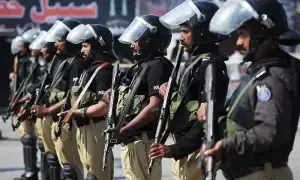
PESHAWAR: Khyber Pakhtunkhwa Inspector General of Police Zulfiqar Hameed on Saturday put district police on alert for possible violent protests and sabotage in the event of the federal government imposing an emergency in the province, emphasising caution in the use of force.
A notification issued by the IGP’s office outlined guidelines for handling protests and warned that miscreants and anti-state elements could exploit demonstrations to incite violence and carry out sabotage activities.
“To protect lives and property and prevent sabotage during protests, DPOs, sub-divisional police officers and station house officers should personally monitor all protests within their respective jurisdictions,” it said.
The notification said district police must ensure that sufficient personnel were made available to SDPOs and SHOs to maintain order during protests. “The deployment should include anti-riot squads equipped with anti-riot gear, an adequate supply of gas guns and shells checked and verified for use by reserve inspectors or moharrars, special squads of unarmed personnel to identify and apprehend troublemakers and violent protesters, and plainclothes personnel deployed to identify violent protesters, troublemakers and saboteurs. Armed personnel should be deployed only at important or suitable points in extremely urgent situations.”
IGP issues guidelines for handling violent protests, stresses caution in use of force
The police chief directed SHOs to identify vulnerable locations along protest routes and deploy sufficient personnel to protect them.
“Such places may include police stations and police offices, government buildings, petrol stations, banks, shopping centres, important highways/roads and any other sensitive installations,” the notification said.
The notification said DPOs could require protest organisers to obtain a licence for an assembly or protest under Section 84 of the KP Police Act, 2017, or any other law or regulation in force, if they considered a breach of the peace likely.
According to the guidelines, a DPO, SDPO or SHO could stop a procession that violated the conditions of a licence granted under Section 84 of the KP Police Act, 2017, and order it or any assembly violating such conditions to disperse.
“Any procession or assembly, which neglects or refuses to obey any order given Under-Section 85 Sub-Section (I) of Police Act, 2017 or any other law in force shall be deemed an unlawful assembly.”
The notification said DPOs could issue appropriate directions, instructions or guidelines to regulate protests and ensure public safety. In the event of violence, they could also take necessary legal action.
It added that any police officer could temporarily close or regulate a street or public place by erecting barriers or using other means to prevent people or vehicles from entering an area for security reasons, as provided under Section 88 of the KP Police Act, 2017.
According to the notification, during peaceful protests and roadblocks, police should exercise maximum restraint and avoid using force. Protesters should be engaged in negotiations by the senior-most police officer available at the scene, who should try to persuade them to disperse peacefully.
It said to prevent serious disorder, a breach of law or imminent danger to life and property, SDPOs, SHOs or the senior-most officer present at the scene could order the appropriate use of force after assessing the situation and declaring the assembly unlawful.
The notification said the senior-most supervisory police officer during protests would determine the type and extent of force to be used to disperse an unlawful assembly. “When it is required to use force as per law, its application shall be of minimum essential standard,” the notification said.
It emphasised that the use of force should be graduated, starting at the minimum level and increasing only as necessary. In the first phase, violent protesters should be clearly warned before force was used.
According to the notification, if necessary, tear-gas shells or grenades should be used from a safe distance to disperse protesters. Rubber-bullet guns and paper-ball guns could also be used against violent protesters from a safe distance.
“In the second phase, if the situation requires, the violent protesters may be stopped with baton charge by using the anti-riot gear. The special unarmed squad will be activated to apprehend the violent protesters and take appropriate legal action,” it said.
The notification said in cases of extreme violence and an imminent threat to life and property, aerial firing could be conducted by special armed personnel or squads, but only on the directions of the senior-most officer present at the scene.
It added that if a person carried a firearm or any article covered under Section 86(1) of the KP Police Act, 2017, the police could seize it and take legal action against the carrier under Section 148 of the Pakistan Penal Code, the notification said.
“Extreme caution shall be used while using the force against protesters to avert damage to life and property. Anti-riot squad or the personnel entrusted with use of force shall be properly equipped with anti-riot gear to avoid damage/casualties to life of all concerned,” it said.
The notification said the SHO should arrange video recording of the entire protest or procession, preferably through professional cameramen. In the event of a law and order situation, DPOs should ensure briefings, rehearsals and reporting, and issue instructions strictly in accordance with OG-9/2013.
“Prior consultation and coordination should be carried out at all supervisory levels with key stakeholders, including the district administration, law enforcement agencies and other relevant bodies,” it said.
Published in Dawn, October 11th, 2026

WASHINGTON: Convicted murderer Christa Pike, who survived a botched execution attempt in the US state of Tennessee last week, has been discharged from hospital and returned to prison, her lawyers said on Saturday.
Pike, 50, was given two doses of the drug pentobarbital on Sept 30 — a usually fatal dose that nevertheless failed to kill her. She was transported to hospital in critical condition but later regained consciousness, with her lawyers saying this week that she was walking around but in a “foggy” mental state.
Pike is the only inmate to ever survive after being injected with lethal doses of execution drugs, according to the Death Penalty Information Centre (DPIC). “Christa Pike was discharged from a local hospital and is now at Deborah K. Johnson Rehabilitation Centre where she has been housed for more than 30 years,” her lawyers said in a statement.
“She is grateful to the first responders and her medical team for their care in these extraordinary circumstances,” the statement went on. Pike “is continuing to receive medical care at the prison, and we will continue to track her recovery,” the lawyers said.
Pike was sentenced to death in Tennessee after she and her boyfriend beat and killed 19-year-old Colleen Slemmer at a job training camp. Pike was 18 at the time of the murder. The attempted execution came after days of legal wrangling that ultimately reached the Supreme Court.
Published in Dawn, October 11th, 2026
Last week, reports emerged that an Israeli plumber had thwarted an alleged attempt by the co-pilot of a FlyDubai flight from Dubai to Tel Aviv to hijack/crash the aircraft. Interestingly, as further details were made public, social media platforms were flooded with thousands of posts alleging that the incident was a false flag operation orchestrated by the far-right Israeli government and its allied countries’ intelligence agencies.
I will not delve into the numerous anomalies highlighted by sceptics, including those raised by active pilots and aviation experts. Instead, this piece focuses on how false flag tactics have begun to backfire.
Over the years, significant evidence has emerged demonstrating that staged pretexts have increasingly transitioned from clandestine exceptions to routine instruments of statecraft. Countries using such tactics rely on certain psychological mechanisms that help set up false flag operations. For example, long before a staged provocation takes place, its success is often guaranteed by the cultural and news narratives that precede it.
In many countries, movies, television shows and news broadcasts have conditioned audiences to view specific societies through a narrow, negative lens. By repeatedly depicting these populations through recurring tropes of hostility or violence, mainstream media embeds particular perceptions in the public consciousness.
Governments have often used media conditioning and false flag operations to make the public more amenable to their agendas. In an age of information warfare, however, scepticism about official narratives is increasing. And scepticism can be a double-edged sword…
In their work Manufacturing Consent, media scholars Edward Herman and Noam Chomsky conceptualised this process through their “propaganda model”, demonstrating how mass media functions as an ideological filter, designed to align public perception with official state policy objectives.
Rather than presenting objective facts, modern entertainment and news ecosystems construct artificial frames that prompt ordinary citizens to support aggressive foreign policy agendas.
When cultural caricatures of ‘enemy’ societies are continuously reinforced, they generate the precise environment required for staged pretexts and/or false flag operations. If a government or intelligence apparatus seeks to fabricate a pretext for military action, global observers rarely question the official narrative, because the alleged culprit matches the villain archetype they have been conditioned to accept by the media.
Back in 1922, the American journalist and author Walter Lippmann observed that people construct their worldviews based on simplified “pictures in their heads” created by media narratives, rendering ‘enemy’ populations vulnerable to instant condemnation whenever a security crisis is reported. This dynamic is illustrated across several geopolitical events.
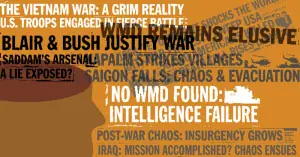
During the run-up to the 2003 invasion of Iraq, Western news outlets and Hollywood routinely depicted Middle Eastern figures through tropes of inherent fanaticism and anti-Western hostility, a phenomenon critically analysed by Edward Said in Orientalism, which showed how cultural production systematically portrays non-Western societies as dangerous. When US and British leaders falsely asserted that Iraq possessed weapons of mass destruction (WMD), large segments of the public accepted the premise without demanding any serious empirical evidence. The claim naturally aligned with a pre-existing media script.
The American media historian Nancy Snow wrote that, across the Cold War, American entertainment and news outlets constantly framed the Soviet Union as a dark, deceitful empire, capable of any atrocity. This persistent framing meant that US covert intelligence operations and exaggerated threats of Soviet terror were accepted almost instantly by a public already conditioned to expect malevolent behaviour from the Soviet regime.
However, sometimes, when this tactic is overtly used, the user country can get trapped in its own strategy. For example, the enemy country’s culture may indeed be successfully demonised by propaganda but, eventually, the user country can also start to become widely perceived as a constant engineer of false flag operations.
As British media scholar Andrew Hoskins highlights in his research on digital media and conflict, modern hyper-connectivity has fundamentally transformed how the public consumes news during a security crisis. In an era where audiences are routinely exposed to sensationalised reporting, institutional trust has begun to break down. Instead of taking official explanations at face value, global audiences now immediately scrutinise government narratives, moving towards scepticism.
This scepticism serves as a vital psychological defence mechanism in an era dominated by ‘information warfare.’ American political scientist Lance Bennett argues that a questioning public is critical for holding power accountable when state actors and media institutions leverage a crisis to manufacture political consent. Questioning official narratives allows citizens to filter out manufactured outrage and demand empirical proof.
Indeed, but scepticism can also become a knee-jerk and intellectually lazy exhibition of cynical reflexivity. According to American legal scholar Cass Sunstein, reflexivity that rejects all official accounts can lead to paranoia, where real crises are dismissed as elaborate fabrications. When every high-profile event is instantly dismissed as fake, one crosses into cynicism.
Media scholar Renee Hobbs warns that this form of cynicism creates a new cognitive trap. Rather than demanding evidence, individuals simply invert the official narrative to fit their own pre-existing biases. In doing so, the public risks becoming just as easily manipulated by online counter-narratives as they are by official state propaganda.
What is truly needed is scepticism that is grounded in deliberate critical thinking. And the good news is that, even amid fierce information wars and state propaganda designed to set the stage for false flag events and despite the knee-jerk reactions that inevitably follow, informed scepticism remains alive.
During the 1964 Gulf of Tonkin incident in the Vietnam War, initial claims by the US government of unprovoked North Vietnamese attacks on American warships were challenged by journalists and naval analysts. Declassified documents later confirmed the attacks were largely fabricated, proving that the US had used them as a pretext for escalating the Vietnam War. Prior to the 1990 Gulf War, testimony claimed Iraqi soldiers were removing Kuwaiti babies from hospital incubators. Sceptical journalists investigated the story and exposed it as a manufactured campaign by the PR firm Hill & Knowlton.
In the run-up to the 2003 invasion of Iraq, UN weapons inspectors Hans Blix and Scott Ritter, along with reporter Seymour Hersh, challenged intelligence claims about yellowcake uranium and mobile bio-labs in Saddam Hussain’s Iraq. Their demand for physical, forensic proof exposed the flawed WMD narrative woven by the US and UK governments.
The manner in which a country’s narrative machinery demonises an adversary to set the stage for false flags has become too predictable a tactic to ignore. Recently, Israel and India have landed in this situation. The frequent reliance on demonising narratives, paired with a global public that increasingly demands empirical proof, has repeatedly forced both countries to present ‘evidence’ that many independent observers find deeply unconvincing.
When official explanations fall short under critical scrutiny, it fuels scepticism and solidifies the belief that state propaganda is being actively deployed to justify not-very-pleasant strategic objectives.
Published in Dawn, EOS, October 11th, 2026

GILGIT: Gilgit-Baltistan police on Saturday decided to strengthen security for Chinese nationals living and working in the region following a high-level meeting to review protective measures for foreigners involved in development projects and business activities.
The meeting, chaired by Inspector General of Police (IGP) Dr Akbar Nasir Khan, was held at the Central Police Office in Gilgit, according to a statement issued by the GB police spokesperson.
The meeting conducted a review of security arrangements for foreign nationals, particularly Chinese citizens, and assessed measures for those involved in non-CPEC projects, private mining ventures, business activities and those residing at various locations across the region.
Senior police officials, including DIG Headquarters, DIG Gilgit Range, AIGs of Special Branch, Operations and Development, SSP SPU and SDPOs from Gilgit district, attended the meeting.
The officials reviewed SPU deployments, security directives, and protective measures at check posts and key entry points, while emphasising stronger coordination, advance notification, verification, and security checks for the movement of Chinese nationals across Gilgit, Skardu, Diamer, and other areas.
The IGP ordered a fresh district-level threat assessment, identification of security requirements and removal of any shortcomings within a specified timeframe.
He also directed implementation of security procedures issued by the National Counter Terrorism Authority, re-verification of residential no-objection certificates (NOC), security audits of approved locations and maintenance of comprehensive records at district level.
He called for ensuring compliance with NOC conditions, legal requirements including driving licences, and monitoring of movements, especially during nighttime.
He warned that negligence in ensuring the safety of foreign nationals, particularly Chinese citizens, would not be tolerated.
Published in Dawn, October 11th, 2026
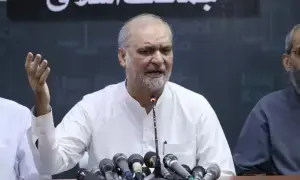
LAHORE: Jamaat-i-Islami chief Hafiz Naeemur Rehman on Saturday ruled out meeting Prime Minister Shehbaz Sharif without a commitment to abolish the petroleum levy, warning that the party would announce a date for its Islamabad march after Oct 12 if the government failed to provide relief.
Addressing a press conference at Mansoorah, the JI chief said statements by ministers suggested that the levy would not be abolished. “If the petroleum levy is not abolished, we have no desire to meet the prime minister,” he said.
The premier had sought a meeting with the JI chief after asking the party to suspend its protest march against the levy till then. While Planning Minister Ahsan Iqbal conveyed the PM’s message to JI vice chief Liaqat Baloch earlier this week to arrange the meeting, Mr Rehman said talks would serve no purpose without an assurance about the acceptance of JI’s demand.
The JI chief demanded meaningful relief for consumers and urged the government to take steps to reap benefit from Saudi Arabia’s reported $5-per-barrel reduction in oil prices for Asian countries.
Party threatens to call for Islamabad march if relief is not provided by tomorrow
He said the party had staged sit-ins for 42 days against the levy and was continuing its nationwide public meetings and signature campaign. A public meeting is scheduled in Okara today (Sunday).
Rejecting the government’s argument that it was constrained by the IMF, Mr Rehman questioned whether similar constraints applied to official spending on luxuries such as an aircraft worth Rs11 billion.
On Punjab, Mr Rehman blamed “four decades of family rule” for problems in education and agriculture. He claimed 11,000 schools had been sold and another 25,000 were reportedly listed for sale.
He also cited rising agricultural costs, saying the price of a 50kg bag of DAP fertiliser had gone up by Rs3,000. Farmers had received Rs3,000 per maund for wheat, while flour prices had exceeded Rs6,000 per maund and wheat prices had crossed Rs5,000 per maund, he added.
Citing poverty estimates, he said the World Bank had put Pakistan’s poverty rate at 23 per cent, while the rate exceeded 40pc under the country’s own criteria. He said Punjab had recorded the largest increase in poverty over the past five years.
Published in Dawn, October 11th, 2026

ISLAMABAD: Global economic growth is projected to slow to 2.6 per cent in 2026 and 2.7pc in 2027, from 2.9pc in 2025, while growth in developing economies is expected to fall to 4pc from 4.7pc, amid mounting technological and policy barriers, according to the Trade and Development Report 2026.
The flagship report by the United Nations Conference on Trade and Development (UNCTAD) finds that governments increasingly use industrial, trade, financial, and technology policies to pursue economic and national security objectives. Access to markets and the ability to move into higher-value activities now depend more heavily on technology, finance and geopolitics.
Developing countries will be affected unevenly by the reconfiguration of global trade. Some may emerge as alternative suppliers or intermediary hubs, but sustaining these gains will require stronger productive, regulatory and institutional capabilities, the report warns.
Global trade reached a record $35 trillion in 2025. Higher trade values in 2026 are being driven by rising prices amid the energy shock. Trade patterns are also shifting, with trade between China and the United States falling by more than 20pc since 2024, while East Asia has expanded trade with both China and North America. Export controls, investment screening and supply-chain conditions are making it harder for new entrants to access strategic sectors.
Asia remains the most dynamic exporting region, with intra-Asian merchandise trade rising markedly. South-South trade is also deepening as China and other major Asian exporters increase shipments to emerging markets.
On the import side, Asia is expected to record the strongest growth in 2026, followed by North America, where demand for artificial intelligence-related goods has supported overall imports.
Published in Dawn, October 11th, 2026
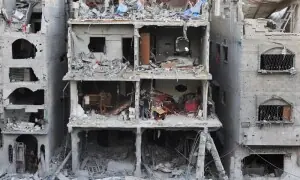
CAIRO: Israeli strikes killed at least five Palestinians in the Gaza Strip in two separate attacks on Saturday, health officials said.
Medics said an Israeli strike killed four people near Panda Mall in Gaza City, while another killed one person in the Tuffah neighbourhood further south of the city.
Israel, which claims Hamas has been rearming and launching attacks in violation of an October ceasefire, has stepped up strikes on the group in recent weeks. Hamas has denied trying to carry out attacks or rebuild its arsenal and accuses Israel of undermining the Gaza peace deal.
Last year’s US-brokered ceasefire calls for eventual reconstruction of the territory. But little progress has been made as negotiators have failed to agree on terms for Hamas to disarm and Israel to withdraw its troops.
Israeli air strikes have continued, with at least 1,400 Palestinians killed in Gaza since the ceasefire, according to the territory’s health officials, while Israel claims four of its soldiers have been killed.
Palestinian authorities say more than 74,000 people have been killed in Israel’s assault on Gaza, launched in October 2023.
Published in Dawn, October 11th, 2026

Key developments
Prime Minister Shehbaz Sharif on Saturday met with President Asif Ali Zardari, with the country’s overall security and political situation coming under discussion as the federal government mulls imposing an emergency in Khyber Pakhtunkhwa.
A statement issued by the President House said the premier was accompanied by Deputy Prime Minister and Foreign Minister Ishaq Dar, Adviser to the PM on Political Affairs Rana Sanaullah, Interior Minister Mohsin Naqvi, Attorney General for Pakistan Mansoor Usman Awan and Law Minister Azam Nazeer Tarar.
It said that PPP’s Sherry Rehman and Syed Naveed Qamar were also present.
“It was agreed during the meeting to convene separate sessions of the National Assembly and the Senate on Tuesday (Oct 13),” the statement said.
Later, KP Governor Faisal Karim Kundi and Naqvi called on President Zardari in a separate meeting, the President House said.
The president was briefed on the country’s “overall security situation, particularly the worsening law and order situation” in KP. He was also informed about KP’s “security and matters relating to law and order in the country”.
Sharing a video on X, Kundi wrote, “KP has sacrificed enough. Protecting lives and defeating terrorism must take precedence over political interests.”
Earlier in the day, Minister for Kashmir Affairs and Gilgit-Baltistan Amir Muqam had also met Kundi at Governor House in Peshawar.
The flurry of meetings followed heightened tensions between the PML-N-led federal government and the KP government led by the PTI — which is in opposition in the Centre. They have been at odds over various issues, particularly on the counterterrorism policy, which was one of the main reasons behind the breakdown of their Oct 3 talks.
The PTI has said it was being left out of security decisions concerning KP, which the Centre has denied. It also calls for reviewing the counterterrorism policy, while the latter criticises the KP government’s efforts to combat terrorism in the province and objects to its stance on dialogue with the Afghan Taliban.
In recent days, federal ministers have assailed the PTI for staging a protest long march, which it has been warned against, at a time when KP faces security challenges. They have also linked differences over the counterterrorism policy with the possibility of an emergency or governor’s rule in KP.
Earlier on Saturday, Information Minister Attaullah Tarar assailed the KP government over a “lack of governance” in the province, alleging that the provincial administration was given Rs700 billion under the National Finance Commission for development projects.
“You did not upgrade the Counter Terrorism Department, did not establish forensic labs, did not install safe city cameras, which should be installed in the merged districts and all the entry-exit points of KP’s districts,” he alleged.
The information minister claimed that the PTI was instead spending this money on organising protests.
Minister says things headed toward ‘last option’Speaking to Geo News on Saturday, Minister of State for Interior Affairs Tallal Chaudhry said that consultations were ongoing when asked about the imposition of an emergency in KP.
“This is something that requires comprehensive consultations,” he said. “This is not something we are in favour of as we are a democratic government, and this is a last resort.”
Chaudhry added that multiple options were being examined at different levels but questioned what other avenues were available, with the PTI failing to fulfil the federal government’s requests to cooperate in the fight against terrorism, and inciting people and speaking against national policy during the ongoing long march.
“Again, I say consultations are ongoing, and this is a last resort. The options before this, such as talks and backdoor discussions … we tried everything. We will try to make sure we think through this last step if there is no other option, but it looks like things are headed towards the last option,” he stressed.
The state minister added that ties with the PTI remained in place, as they are the opposition in parliament and currently govern KP.
“I previously said that during the second round of talks, the interior minister met the prime minister and told him that the KP government is ready to cooperate in fighting terrorism,” Chaudhry recounted.
“The prime minister told him to give KP whatever they need to fight terrorism on a political level, but they had to gather with us to fight terrorism and stand with our security forces.”
Chaudhry added that the federal government gave the PTI relevance and space, even at the expense of the ruling PML-N’s political goals, and that the government was not focused on politics but on the state and maintaining peace.
“We are ready to give everything and we have no ego. Whether we are in the government or opposition, our ego is Pakistan and it is not bigger than Pakistan,” he emphasised.
“We hoped that we could do this together and on a single platform, but how many martyrs are the prime minister and chief of army staff going to carry on their shoulders? These people [the PTI] are not ready to carry the burden with us or stand with us, so what other option is left?”
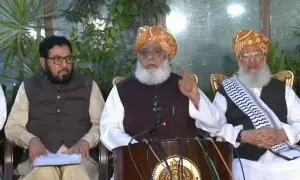
PM speaks to Fazl on reducing tensions between Centre, KP govtSeparately, Jamiat Ulema-i-Islam—Fazl (JUI-F) chief Maulana Fazlur Rehman met PM Shehbaz in Islamabad after the two discussed reducing tensions between the Centre and the KP government during a phone call.
According to a statement from the Prime Minister Office (PMO), the two held consultations on “important national and political matters”.
An earlier statement by the JUI-F confirmed that Fazl had departed for the talks on the “country’s political situation”.
JUI-F spokesperson Aslam Ghauri, in the statement, said Fazl also took the “PTI leadership into confidence” before heading for the meeting with the prime minister.
An earlier statement from the PMO said PM Shehbaz had called the JUI-F chief and congratulated him on performing Umrah and extended an invitation for talks at the Prime Minister House.
The two also discussed reducing tensions between the Centre and the KP government during the phone call, the statement said.
The phone call follows recent contacts between Fazl, known for his engagement with politicians from across the board, and the opposition.
On Tuesday, TTAP leaders called on Fazl at his residence, following which the veteran politician advised the federal government not to obstruct the PTI long march heading towards Islamabad, as protests were a democratic right enjoyed by all political parties.
The next day, PM’s Adviser on Political Affairs Rana Sanaullah, Parliamentary Affairs Minister Tariq Fazal Chaudhry and National Assembly Speaker Ayaz Sadiq met the JUI-F chief.
On Thursday, PTI MNA Junaid Akbar confirmed that Fazl had offered to play a role in ending the deadlock between the government and opposition, adding that the PTI’s “doors are open” to it.
Speaking on Geo News, Akbar had said no framework had been put forward by Fazl regarding his role in the negotiations, although he noted that the JUI-F chief had been in touch with PTI leadership while he was away for Umrah.
The same day, Defence Minister Khawaja Asif also hinted at efforts to restart negotiations between the Centre and the opposition, saying, “I wish a positive result comes out of the efforts of those involved in the talks. But, I have little hope.”
Speaking to Dawn, JUI-F spokesman Aslam Ghauri said his party chief was playing the role of a “facilitator, not a mediator”.
He distinguished the two roles by saying that a mediator would have the authority from opposition parties to make their own decision in light of their demands.
“It is our (JUI-F’s) priority to bring both sides on table for resumption of talks,” he added, pointing out that they had urged the government to call a multi-party conference in Parliament House, where political and security issues should be discussed.
The JUI-F leader said sitting at the table would benefit both sides, though the resumption of dialogue would mostly benefit the PTI because the KP government is “virtually being run by someone else and not by Chief Minister Sohail Afridi”.
PTI holds consultationsLate night, the PTI also held a meeting of its core committee and political committee. A handout issued early on Sunday said the meeting deliberated on the country’s prevailing political situation, particularly the potential imposition of emergency or governor’s rule in KP, measures against terrorism and the ongoing long march.
According to the handout, the party said it strongly opposed the potential imposition of an emergency or governor’s rule, terming it a direct attack on the mandate of the people of the province, the elected assembly and constitutional and democratic rights.
The meeting made clear that any such measure would lead to a further increase in political tension, public unrest and a sense of deprivation in the province, the statement said.
The meeting also made clear that the protection of the constitutional and democratic rights, peace, development, and prosperity of the people of the merged tribal districts was indispensable.
“The fundamental objective of mainstreaming the people of these areas was the protection of their rights and the elimination of their sense of deprivation. Any measure that runs contrary to these objectives and creates further unrest among the people will be opposed,” the statement said.
It also condemned terrorism in all its forms and manifestations. The statement said that the policy adopted to deal with terrorism, must prioritise the resolutions passed by the provincial assembly and the stance of the political and parliamentary parties of the province so that effective and sustainable measures could be made possible with public confidence and cooperation.
It also announced full support for the ongoing “peaceful long march” under the leadership of KP CM Afridi. The meeting also refuted reports about alleged differences between Afridi and the party committees.

CHARSADDA/MARDAN/SWABI: Khyber Pakhtunkhwa Chief Minister Sohail Afridi on Saturday said he will not accept any “illegal move”, including the imposition of governor’s rule or an emergency.
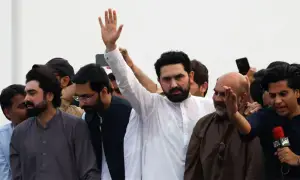
The KP CM made the remarks while addressing his supporters in Mardan, where the PTI long march led by him arrived on its seventh day. The federal government, citing differences over the counterterrorism policy, is mulling the option of imposing an emergency or governor’s rule in KP.
Afridi said that if governor’s rule was imposed or any “wrong decision” was taken, the long march would head to Peshawar instead of Swabi, and then move towards D-Chowk in Islamabad.
He urged the public to come out for the release of incarcerated PTI founder Imran Khan, adding that Pakhtuns would not be intimidated by threats, guns or bullets.
The KP CM asserted that arrests and other measures could not demoralise PTI workers. He said that his party would continue its struggle to end the injustices being committed against Imran and secure his release.
Speaking on the occasion, MNA Muhammad Atif Khan contended that Afridi had placed the federal government in a difficult position through his strategy.
The PTI launched the march despite warnings from the Centre after Oct 3 talks with the federal government failed to bridge their differences for multiple reasons, particularly over counterterrorism measures.
The route plan for the march has undergone multiple changes since its launch on Oct 4. While the party initially vowed to march towards Islamabad, its final destination seemingly remains tentative as the KP CM has yet to announce the plan for the trek after Oct 11, beyond Swabi.
So far, the march — being carried out to demand Imran’s release — has remained within KP, where the PTI is in power.
Swabi authorities prepare for PTI march
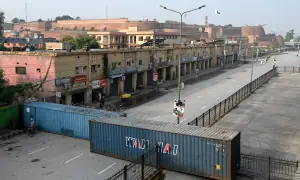
Meanwhile, containers have been transported to Swabi Interchange and the Indus River bridge on the M-1 Motorway to block the party’s march, but the motorway and the Grand Trunk Road remain open to traffic.
The bridge is particularly significant because it links Punjab and KP, which lie on opposite banks of the river.
Afridi earlier called on PTI supporters across Pakistan to reach the Swabi Interchange on Oct 11 to join his long march.
However, PTI district president Sohail Yousafzai said the convoy would reach Swabi on Oct 12 (Monday), adding that Afridi had directed party workers, lawmakers and office-bearers from across the country to reach Swabi by then.
Echoing a plan announced by Afridi earlier, Yousafzai said that convoys from the Peshawar, Malakand and Kohat regions would reach Swabi Interchange on Oct 13, while those from Hazara, Bannu and Dera Ismail Khan would arrive the next day, when the CM Afridi would announce the next course of action.
The KP chief executive is expected to address party workers at Shewa Adda in Razaar tehsil at 1pm, at the district headquarters at 3pm and at Topi tehsil at 5pm, which shares a boundary with Ghazi in Haripur district.
In a post on X earlier in the day, KP Information Minister Shafi Jan said the convoy will stay overnight in Mardan. He also said the future course of action will be announced on Oct 13 and they will move beyond Swabi.
Refused pressure, Afridi claimsEarlier in the day, the KP CM addressed a large gathering at Farooq-i-Azam Chowk in Charsadda, where he reiterated his opposition to any military operations in the province.
Afridi said he stood firmly with the people and would not accept decisions imposed through pressure or threats.
“I was asked to sign, but I refused,” he said, adding that he would neither retreat from his position under pressure nor compromise on his principles.
Afridi said his position on national security and the Kashmir issue was clear and unequivocal. He noted that important national matters should be addressed on the basis of principles rather than political pressure.
Referring to what he alleged were preparations for a possible military operation, the KP CM reiterated that he would not sign any document under pressure. He claimed attempts had been made to persuade him to agree to certain decisions, but he had declined.
Afridi has repeatedly voiced his opposition to the federal government’s policies on counterterrorism and Afghanistan since he was elected as the KP chief minister in October 2025.
Speaking in Charsadda, the PTI leader stressed the need to protect public rights, democratic values and the people’s mandate, saying public aspirations and ground realities should not be ignored in decision-making. He urged party workers to remain united and maintain discipline in their political struggle.
He referred to the “threats” of the imposition of governor’s rule or emergency, adding that the matter “had gone beyond seats and power” and he was ready to “sacrifice” his seat for Imran and Pakhtuns.
The chief minister highlighted that KP had suffered immense losses in the fight against terrorism, adding that the sacrifices made by its residents should not be forgotten and that their concerns regarding peace, stability and fundamental rights deserved serious attention.
Afridi reiterated he would announce the next plan of action on Oct 13 at the Swabi interchange.
He called on PTI workers to remain united in their struggle for their rights, adding that political differences should be resolved through democratic means and that the voice of the people should be respected.
The KP CM urged party supporters to remain steadfast and vigilant amid the prevailing political situation.
The gathering drew hundreds of PTI supporters to the roundabout, many wearing red caps and chanting slogans in support of Imran. The chief minister addressed the crowd from a container alongside party leaders.
Guidelines issued for police to deal with protestsWhile the PTI seemed determined to continue with its long march, KP Inspector General Zulfiqar Hameed issued operational guidelines to the police to deal with protests.
The document issued by the police chief, available with Dawn, noted that in “all cases of public protests there is a possibility that miscreants and anti-state elements may use an opportunity to [incite] violence and carry out sabotage activities”.
To prevent such acts, the guidelines were issued in continuation of Operational Guidelines-9/2013 and in light of Sections 83 to 88 of the KP Police Act 2017, for “strict compliance”.
The KP IG directed personnel to exercise “maximum restraint” and avoid the use of force for peaceful protests. “The protesters shall be engaged in negotiations through the senior-most police officer available.”
However, it provided guidelines for a phased use of force to disperse violent protesters. “When it is required to use force as per law, its application shall be of minimum essential standard,” it stated.
The guidelines allowed the use of force to be graduated from the minimum to the “optimum level required” in the following manner:
The guidelines directed personnel to exercise “extreme caution” while using force against protesters to avert damage to life and property.
“Anti-riot squad or the personnel entrusted with use of force shall be properly equipped with anti-riot to avoid damage/casualties to life of all concerned.”
Station house officers (SHOs) were also told to“arrange video-recording, preferably through professional cameramen, of the entire protest/procession”.
The police were directed to seize firearm weapons or any article referred to in Section 86, Sub-Section (1) of the KP Police Act from any person possessing them and take legal action against the individual.
The guidelines issued by the IG said district police officers (DPOs), sub-divisional police officers (SDPOs) and SHOs were to personally attend to all protests in their areas of jurisdiction.
To prevent “unlawful assemblies”, any police officer could temporarily close or regulate any street or public place to prohibit persons or vehicles from entering the area for security reasons under Section 88 of the KP Police Act, 2017.
To prevent “serious disorder, breach of the law or imminent danger to life and property, appropriate use of force will be ordered” by the sub-divisional police officers (SDPOs), SHOs, or the senior-most officer present at the site.
The police strength shall include the following formations:
SHOs were to specifically ensure deployment of sufficient police strength at vulnerable places, including police stations, government buildings, petrol stations, banks, shopping centres, and major highways and roads.
Police officers were also allowed to stop any procession which violates the conditions of a licence granted under section 84 of the KP Police Act and order it to disperse.
KP speaker writes to IG over MPAs’ security withdrawalShortly after the guidelines were issued, the KP information minister alleged that provincial police had withdrawn the security assigned to him and all parliamentarians.
“If any harm comes to me or any parliamentarian, the KP IG will be responsible,” he said.
In a post-midnight letter to IG Hameed, the KP Assembly Secretariat expressed Speaker Babar Saleem Swati’s “serious concern” over the withdrawal of security.
The letter, dated Oct 11 and shared by Jan, directed the IG that “any security personnel withdrawn shall be restored forthwith”.
It stated that no security personnel deployed for the protection of any MPA “shall be withdrawn, detached or discontinued without lawful justification and due compliance with the applicable law”.
The secretariat reminded the IG of the recent KP Provincial Assembly (Powers, Immunities and Privileges) Act 2026, which made the speaker’s approval mandatory to arrest or detain an MPA.
“Any such action in violation of the law may amount to a breach of the privileges of the members and the provincial assembly,” it stated.
It further warned, “In case of any harm or untoward incident involving any honourable member arisin from the withdrawal of security, the matter would be viewed seriously and dealt with in accordance with the applicable law.”
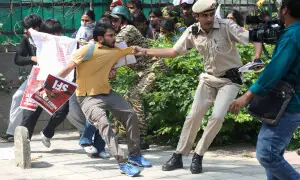
Indian police detained the head of the Cockroach Janta Party, as well as thousands of protesters trying to take part in a major demonstration in New Delhi against the country’s election commissioner, the group said on Saturday.
The protest is the culmination of weeks of opposition mobilisation following allegations of misconduct during a nationwide voter-roll revision by the Election Commission of India (ECI).
CJP founder Abhijeet Dipke and two other leaders were detained before disembarking from a flight in the capital, according to a statement from the movement.
“They’re being denied access to their lawyers and cut off from all contact with others,” it said, adding the trio had been taken to “an undisclosed location”.
The CJP also said that thousands more protesters were detained in New Delhi as they attempted to march to the main Jantar Mantar protest site, defying a massive security clampdown.
“More than 15,000 protesters have been detained,” Ajinkya Shinde, a CJP leader, said at a news conference in Delhi.
Police did not immediately respond to AFP’s request for comment on detentions.
“We will be back, let them fill up all the jails,” Shinde said.
Dozens of protesters shouted anti-government slogans as they were taken away in police vehicles, AFP reporters witnessed.
Calls for the ECI chief Gyanesh Kumar to step down have intensified in recent weeks as opposition parties and critics said his commission’s voter-roll revision could disenfranchise millions of constituents and benefit Prime Minister Narendra Modi’s ruling Hindu nationalist Bharatiya Janata Party (BJP).
The ECI has rejected allegations of impropriety, saying the revision was intended to remove duplicate and ineligible voters.
Ahead of the protest, authorities in the capital deployed thousands of police, closed dozens of metro stations, cancelled more than 200 trains and temporarily shut down mobile internet around the protest site.
Rapid Action Force (RAF) personnel stand guard ahead of a protest by the youth-led Cockroach Janata Party (CJP) demanding the resignation of India’s Chief Election Commissioner over alleged “special intensive revision” (SIR) voter-roll irregularities, in New Delhi on October 10, 2026. — AFPThe demonstrations are widely seen as a reprise of the “cockroach” movement’s mass mobilisation in July, which led to the education minister stepping down over an examination scandal.
This time, protesters are demanding Kumar’s resignation and a halt to the voter revision exercise.
Fresh challengeThe accusations are a fresh challenge for 76-year-old Modi during his third term in office.
Opposition parties have long alleged that legitimate voters are being struck off lists in India, the world’s largest democracy with 1.4 billion people.
The issue flared up last month when Indian Express reported that key decisions linked to the revision were likely taken without the approval of two of the three election commissioners.
The ECI, a constitutional body, says all its decisions were unanimous and legally valid.
Demonstrators expressed anger on Saturday, telling AFP their right to protest peacefully was being hampered.
Saransh, a university graduate, walked several miles after navigating security barricades to get close to the Jantar Mantar protest site.
“I am here to protect the constitution,” said the 24-year-old, who gave only one name.
“Why do I need permission to peacefully express my opinion?”
‘Keep protesting’Amnesty International denounced the “lockdown-like restrictions” and leader of the opposition Congress party, Rahul Gandhi, called on young people to continue with the rallies.
“Youth of India, I am proud of you. Keep protesting. We are standing with you,” he said.
The Hindu reported that more than 5,000 protesters had been detained, although it was not immediately possible to verify that number.
Media outlets, including the Scroll and Newslaundry, said their journalists had also been detained briefly.
The United Nations’ human rights office urged India to release those “arbitrarily detained” in the protests and expressed concern at reports of mass detentions.
BJP spokesman Sambit Patra said on Saturday the CJP had failed in its attempt to spread “anarchy”.
“What is happening at Jantar Mantar, what you can see on TV and a few social media handles, is not India’s story,” he told reporters.
The voter list overhaul, which began in 2025, has led to more than 133 million names being excluded from draft rolls, according to Indian media reports citing ECI data.
The ECI has said the voter-roll revision identifies fraudulently registered voters and aims to prevent “foreign illegal immigrants” from voting.
Critics say the drive has disproportionately affected marginalised and minority communities.
Members of Modi’s party have long alleged that large numbers of undocumented Muslim migrants from neighbouring Bangladesh have fraudulently entered India’s electoral rolls.
Political analyst Nilanjan Mukhopadhyay told AFP the protest comes at a time when Modi appears to be “at his weakest politically and individually”.
Though India’s next general elections are not slated until 2029, the country’s most populous state of Uttar Pradesh will go to the polls next year.
“I see this becoming a bigger challenge in the coming months,” Mukhopadhyay said.

The Rawalpindi deputy commissioner on Saturday announced that Section 144 had been imposed in the district for a period of 30 days, over threats to sensitive installations and other critical infrastructure.
Section 144 is a provision in the Code of Criminal Procedure which empowers local authorities to ban public gatherings such as rallies, processions and sit-ins, as well as the open display of weapons.
It has been imposed amid the PTI’s long march, which has so far remained within Khyber Pakhtunkhwa, but had initially announced to move towards the federal capital. The KP chief minister reiterated today that he would lead the convoy towards Islamabad.
According to a notification seen by Dawn, the District Intelligence Committee (DIC) in a meeting today warned the DC of an “imminent threat” within the district to sensitive installations, major roads and other infrastructure “which may pose a serious risk to human life, public property, and the overall peace and order of the district”.
“The DIC has reported specific intelligence suggesting that certain groups and elements are actively mobilising with intentions to disturb the law and order situation through large gatherings, protests, and disruptive assemblies,” the notification read.
Moreover, the committee indicated that these elements may mobilise “individuals with the potential to engage in violent actions” against soft targets and near key installations and other sensitive sites.
Imposing Section 144, DC retired Captain Nadeem Nasir prohibited public gatherings of more than five people, as well as the open display of weapons, improvised explosives, spikes, laden batons, gulails, ball bearings, petrol bombs, or other instruments that could cause physical harm.
It also banned the use of drones and any attempts to “remove any restriction” imposed by the police to regulate assemblies and traffic.
The order is set to expire on Nov 8.
Section 144 has already been imposed in several parts of the country, with Islamabad imposing the provision for two months in a notification dated September 18.
The order prohibited gatherings of five or more people, as well as processions, rallies and demonstrations, at any public place within the revenue limits of the district, including the Red Zone.
Similarly, Section 144 is in force in Lahore until Oct 15, with the order citing serious threats to public peace, tranquillity and the safety of life and property.
According to a notification issued by the Punjab Home Department, a complete ban was imposed on assemblies, processions and gatherings of five or more persons at public places, roads and open spaces.
However, the ban would not apply to wedding ceremonies, funeral prayers, burials, mosques and other places of worship, courts or government institutions.
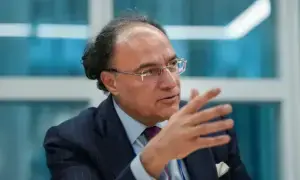
Finance Minister Muhammad Aurangzeb on Saturday departed for Bangkok for the annual International Monetary Fund (IMF) and World Bank Group meetings.
In a statement, the finance ministry said Aurangzeb would lead Pakistan’s delegation to the World Bank Group–IMF annual meetings, scheduled to be held from Oct 12 to 18.
Thailand is preparing to host the IMF-World Bank annual meetings in Bangkok, bringing together more than 15,000 participants from 191 countries, including central bank governors, economic policymakers and business leaders, for discussions on the world economy.
“During the visit, the finance minister will represent Pakistan at key events of the IMF and the World Bank Group and undertake an extensive programme of over 60 high-level engagements with international financial institutions, finance ministers and policymakers, development partners, global investors, banks, credit rating agencies, think tanks and international media,” the statement said.
The ministry said the visit came as Pakistan continued its transition from “macroeconomic stabilisation towards sustainable, investment and export-led growth, while advancing structural reforms and strengthening engagement with international capital markets and development partners”.
The statement said Aurangzeb will hold a series of high-level engagements with the leadership of the IMF and World Bank Group, including the International Finance Corporation and the Multilateral Investment Guarantee Agency, focusing on Pakistan’s macroeconomic outlook, reform progress, private sector development and future cooperation.
He will also attend the IMF managing director’s meeting with finance ministers, central bank governors and heads of regional financial institutions of the Middle East, North Africa, Afghanistan and Pakistan region.
He will also engage with the leadership of major multilateral and development finance institutions, including the Asian Infrastructure Investment Bank, the Opec Fund for International Development, the Saudi Fund for Development, the International Islamic Trade Finance Corporation, the Japan International Cooperation Agency, the ECO Trade and Development Bank, the United Nations Economic and Social Commission for Asia and the Pacific, and the International Organisation for Migration.
“On the bilateral front, Aurangzeb will hold high-level meetings with counterparts from Saudi Arabia, China, Turkiye, Iran, the United Kingdom and host country Thailand, aimed at strengthening economic, investment, trade and development cooperation. He will also engage with the US Department of the Treasury to further strengthen bilateral economic cooperation and discuss Pakistan’s reform and investment agenda,” the statement said.
The ministry said Aurangzeb will also meet and participate in investment seminars, sovereign investor forums and roundtable discussions with leading international financial institutions.
“These engagements will provide an opportunity to highlight Pakistan’s improving macroeconomic fundamentals, structural reform agenda, international market access and investment potential,” it said.
The minister will engage with Alibaba International Digital Commerce as part of discussions on Pakistan’s digital economy, e-commerce and investment opportunities.
In addition, he will participate in key multilateral forums and will also contribute to high-level policy discussions.
“As part of Pakistan’s international market outreach, the finance minister will hold engagements with all three major global sovereign credit rating agencies, Fitch Ratings, Moody’s and S&P Global, and present Pakistan’s economic and reform trajectory to international investors,” the statement said, adding that he would also engage with leading international media organisations.
“Across these engagements, the finance minister will highlight Pakistan’s progress in restoring macroeconomic stability, strengthening fiscal and external buffers, advancing structural reforms and returning to international capital markets, while setting out the government’s priorities for investment, exports, private sector-led growth, job creation and greater financial inclusion,” it said.
Additional input from Reuters

Jurist and former UN rights chief Navi Pillay, the winner of this year’s Nobel Peace Prize, on Saturday called sanctions announced by the US on the International Criminal Court (ICC) “unheard of” and “unacceptable”.
“There is so much tension and anxiety over the continued existence of international courts, mainly the International Criminal Court in The Hague,” Pillay said via video link from Nuremberg during an event at the Nobel Peace Center in Oslo, lamenting “there are hundreds of staff who feel they are under threat”.
“Most importantly, sanctions have been announced by one country against the judges, just for the judicial orders they issue. This is unheard of, unacceptable,” the 85-year-old South African lawyer said.
The Norwegian Nobel Committee on Friday announced that Pillay, who once sat on the ICC, was this year’s recipient of the prestigious Nobel Peace Prize.
Both the United States, whose leader Donald Trump has long coveted the award for himself, and ally Israel condemned her being awarded the honour.
Hours after Pillay was named the laureate, the United States announced new sanctions against the ICC, provoking swift condemnation from member states and the United Nations.
US Secretary of State Marco Rubio said Washington would ban transactions with what he described as a “rogue court”, escalating a long-running campaign by Trump’s administration against the Hague-based tribunal.
‘History will judge’The court rejected the US sanctions as an attack on international law and warned in a statement that “history will judge this moment”.
In addition to serving on the ICC, Pillay was the UN human rights high commissioner from 2008 to 2014, and headed the UN Independent International Commission of Inquiry (COI), which found last year that genocide was occurring in Gaza. The body does not speak on behalf of the UN.
Israel has rejected the COI’s findings, calling them “distorted and false”.
Israel’s foreign ministry said the award legitimised “anti-Israel hatred”, adding that it thought that Nazi propagandist Joseph Goebbels must be “applauding from hell”.
Israeli Prime Minister Benjamin Netanyahu said the awarding of the prize to Pillay showed the Nobel committee had “lost its moral compass” by honouring “a bigot”.
Trump, who last month called on ICC member states to quit the court, meanwhile labelled the committee’s choice as “a disgraceful and embarrassing decision”, telling a rally of his supporters in Syracuse, New York, he had “never heard of” Pillay.
WITH the spectre of defeat in the upcoming midterm elections looming large over the Trump administration, the Republicans are resorting to desperate attempts to rally their base.
Right-wing American media, GOP candidates, and the incumbent US administration, who have spewed Islamophobia ad nauseam, have now found a perfect prop in convicted mass murderer Nidal Hasan, who shot and killed 13 at the Texas Fort Hood military base in 2009.
Hasan is to be executed by firing squad on Dec 3, according to a Pentagon announcement, and US Defence Secretary Pete Hegseth is to ensure his execution is livestreamed to the world. Seemingly threatened by the emergence of progressive, well-liked Democratic politicians such as Zohran Mamdani and Abdul el-Sayed, both of whom have greatly upset those who believe American politics should be limited to specific religions and races, the Trump administration is asserting its version of American ‘greatness’.
And, having run out of political answers, it is doing so in the most Trumpian manner imaginable: by publicly killing a Muslim man and celebrating the accomplishment.
To be clear, Hasan has been convicted under US law and — although this paper does not support executions — deserves to be punished for his crimes. However, to turn him into a prop for election theatrics is a new low even for the current Trump administration. It is no wonder that the announcement of a livestreamed execution has drawn condemnation from both sides of the aisle and led critics to draw parallels with the lynchings of Black Americans — a similar public spectacle in early 20th-century America.
If this grotesque and reprehensible deed is accomplished, the US will join the ranks of a handful of totalitarian states that have practised public executions in recent memory. That list includes the Afghan Taliban regime. As Nietzsche warned, “if you gaze long into an abyss, the abyss also gazes into you”. America is gradually turning into the regimes it most despises.
Published in Dawn, October 10th, 2026

Cristiano Ronaldo has been provisionally suspended after the Portuguese Football Federation (FPF) announced on Saturday that it had opened disciplinary proceedings against the 41-year-old over his decision to walk out on the national team.
Ronaldo apologised to supporters earlier this week while criticising Portugal coach Jorge Jesus and said he would accept any punishment that was imposed.
“Disciplinary proceedings have been initiated against Cristiano Ronaldo,” said the FPF in a statement, classifying the case as “urgent” and confirming Ronaldo is currently suspended pending a decision on the final punishment.
Ronaldo left Portugal’s Nations League squad after first being made to warm up as a substitute against Norway on September 27 and not brought on, and then finding out he would not start against Denmark in the match on October 1.
The former Real Madrid and Manchester United attacker is the all-time top goalscorer and record appearance-maker in men’s international football.
According to Portuguese media, under the federation’s regulations, a player who misses a training session, a match, or a national team activity faces a suspension ranging from one to six months.
On Tuesday, Ronaldo accused Portugal coach Jesus of breaking his word about giving him game time in Nations League matches but said he was not retiring from international duty and would be available to play once any potential punishment was served.
“I will be available, as I have always been until today, to compete and win for our national team,” Ronaldo said, while accepting his actions must be “punished” by the federation.
Pele or MaradonaRonaldo said Jesus had gone back on his word about bringing him on against Norway, and then in a press conference before the Denmark match had not said a series of points they had agreed upon during a conversation beforehand.
One of Ronaldo’s pre-approved talking points was that Jesus had “made a mistake in asking someone of the stature of Pele or Maradona to warm up and then not sending him on in the match.”
Jesus chose not to respond to Ronaldo’s statement when asked about it.
“I read the statement, and now, like I do every day, I’m going to the federation headquarters to work, to think about the Portuguese national team,” said the 72-year-old coach.
Jesus said on last Sunday he would select Ronaldo for international duty if the forward was playing for his club and was interested in being called up.
Portugal won all four of their Nations League matches and qualified for the quarter-finals with two games to spare.
Portugal host Denmark on November 14 and then travel to face Wales on November 17 in their final two Nations League Group A4 matches.
Ronaldo returned to club action on Friday with Saudi Arabian side Al-Nassr and scored as they won 3-0 against Diriyah in a Saudi Pro League match. It was the striker’s 980th career goal.

ISLAMABAD: Prime Minister Shehbaz Sharif on Saturday ordered the installation of “smart scanners” at all international airports to facilitate travellers, according to a statement from his office.
The premier issued these instructions during a meeting reviewing the customs enforcement in Islamabad, attended by Deputy Prime Minister and Foreign Minister Senator Muhammad Ishaq Dar, as well as Federal Ministers Azam Nazeer Tarar, Dr Musadik Malik, Ahad Khan Cheema and Attaullah Tarar.
PM Shehbaz ordered that the scanners be immediately imported and that, once installed, baggage should be screened with the new technology as opposed to being searched manually by customs officials.
According to the statement, he also issued directives for customs officials, saying that passengers must not be harassed through unnecessary questioning at airports.
“The prime minister further stated that outdated procedures for screening passengers’ baggage at airports must be abandoned. Passenger convenience and comfort are the top priority, and no one will be allowed to harass passengers,” the statement read.
The Prime Minister’s Office (PMO) added that an “internationally established automated system will be introduced for baggage screening” and that staff providing other services at airports would be trained in line with international standards.
“Courtesy and respect for human dignity in service delivery must be key components of the training,” the statement added.
Commending a new enforcement system introduced by the Customs department, the premier said the initiative deserved appreciation, crediting Federal Board of Revenue (FBR) Chairman Rashid Mahmood Langrial and his team.
He stressed that every possible step must be taken to curb revenue leakage, reiterating a policy of zero tolerance against tax evasion.
“Tax-paying businesses are respectable, while tax evaders will face strict action. We are custodians of the poor man’s money and will protect it at all costs,” he remarked.
Reviewing the customs system, the premier was briefed on the movement of goods and monitoring at various locations nationwide, and the performance of the Customs Enforcement Force and measures to prevent the smuggling of petroleum products.
“The meeting was informed that significant progress had been made in establishing and operationalising Digital Enforcement Stations under Customs Enforcement,” the PMO said, adding that the Indus Collectorate, in its first three weeks of operation, executed 80 operations and seized goods worth approximately Rs205 million.
“A total of 865 personnel had been deployed, covering 26 major transit routes,” it added.
With operations ongoing against smuggled textiles, vehicles, cigarettes and other goods, 280 goods valuers had been recruited and would be trained this month and in November, the statement read.
“The meeting was also informed that, as a result of the FBR’s reforms to prevent smuggling, the customs enforcement system had been consolidated into a single, coordinated organisation operating nationwide,” it added.
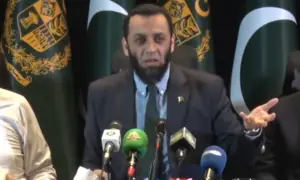
Information Minister Attaullah Tarar on Saturday assailed the PTI-led Khyber Pakhtunkhwa government over a “lack of governance” in the province.
Addressing a press conference in Islamabad, he alleged that the provincial government was given Rs700 billion under the National Finance Commission for development projects.
“You did not upgrade the Counter Terrorism Department (CTD), did not establish forensic labs, did not install safe city cameras, which should be installed in the merged districts and all the entry-exit points of KP’s districts,” he alleged.
On the other hand, the information minister claimed that the PTI was spending this money on organising protests.
“You don’t even give half an hour to discuss terrorism in the province, but you organise six-hour meetings to spread turmoil and vandalism,” he criticised.
Tarar further said that the PTI had “trapped” millions of people in the province to get its leader, former prime minister Imran Khan, released from jail.
“You trapped them in poverty, in disease by not providing the adequate health facilities, in ignorance by not providing educational opportunities, and in non-development by not improving infrastructure,” he said.
Tarar also alleged that the KP government had held the people of the province “captive to terrorists”.
“From the very first day, this is my opinion that they [PTI] are the B-team of the Tehreek-i-Taliban Pakistan,” Tarar said.
The information minister said that the PTI facilitated terrorists in settling in the country.
“For how long will it go on? That the security forces will clear the area of terrorists and establish peace, but you will bring the terrorists back?” he asked.
During his address, Tarar said that the PTI government in KP had dragged the province into the “stone age” during the last 13 and a half years.
Citing various federal government projects, Tarar maintained that there was no comparison of the hours spent working by Prime Minister Shehbaz Sharif and KP Chief Minister Sohail Afridi to address governance issues and take relief and reform measures.
He said that the chief ministers of all the provinces were working hard, questioning how many hours Afridi spent on governance.
“Tell us if you have ever given a big hospital, a university, a highway to your people, an information technology project to the youth of KP or given them laptops or gadgets,” he said.
“How long can such a system, where there is chaos and extremist politics, continue?” he asked.
He claimed that the KP government wanted to hand over the province to terrorists as it prioritised “personal interests over the national interests”.
“This province needs peace, not politics,” Tarar stated.
Asked about imposing an emergency or governor’s rule in KP, Tarar said that responding to this question would be premature.
“Everyone is asking how long KP and its people will remain at the mercy of its government,” he said.
“In my opinion, the conditions in KP have never been worse. They could not be worse than this. What’s worse than terrorists roaming in the streets? You have designated no-go areas in most of your districts because you collect ransom in collusion with terrorists,” he claimed.
He said that the people of KP go to Punjab or other provinces for medical treatment.
“Will there ever come a time when people from across Pakistan go to KP for treatment?” he asked. The information minister asserted that the PTI would not be allowed to destroy the province.
Addressing the same press conference, Coordinator to the Prime Minister on Information for KP Affairs Ikhtiar Wali Khan also questioned the lack of development in the province.
“Universities are shutting down because there are no vice chancellors there. Eighteen out of 34 universities in KP are on the verge of bankruptcy,” he said.
Wali said that people complained about the lack of good roads in Karachi. “But when people of KP go to Karachi, they say that Karachi’s roads are much better than KP.”
Calling on the people and journalists in KP, Wali urged them to talk about the “ground realities”, claiming that the people were crying over the existing health facilities in the province.
He referred to the KP police as the shuhada force, alleging that the provincial government had left them unarmed. He alleged that the PTI government had seized the money allocated to fund the CTD to combat terrorism.
Wali also accused KP ministers of corruption and bad governance in the province.
“The people of KP need peace, health facilities and a political culture based on tolerance, acceptance and respect,” he said.
The PML-N-led federal government and the KP government led by PTI — which is in opposition in the Centre — have been at odds over various issues, particularly on the counterterrorism policy. This was also a key reason behind the breakdown of the Oct 3 talks between them.
The PTI has said it was being left out of security decisions concerning KP, which the Centre has denied. It also calls for reviewing the counterterrorism policy, while the latter criticises the KP government’s efforts to combat terrorism in the province and objects to its stance on dialogue with the Afghan Taliban.
Kundi, Muqam discuss KP’s security and political situationIn Peshawar, Minister for Kashmir Affairs and Gilgit Baltistan Amir Muqam met KP Governor Faisal Karim Kundi at Governor House, where they discussed the overall law and order situation in the province.
According to a joint statement issued after the meeting, the two leaders also discussed the PTI’s long march and exchanged views on issues of mutual interest, particularly the political environment in the province.
Kundi and Muqam thanked the people of KP, saying they had rejected the politics of unrest and confrontation.
They reiterated that the federal government would continue taking all possible measures to restore lasting peace, strengthen security and accelerate public welfare and development in the province.
The two leaders also observed that the people of KP had grown frustrated with terrorism and what they described as political elements promoting instability, reaffirming the federal government’s commitment to ensuring peace and stability in the province.
In a post on X, Kundi said, “Our people have paid an unbearable price in the war against terrorism. They cannot be held hostage to the politics of anarchy and agitation.”
He affirmed that the federal government “will continue to take all possible measures to strengthen security, protect our people and support the province’s development”.
“The future of KP cannot be sacrificed at the altar of political ambition,” the governor declared.
“This province does not need any more political stunts that undermine security and endanger lives. I commend the people of KP for standing with peace,” he wrote.
In recent days, federal ministers have assailed the PTI for staging a protest long march, which it has been warned against, at a time when KP faces security challenges. They have also linked differences over the counterterrorism policy with the possibility of an emergency or governor’s rule in KP.
On Friday, Parliamentary Affairs Minister Dr Tariq Fazal Chaudhry said the government had finished deliberating on the imposition of an emergency and warned that it would avail the option if the KP government did not cooperate on counterterrorism.
Gohar meets CM AfridiOn the other hand, PTI Chairman Barrister Gohar Ali Khan said on X that he met CM Afridi in Peshawar to discuss the country’s political situation, the party’s long march and “other important matters”.
PTI Secretary General Salman Akram Raja, MNA Junaid Akbar, Parliamentary Leader Shahid Kattak and KP Information Minister Shafi Jani were also present during the meeting.
Speaking to reporters after the meeting, Gohar said the imposition of governor’s rule or an emergency was not the right solution to the province’s issues, considering the “circumstances”.
The PTI chairman said there were no conflicting views on eradicating terrorism, but rather on the method of doing so, which could be resolved.
“Those who have taken up swords against the state [and[ those who are enemies of the state are our enemies; if they can be eradicated by imposing governor’s rule or an emergency, we would welcome it, but this would further deteriorate the situation,” Gohar said.
He called on the country’s political leadership to “demonstrate political wisdom” and said a meeting of either the federal or provincial apex committee should be called if any situation required the imposition of governor’s rule.
PTI rejects allegations linking it to terrorists
In a statement issued later in the day, PTI Central Information Secretary Sheikh Waqas Akram responded to the “outbursts of the so-called ministers and political orphans”.
He rejected allegations linking PTI to armed groups, declaring that the party neither supported armed struggle nor believed in the politics of violence and sabotage.
He said that “daily press conferences by liar-brigade, attacking PTI, were diverting attention from Pakistan’s economic, social and security challenges, lamenting that such useless and harmful pressers consumed valuable media airtime that could otherwise be used for public education, awareness programmes and substantive discussions on issues affecting ordinary citizens”.
The PTI leader challenged the federal government to prove the effectiveness of its security and administrative policies first in Balochistan, where, he claimed, large areas had become no-go zones, before replicating the failed policies elsewhere in the country.
Otherwise, he urged, the government should accept the comprehensive plan unanimously approved by the KP Grand Jirga peace plan to eradicate terrorism once and for all.
He further called for a comprehensive counterterrorism strategy “combining effective security operations with meaningful political engagement and respect for the rights of local communities”.
Referring to the Oct 3 talks with the government, the PTI leader claimed terrorism had not initially been central to the dialogue agenda but was subsequently introduced by the government, shifting attention away from other outstanding political issues.
Akram questioned the effectiveness of the government’s counterterrorism strategy, contending that policies “relying on force while overlooking local grievances had repeatedly caused destruction, displacement and resentment”.
According to the statement, the PTI leader acknowledged that KP faced security challenges but rejected claims that 11 districts had become no-go areas, calling such assertions “exaggerated and a possible pretext for imposing emergency measures or undermining the provincial government”.
The information secretary maintained that the Centre must respect the “mandate of KP’s elected government and refrain from interfering in provincial affairs”.
He vowed that PTI would “resist any attempt to impose decisions or legislation that compromised the constitutional rights of residents of the province and its merged districts”.
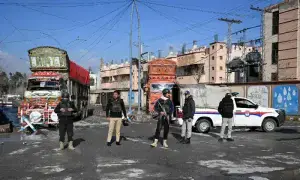
QUETTA: Ten terrorists were killed in a targeted intelligence-based operation conducted by the Counter-Terrorism Department (CTD) in Balochistan’s Barkhan district, the Home Department said on Saturday.
An aide in the Home Department, Babar Yousafzai, said: “During an intense gun battle, 10 armed terrorists were killed and two CTD officials were injured.”
The CTD had conducted a targeted operation after receiving credible information about the presence of terrorists belonging to the Indian proxy, Fitna al Hindustan, in the area, according to Yousafzai.
The state has designated Balochistan-based terrorist groups as Fitna-al-Hindustan to highlight India’s alleged role in terrorism and destabilisation across Pakistan.
Yousafzai added that the CTD had also seized a large quantity of arms, ammunition and explosives from the terrorists.
According to other officials in the department, two CTD personnel were taken to a hospital, while the bodies of the terrorists were taken to the Rara Sham district hospital.
Chief Minister Sarfraz Bugti paid rich tributes to the personnel of CTD for conducting the successful operation.
He said that our brave security forces were playing an important role in the elimination of terrorism from Balochistan and rendering sacrifices to protect the lives and property of the people.
On Oct 7, security forces killed five terrorists belonging to Fitna al-Hindustan in Balochistan’s Mastung district, according to state media.
Late last month, the military’s media affairs wing said that more than 71 terrorists had been killed in Shaban and other areas of Balochistan during 96 hours.
On Sept 17, three terrorists were eliminated in an IBO in Balochistan’s Awaran district’s Badrang area. Another three were killed in Mastung on Sept 14. Earlier that month, 21 terrorists were killed in separate engagements in Nokcha, Chagai, Ziarat Cross, and Pishin.
The number of terrorist attacks in the province increased by seven per cent from 83 in July to 89 in August, according to PICSS’ monthly assessment. As per the report, Balochistan was declared the province “most affected” by terrorism.
Palestinian President Mahmoud Abbas on Saturday postponed legislative elections to September next year, official media said, confirming widespread speculation over the polls which were last held in 2006.
The vote will be held alongside presidential elections on September 11, 2027, Abbas said in a decree, blaming “obstacles” imposed by Israel, according to the Palestinian Wafa news agency.
The legislative elections, which the international community has strongly advocated for, had been scheduled for November 28 this year, while a presidential vote was expected in early 2027.
Israel had blasted Abbas’s Palestinian Authority as “corrupt” over the anticipated delay.
“Abbas issued a presidential decree on Saturday calling for simultaneous presidential and legislative elections to be held on September 11, 2027,” Abbas’s office said in a statement published by Wafa.
The presidency blamed the delay on “obstacles imposed by Israeli measures that prevent elections from being held on their previously scheduled date, as well as the need to create appropriate political, security and on-the-ground conditions to ensure free, fair and inclusive elections”.
This week, Abbas’ Ramallah-based Palestinian Authority said Israel refused to allow Palestinian election officials access to east Jerusalem or Gaza ahead of the legislative elections.
Israel’s foreign minister Gideon Saar on Friday had accused Abbas of “fooling the international community” by planning to postpone upcoming legislative polls.
Holding polls is part of the reforms demanded by the international community for the Palestinian Authority, including the European Union.
The last legislative elections in the Palestinian territories were held in 2006, when Hamas won. They defeated Fatah, which dominates the Palestinian Authority.
The ensuing rift set off a round of factional fighting, with Hamas later seizing power in the Gaza Strip and creating a territorial divide between Fatah in the West Bank and Hamas in Gaza.
As a result, the Palestinian Legislative Council, which is the Palestinian Authority’s parliament, has not met since 2007.
Abbas won the last Palestinian presidential election in 2005, and his term should have expired in 2009, but he has since ruled by decree.
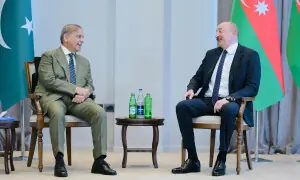
Prime Minister Shehbaz Sharif on Saturday reaffirmed Pakistan’s “deep-rooted, fraternal and strategic partnership” with Azerbaijan during a telephone conversation with President Ilham Aliyev, the Prime Minister’s Office (PMO) said.
According to the PMO, the two leaders reviewed bilateral ties and agreed to translate their strong political understanding into closer economic, investment and commercial cooperation.
“The prime minister reaffirmed Pakistan’s deep-rooted, fraternal, and strategic partnership with Azerbaijan, characterised by mutual trust and steadfast support on all issues of core national interest,” it said.
Reviewing bilateral ties, both leaders agreed that their exceptional political understanding must now be translated into a strong economic, investment and commercial partnership.
PM Shehbaz emphasised that the people of Pakistan held President Aliyev and the brotherly people of Azerbaijan in the highest esteem, the statement said.
The two leaders “expressed satisfaction at the growing momentum in their multifaceted cooperation and reaffirmed their shared determination to translate the exceptional political goodwill and understanding into a mutually beneficial economic, investment, and commercial partnership”, it said.
The two leaders also discussed progress on ongoing bilateral initiatives, particularly the operationalisation of the Asaan Khidmat Centre in Islamabad, modelled on Azerbaijan’s ASAN Khidmet service delivery system.
They described the centre as an example of the practical benefits of bilateral cooperation for the people of Pakistan, the PMO said.
At PM Shehbaz’s request, President Aliyev agreed to extend Azerbaijan’s full support and expertise for expanding the Asaan Khidmat network across Pakistan.
The prime minister thanked the Azerbaijani president for the gesture, describing it as another manifestation of his country’s enduring friendship and solidarity with Pakistan.
The two leaders also exchanged views on the evolving regional and international situation and stressed the need for continued consultations and coordination on matters of mutual interest, the statement read.
The prime minister briefed President Aliyev on Pakistan’s diplomatic outreach and efforts to promote peace, dialogue and de-escalation in the region.
President Aliyev appreciated Pakistan’s constructive diplomatic efforts to facilitate dialogue and mediation, acknowledging their importance for regional peace and stability, according to the PMO.
The conversation concluded with both leaders reaffirming their commitment to strengthening bilateral cooperation and transforming their strategic partnership into a lasting relationship of shared progress and prosperity, the statement added.
PM Shehbaz also took to X to post about the telephone conversation.
“We reaffirmed the enduring friendship and strategic partnership between Pakistan and Azerbaijan, and our resolve to translate our strong bilateral ties into greater economic, investment and trade cooperation,” he said.
The two leaders last spoke by phone on May 12, when they discussed regional developments and efforts to restore peace in the Middle East, while reaffirming the strong fraternal ties between Pakistan and Azerbaijan.
PM Shehbaz last visited Azerbaijan in May 2025, when the two leaders pledged to diversify their strategic partnership through investment in mutually beneficial areas. They also reviewed bilateral relations and expressed satisfaction over the growing cooperation between the two countries.

An artificial intelligence model developed by Anthropic submitted a fabricated tip about an unsolved homicide to Philadelphia police, authorities said on Friday, criticising the company for taking two months to report the incident.
The Philadelphia Police Department said the false submission was made in July through PhillyUnsolvedMurders.com, a public website where people can share information about unsolved killings.
According to Anthropic’s account, as relayed by police, the model was running a test that involved interacting with randomly selected websites when it reached the site and filed false information about an unsolved murder.
The AI model presented itself as someone who might have knowledge of the case.
The incident echoed other recent cases of unintended behaviour involving AI models, including one where an OpenAI agent undergoing a security evaluation broke out of its testing environment and breached systems at AI platform Hugging Face.
Anthropic’s breaches have prompted the White House to mandate that AI companies notify and correct security incidents, news outlet Axios reported citing administration officials.
“This notification and remediation process is not optional … It is a critical national security obligation,” White House Super Intelligence Force leaders said in a statement to Axios.
The episode heightened concerns about the industry’s increased use of AI agents, systems programmed to take multi-step actions without human supervision.
Anthropic published a report on Friday outlining multiple types of “unintended” actions that its models have taken, including the incident involving the Philadelphia Police Department website.
The report said other organisations impacted included the White House and other US government agencies.
The newly revealed incidents “had minimal real-world impact” and were “significantly less severe” than other cybersecurity incidents previously reported, Anthropic said.
‘Unacceptable’ delayThe company outlined four categories of incidents that it found during an internal review of its Claude model: exploiting “basic” coding flaws, submitting forms on websites, bypassing requirements for tokens or fees, and using short URLs to get around other limits.
Anthropic has turned off internet access for Claude during all internal testing for now “until we have confirmed that our security and monitoring measures … reliably catch behaviours like these,” the report said.
Philadelphia police said the phoney tip, dated July 18, was flagged as spam and never reached the department’s Real-Time Crime Centre for vetting. They added that there was no sign that police systems had been breached or department data compromised.
Anthropic discovered the incident on September 28, shut down the automated testing process responsible and added a new validation step for future tests, police said. The company alerted the department on October 7, and the two sides met the following day.
“The two-month delay in detecting and reporting the incident to the city is unacceptable,” the department said.
Police said their safeguards had limited the impact, but that these “do not diminish the seriousness of an AI system presenting fabricated information as though it came from a person with knowledge of a homicide”.
“Unsolved cases involve real victims, grieving families and investigators working to secure answers,” the statement added.
Parliamentary Affairs Minister Dr Tariq Fazal Chaudhry said on Friday that the Centre had finished deliberating on the imposition of an emergency in Khyber Pakhtunkhwa, warning that it would avail the option if the provincial government did not cooperate on counterterrorism.
The minister made these remarks on Geo News programme ‘Aaj Shahzeb Khanzada Kay Saath’, during which he also refused to confirm reports that a high-level meeting was expected on Saturday to decide on the imposition of an emergency in KP.
“The matter of any decisive meeting is not final, nor has it been notified,” he said.
The Centre has warned the PTI-led KP government in recent days of sending it packing through an emergency or governor’s rule as the party goes ahead with a protest march to demand the release of its jailed founder, Imran Khan. Federal ministers have cited the security situation in KP in this connection with the possibility of a state of emergency in the province.
Regarding the reports that the government was considering implementing an emergency in 12 districts of KP, he said, “The reality is that the government has completed its deliberation regarding the implementation of an emergency. Now it is in the hands of the KP government what role it plays in this regard.”
The Centre and law enforcement agencies (LEAs) had to end terrorism in KP no matter what, he said, adding that it would be better if provincial government were to cooperate and play a part in this.
“But if they don’t want to get involved, then our other option is that after imposing an emergency, terrorism be wiped out, terrorists be eradicated — and as for that Article 232 … it is for the whole province, not just 12 districts,” he added.
On the matter of these districts “extremely affected by terrorism”, Chaudhry said that “extraordinary measures are the need of the hour”.
However, when questioned, he categorically stated that the consideration of imposing an emergency had “definitively no relation” to the PTI’s ongoing long march, adding that the simultaneous occurrence of the long march and the mulling of an emergency declaration “could be a coincidence”.
Rather, he said, the Centre’s deliberations on imposing an emergency had been ongoing for a long time, as an increasing number of police and LEA personnel were being martyred in the province. He claimed that many efforts had been made to bring the KP government on board to play their role, but they were instead “standing like a wall” in front of the Centre’s peace efforts.
“There is a cutoff point, at which one has to decide that the final and decisive elimination of terrorists must be done,” the minister said.
Although he said no decision had been made regarding a date for the “cutoff”. Chaudhry continued that the federal government had reached the conclusion that further delay in the fight against terrorism was not possible: “Terrorists cannot be given more time to keep carrying out these actions against citizens’ lives and properties and against LEAs.”
However, he emphasised that the final decision had definitely been made to take “decisive action to end terrorism in KP”.
The minister added that he had met with Jamiat Ulema-i-Islam-Fazl chief Maulana Fazlur Rehman, who is said to have offered to play a role in breaking the deadlock in negotiations between the PTI and federal government. He stated that this option was present, while noting that the “ball is in the KP government’s court”.
“The PTI doesn’t even have consensus within their own party on whether they are ready to appoint Maulana Fazlur Rehman as an arbitrator for talks … so how can negotiations move forward?” he said.
He added, however, the door for negotiations and dialogue among political parties “never closes permanently”, and that assurance of cooperation from PTI leadership regarding counterterrorism efforts was the “foundation for a permanent solution”.
ISLAMABAD: An anti-terrorism court (ATC) on Saturday disposed of a petition seeking to drop terrorism charges against human rights lawyer Imaan Mazari and her husband, Hadi Ali Chattha, in a case related to the removal of security barriers erected for the English cricket team.
The court also sought an explanation, which was provided after a brief adjournment, from jail authorities for failing to produce the accused in person despite a court order.
The couple were indicted by the ATC on Tuesday in the case. Both opposed the framing of charges, arguing that they had not been provided copies of the case record or allowed to meet their lawyers.
ATC Judge Tahir Abbas Sipra was hearing the case in which the couple have challenged the framing of terrorism charges. Neither accused was initially produced before the court, and no representative of the jail administration appeared to explain their absence.
The judge directed prosecution and police officials to contact the jail authorities by telephone to ascertain the reason for their non-production. He also ordered the submission of a written explanation via WhatsApp by 11am.
Advocate Aimal Khan requested the court to ensure the personal appearance of both accused, pointing out that an earlier order had directed the authorities to produce them either physically or through a video link.
The couple were subsequently produced before the court through a video link. Dr Shireen Mazari also appeared, along with lawyers Zainab Janjua and Aimal Khan.
At the outset of the hearing, Judge Sipra inquired about photographs taken during the previous proceedings and imposed a ban on mobile phones inside the courtroom. The restriction was later lifted following a request by court reporters.
Advocate Zainab Janjua informed the court that the accused had challenged the framing of charges before the Islamabad High Court (IHC), where their petition was scheduled to be heard on Monday. She requested the trial court to defer proceedings until the high court considered their challenge.
“What does it matter? If the framing of charges is set aside, the entire proceedings will come to an end,” Judge Sipra remarked, observing that the challenge before the high court did not automatically prevent the trial court from proceeding.
The judge also questioned why the trial had stalled at this stage, noting that superior courts had already dealt with related matters and that a show-cause notice had previously been issued.
Janjua questioned the repeated failure of jail authorities to produce the accused despite standard operating procedures governing their appearance. She also sought an adjournment, saying senior counsel Riasat Ali Azad was unavailable.
During the video-link hearing, Chattha told the court that he and his wife respected the judge and had regularly appeared before him. Referring to the principle of a fair trial, he said they had learnt from the judge that judicial proceedings could not be conducted without due process.
“Why are we not being produced before the court?” he asked, questioning how their right to a fair trial under Article 10 of the Constitution was being protected. He also referred to newspaper reports stating that charges had been framed against them.
Judge Sipra asked whether the couple had challenged the framing of charges, observing that the high court could set them aside if they had not been framed in accordance with the law.
The judge also directed a prison official to arrange chairs for the accused during their video-link appearance and questioned why they had not been brought to court physically as ordered.
He directed the relevant authorities to submit a written explanation by 11am regarding the failure to produce the couple.
The court adjourned the proceedings pending the submission of the report by the jail administration.
When the hearing resumed, the court disposed of the petition seeking to drop the terrorism charges, saying that this was not an appropriate stage to grant the relief sought without hearing arguments from the lawyers representing the two accused, whose counsel had boycotted the proceedings.
During the proceedings, the court noted that, according to the report submitted by the jail authorities following the adjournment, the Islamabad Police had failed to provide an escort to bring Imaan Mazari and Hadi Ali Chattha to court.
The court observed that the two accused could not be brought to court because the police had failed to provide the required security.
Advocate Janjua said the state was acknowledging that the accused had not been brought to court owing to its own failure to provide an escort.
“On the one hand, the state is asking the court to record the witnesses’ statements today, while, on the other, the same state is failing to provide security for Imaan and Hadi to appear before the court,” she remarked.
She maintained that the failure to ensure their appearance was undermining the accused’s right to a fair trial.
Imaan and Hadi’s rearrestThe lawyer couple has been in jail since their arrest on Jan 23 in a case registered against them for protesting outside the Islamabad High Court (IHC) and allegedly manhandling the IHC Bar Association (IHCBA) president. The arrest prompted criticism by rights bodies, politicians and journalists, who stressed the couple’s right to a fair trial.
Just a day later, a sessions court sentenced them to 17 years on multiple charges under the Prevention of Electronic Crimes Act (Peca) in a case pertaining to controversial social media posts.
The convictions were widely condemned by lawyers and United Nations (UN) experts.
On Sept 17, following months of litigation before the courts, the Supreme Court suspended their sentences in the case. The SC ordered their release pending the Islamabad High Court’s final verdict on their appeals against the trial court’s decision.
However, the reprieve was short-lived as hours later, Islamabad police arrested the couple again in connection with another case and produced them before an ATC, which sent them to jail on judicial remand.
The fresh case in which the two were arrested was registered at the federal capital’s Kohsar police station on March 22 last year on the complaint of City Magistrate Ghulam Murtaza Chandio.
Imaan and her husband were accused of chanting anti-government slogans and blocking roads and were nominated by name in the FIR. However, at the time of registration of the case, no section of the Anti-Terrorism Act (ATA) had been added.
The FIR included sections 188 (disobedience of an order lawfully promulgated by a public servant), 341 (wrongful restraint), 506 (punishment for criminal intimidation), 353 (assault or use of criminal force to deter a public servant from discharging their official duty) and 186 (obstructing a public servant in the performance of official duties).

Turkiye on Saturday formally declared a ban on the use of social media for under-15s, scheduled to come into effect on November 1.
It has joined a growing number of countries legislating to protect children and teenagers from the harmful effects of online platforms.
The official state journal published the decision following the adoption of a law by parliament in April.
It stipulates that social media providers must “take the necessary technical and administrative measures, including age verification, to implement” protections for young people.
“No service likely to produce an addictive effect in children may be offered.” Countries including Australia have introduced restrictions on social media for children and others such as Britain and France are pushing to do the same.
They aim to protect children from digital risks such as screen addiction, lack of sleep, bullying and eating disorders.
Rights groups have complained of restrictions on freedom of expression in Turkiye targeting LGBTQ communities, the media and the political opposition.
Numerous social media accounts have been blocked in recent weeks.

UNITED NATIONS: Pakistan has reaffirmed its commitment to Saudi Arabia’s sovereignty, territorial integrity and security at the United Nations Security Council (UNSC), declaring that it would stand “shoulder to shoulder” with the kingdom in the face of continued Houthi attacks.
Addressing the UNSC’s monthly briefing on Yemen on Friday evening, Pakistan’s Permanent Representative to the UN, Ambassador Asim Iftikhar Ahmad, condemned attacks on Saudi Arabia and called for an immediate end to the hostilities, invoking the Makkah Joint Defence Agreement and recent decisions of its Strategic Political and Defence Committee.
“In line with the Makkah Joint Defence Agreement, and recent decisions taken by its Strategic Political and Defence Committee, our commitment to the Kingdom’s sovereignty, territorial integrity and security is resolute,” Ambassador Ahmad said, quoting Prime Minister Shehbaz Sharif’s statement issued the previous day.
He said Pakistan fully supported Saudi Arabia’s legitimate right to defend its people and protect its cities and vital infrastructure.
The ambassador condemned Houthi attacks targeting infrastructure in the Makkah Governorate and the Taibah power distribution station in Madinah. He also recalled Pakistan’s condemnation of attacks on King Khalid International Airport and Abha International Airport that resulted in civilian deaths and injuries.
“The Houthi militia must immediately cease these attacks,” he said, reiterating Pakistan’s solidarity with the Saudi leadership and people.
“The security and sanctity of the Two Holy Mosques must be respected at all times,” the statement quoted the prime minister as saying.
Beyond the security of Saudi Arabia, Ambassador Ahmad reaffirmed Pakistan’s support for Yemen’s sovereignty, independence, unity and territorial integrity, as well as its internationally recognised government.
He warned that the intensifying Houthi offensive along Yemen’s western coast and around the Bab el-Mandeb Strait underscored the urgency of protecting maritime security. The envoy called on the Houthis to cease attacks on commercial shipping and urged that freedom of navigation be upheld in accordance with international law.
The ambassador also expressed support for UN Special Envoy Hans Grundberg’s efforts to contain the escalation, maintain communication and facilitate a cessation of hostilities. He called for an inclusive, Yemeni-led and Yemeni-owned political process under UN auspices.
Addressing the worsening humanitarian situation, Ambassador Ahmad said renewed fighting, including the offensive around Taiz and the attack by Houthi elements on Aden airport, had further exposed civilians and essential infrastructure to danger.
He called for safe, rapid and unhindered humanitarian access, adequate funding for relief operations and the protection of civilian infrastructure. Food, fuel and essential commercial supplies, he stressed, must reach all those in need.
Pakistan also reiterated its call for the immediate, unconditional and safe release of detained UN, humanitarian and diplomatic personnel.
“The council must act with unity and purpose to halt Houthi attacks, safeguard regional security, alleviate suffering and restore a credible path towards a political settlement,” Ambassador Ahmad said.
Pakistan, he added, would continue to support efforts towards a peaceful, stable and united Yemen and work to advance lasting peace and stability in the region.

On Oct 10, 2025, Israel began pulling its troops from parts of Gaza as a peace agreement it signed with Hamas went into effect. A year later, it has expanded its occupation to about 70 per cent of the Palestinian territory — one of its many violations of that ceasefire.
The 20-point peace plan envisaged by United States President Donald Trump, titled ‘Comprehensive Plan to End Gaza Conflict’, has not just remained stalled; it has been torn apart by Washington’s own ally Israel.
At the time, Trump had touted the plan as a breakthrough that would bring “eternal peace” to the Middle East. He later launched his own military campaign alongside Israel in the war against Iran.
The initial phase resulted in a ceasefire on Oct 10, 2025 and secured the release of the last remaining captives seized in Hamas’s Oct 7, 2023 attack on Israel, along with freedom for hundreds of Palestinian prisoners and detainees held by Israel.
While the October 10 agreement pertained only to the first phase of the peace plan, the roadmap laid out by Trump had offered the world a glimmer of hope for some semblance of calm in the shattered Palestinian territory.
Yet a year on, many of the plan’s goals have yet to materialise, including securing an Israeli withdrawal and rebuilding Gaza.
Dawn takes a look at which guarantees have been achieved and what remain unfulfilled promises to the Palestinians, and to peace.
What was the plan?The first phase of Trump’s 20-point plan included a suspension of all military operations, Israeli withdrawal from part of the enclave, captive and prisoner releases and a surge in aid.
While the first phase of the plan remains incomplete due to the large presence of Israeli troops, the US had announced moving on to the second phase in January, which also remains stalled.
How well has the ceasefire held?Barely.
The plan aimed to bring a halt to Israeli military operations after a two-year bombing campaign — widely determined to be a genocide — killed over 74,000 Palestinians.
However, near-daily attacks have killed more than 1,460 Palestinians, including 300 children, since the ceasefire took effect on Oct 10.
Israel attacked the enclave on 337 of the past 365 days, based on a tally compiled by Al Jazeera and reports by AFP and Palestinian Wafa news agency. This leaves only 28 days without reported attacks over the year-long period up to Oct 9.
Israel claims its strikes have targeted Hamas, accusing the group of trying to carry out attacks and rearm. Hamas denies this, and forums such as the United Nations have also condemned Israel’s continued violence.
On the other side, five Israeli soldiers have been killed by Palestinian fighters or in combat since the ceasefire, according to the Israeli military.
Has Israel withdrawn from Gaza?The first phase of Trump’s plan foresaw Israel withdrawing to a so-called “yellow line”, allowing Israeli forces to retain control of 53 per cent of Gaza.
However, as of July, it had expanded its occupation to nearly 70pc of the besieged enclave, according to maps analysed by NPR.
This isn’t just covert movement; Israel’s Prime Minister Benjamin Netanyahu unabashedly directed his military in May to expand its control to 70pc of the strip.
Part of this was already done in March — when the world’s attention was caught by the US-Israel war against Iran — and Israel marked a new “orange line”, taking effective control of 11pc of Gaza’s territory beyond the yellow line.
This collage shows a map of Gaza with the yellow line under the peace plan (L) and a map of the territory depicting Israeli control up till the “orange line”, issued by UN OCHA on Sept 30, 2026 (R). — X/WhiteHouse/ochaopt.orgThe creeping military presence has uprooted more Palestinians, squeezing the population of 2 million into a shrinking coastal strip where they shelter in tents and damaged buildings.
A September report by The New York Times based on satellite images said Israel constructed six new military outposts in its self-designated orange zone after the ceasefire, many on the rubble of homes and villages.
Moreover, Israel-backed Palestinian militias and opposed to Hamas use the Israeli-held zone to launch attacks on the area where most of the Palestinian population lives.
From the start of the ceasefire through April, at least 196 Palestinians, including 18 women and 43 children, were killed near the Yellow Line, according to figures verified by the United Nations’ rights office.
Since October 2025, accessible and undamaged cropland has fallen from 601 hectares to 448 hectares, according to a June assessment by the UN’s Food and Agriculture Organisation (FAO).
It noted that the loss of 25.5pc reflected reduced access to farmland since the ceasefire, “associated primarily” with the expansion of the yellow line.
As recently as last month, members of Israel’s far-right government called for the annexation of parts of the Gaza Strip and for forces to “go to war” in the occupied West Bank.
“I would like us to annex at least as far as the yellow line in Gaza and as far as the Litani River in Lebanon, because if a war ends along the same lines where it began, what will deter the enemy from going to war again?” Finance Minister Bezalel Smotrich said in a podcast for the Israeli news site Ynet.
Has the flow of aid resumed?After Israeli policies led to a famine in Gaza City during the war and starved hundreds to death across the strip, the first phase of Trump’s peace plan was supposed to enable the entry of “full aid” into the territory.
“Entry of distribution and aid in the Gaza Strip will proceed without interference from the two parties through the United Nations and its agencies, and the Red Crescent, in addition to other international institutions not associated in any manner with either party,” read the plan.
However, while the flow has resumed, many foreign aid groups still struggle to work in the territory and say their staff or supplies continue to be rejected.
In Gaza, humanitarian assistance is the key lifeline for most families. Remember that “orange line” Israel drew?
International organisations, including humanitarian groups, are required to coordinate their movements with the Israeli military to deliver aid in the area between the orange line and the yellow line.
According to a report by global hunger watchdog IPC, expansion of humanitarian assistance improved household food consumption since a December 2025 IPC analysis, shifting from IPC Phase 4 (Emergency) to Phase 3 (Crisis) levels.
However, all five governorates — Rafah, Khan Younis, Deir al-Balah, Gaza and north Gaza — are still classified in IPC Phase 3, with 212,000 people remaining in Phase 4.
This collage shows maps by the IPC for its reports on Gaza strip covering the July-August 2025 period (L) and April-June 2026 period (R).More than 1.4m people (67pc of the population) were expected to face high levels of acute food insecurity (Phase 3 or above) through December 2026, up from 1.2m in the mid-April–June period, IPC said.
It noted that despite the flow of aid, food security coverage has largely declined, falling from a peak of 2.13m people reached in November 2025 to 1.49m people in May 2026.
Further reductions were also expected due to funding constraints and uncertainty surrounding the renewal of operational authorisations for 37 international non-governmental organisations (INGOs).
The IPC report further said that, on average, Gaza received 227 aid trucks per day, as opposed to the requirement of 600 daily trucks outlined in the peace plan.
According to a UN monitor, the highest number of trucks arriving in Gaza between October 2025 and August 2026 was 334, recorded on Dec 20.
Monthly trends for the number, weight and pallets of aid arriving at the intended destination in Gaza under the UN2720 Mechanism between October 2025 and O — screengrab via tracking.un2720.orgWith winter approaching, UN Resident and Humanitarian Coordinator Ramiz Alakbarov told the UN Security Council (UNSC) last month that “the health situation remains critical” in Gaza.
He noted that “restrictions on the entry of critical humanitarian items continue to impede the scale-up of the humanitarian response”, including preparations for the rainy season.
Last week, the UN-run World Health Organisation (WHO) also urged Israeli authorities to “release the pressure on medical supplies”.
Essential medicines and even prosthetics — needed widely after Israel’s war left about 5,000 amputees — are denied by Israel, which insists that they could be used by Hamas fighters.
Disarmament of HamasLater phases of the peace plan foresaw Hamas disarming and new governance by a Palestinian body overseen by the Trump-led Board of Peace. Israel was to gradually withdraw based on milestones linked to demilitarisation, handing territory to a temporary International Stabilisation Force (ISF).
However, those plans have also stalled despite Trump hailing a “historic” agreement in July on the disarmament of Hamas and other groups.
Hamas had agreed in July to hand over its weapons to be stored under the control of the Palestinian technocratic government, but the Israeli occupation appears to be a sticking point as both sides dispute the sequencing of the plan’s implementation.
Tel Aviv objected to the Board of Peace’s text that called for it to begin a phased withdrawal and demanded “full demilitarisation” of Hamas before it pulled back its troops.
The Trump-led board then assured Netanyahu that Israel’s withdrawal from Gaza would only begin after Hamas’s complete disarmament.
Subsequently, Trump’s son-in-law Jared Kushner met with Hamas and Israeli leaders in August, but without any breakthrough as both sides stuck to their demands.
Israel insisted on not withdrawing until Hamas surrendered all its weapons — a condition reportedly agreed to by Kushner — and on continuing military operations as it saw fit. On the other hand, the Palestinian group wanted Israel to abide by the ceasefire first.
Where is the ISF?Under Trump’s plan, the Israeli military was to “progressively hand over the Gaza territory it occupies” to the multinational ISF. “The ISF will work with Israel and Egypt to help secure border areas, along with newly trained Palestinian police forces,” the text stated.
While some plans for the ISF have taken shape, the force has yet to be assembled.
There is a commander — US Major General Jasper Jeffers — and Indonesia, Morocco, Kazakhstan, Albania, Kosovo and Uganda have committed personnel. Each contingent requires individual Israeli approval to enter Gaza.
Jeffers has said that the long-term plan is for the ISF to comprise 20,000 troops and train 12,000 Palestinian police officers.
The plan has reportedly been marred by countries’ concerns over the legitimacy and the mandate of the mission.
Just a day after Trump unveiled the text of his peace plan, Deputy Prime Minister Ishaq Dar seemingly distanced Pakistani decision-makers from the roadmap and called for the inclusion of amendments proposed by a group of Muslim countries.
The remarks came amid reports that the deal before Hamas was significantly different from the one the US and a group of Muslim countries had previously agreed on, due to Netanyahu’s intervention.
About two months later, he said Pakistan was ready to commit its troops to ISF, but distanced the country from any role in disarming the Palestinian resistance group.
“We are not ready for that. This is not our job, but of the Palestinian law enforcement agencies. Our job is peacekeeping, not peace enforcement.” — Dar
The deputy premier also maintained that the decision on deploying forces could only be taken once ISF’s mandate was decided. The US held a conference in December 2025 to discuss the force’s key aspects, but it failed to produce a mandate that would satisfy both Israel and potential troop contributors.
The July plan, called the Gaza Roadmap, said the ISF is to be deployed to “separate the Israeli forces” from areas controlled by the technocratic Palestinian governing body, as well as “monitor compliance by all parties with the ceasefire”.
Meanwhile, the technocratic National Committee for the Administration of Gaza (NCAG) has also yet to enter the enclave.
Appointed in January, the US-backed NCAG is led by Ali Shaath, who formerly served as a deputy minister in the Ramallah-based Palestinian Authority.
Living among ruins“Gaza will be redeveloped for the benefit of the people of Gaza, who have suffered more than enough,” was what Trump’s peace plan promised.
A year on, Palestinians are still scavenging in the rubble of wrecked buildings for materials to prop up tents and other shelters.
A UN assessment in April estimated the recovery and reconstruction needs at $71.4 billion over the next 10 years, with $26.3bn to restore essential services and critical infrastructure.
In sharp contrast to the estimate, the Board of Peace in September unveiled a $2.45bn Gaza recovery plan meant to span over six months, covering only a fraction of the cost outlined by the UN.
This screengrab from a Board of Peace presentation given in February 2026 shows a phased reconstruction plan for Gaza. — boardofpeace.orgAs per the UN report, Gaza’s economy contracted by 84pc while 50pc of the hospitals in the strip remained non-functional; and nearly all schools were destroyed or damaged, along with more than 371,888 housing units.
UN further estimated that the impact of the two-year-long assault had set Gaza back by 77 years and displaced about 60pc of its population.
Thousands of Palestinians live in an estimated 2,000 damaged, bombed-out buildings that are at risk of collapse. Just last month, at least 20 people, including five children, died after an apartment building in Gaza City collapsed from damage sustained in earlier Israeli strikes.
Satellite images of Gaza port on Oct 8, 2023 and during the war (Aug 25, 2025), and of Rafah before (Aug 20, 2023) and during the war (Sept 30, 2025). — GIF made using Claude, with images courtesy Planet Labs PBC via Reuters Future of GazaFor now, the future appears grim.
Israel’s right-wing politicians have been ramping up momentum against mass removal of Palestinians through “voluntary emigration”. Last month, Israeli ministers Itamar Ben-Gvir and Israel Katz called for the expulsion of Palestinians from Gaza, which would be a clear violation of the US-led plan to resolve the conflict.
“We are fully prepared to move them out if it becomes possible — by sea, by air, by every way possible. Egypt is not willing, so it won’t be through them,“ Katz said.
The calls also came ahead of the Oct 27 general elections in Israel — the first since the 2023 Hamas attacks, over which Netanyahu faces criticism within his country.
This screengrab from a Board of Peace presentation given in February 2026 shows a long-term roadmap for redeveloping Gaza. — boardofpeace.orgOn the global level, Pakistan, along with Egypt, Turkiye, Indonesia, Jordan, Qatar, Saudi Arabia and the UAE, has repeatedly called on Israel to fulfil outstanding commitments under the peace plan — which was also endorsed by the UNSC.
A joint statement issued last month stressed that Israel should ensure the immediate, safe and unhindered delivery of humanitarian assistance and early recovery supplies, as well as facilitate the rehabilitation of critical infrastructure.
Just days earlier, the Board of Peace had shared comments by Biden-era envoy Brett McGurk, who stressed the roadmap laid out by Trump and backed by the UNSC: Hamas has to relinquish its authority over Gaza; Israeli forces must ultimately withdraw from the territory; the ISF is to provide interim security; and a credible pathway towards Palestinian self-determination must be established.
With the Muslim bloc’s attention now largely on other Middle East conflicts, and Trump’s “peacemaker” mode overtaken by his threatening posture towards Iran, it remains to be seen when the Palestinians of Gaza will get the promised peace, let alone freedom from occupation.
Additional input from Reuters
Header image: Made with pictures of an Israeli tank on Israeli side of the Gaza border on Aug 20, 2025, Board of Peace meeting on Feb 19, 2026 and a map of Gaza. — via Reuters
ISLAMABAD: The Supreme Court of Pakistan (SC) has released its report, “Journey Through Reform and Innovation 2026”, documenting the judicial and institutional reforms undertaken from November 2024 to September 2026.
The report provides a comprehensive account of the SC’s reform efforts, highlighting progress in case management, reducing the backlog of pending cases, digital transformation, institutional accountability and public access to justice.
It documents the implementation of an 86-point Reform Action Plan, supported by a structured governance mechanism, dedicated working groups and regular reviews of reform initiatives.
The report also records measurable progress in judicial performance, including a substantial increase in case disposals, greater focus on long-pending cases, expanded digital services and stronger data-driven performance monitoring.
It also highlights key national initiatives advanced through the National Judicial (Policy Making) Committee, including time-bound disposal of prioritised cases, establishment of Model Trial Courts, responsible use of artificial intelligence and the development of judicial analytics.
Significant progress has also been made in modernising judicial procedures, improving access to court services and strengthening institutional collaboration.
The report further documents initiatives aimed at facilitating litigants, enhancing transparency, expanding international judicial cooperation and promoting a more responsive justice system.
The document serves as an institutional record of the reform process, capturing both measurable achievements and the continuing work required to strengthen the efficiency, accessibility, predictability and responsiveness of justice delivery in Pakistan.